
What this calculator does
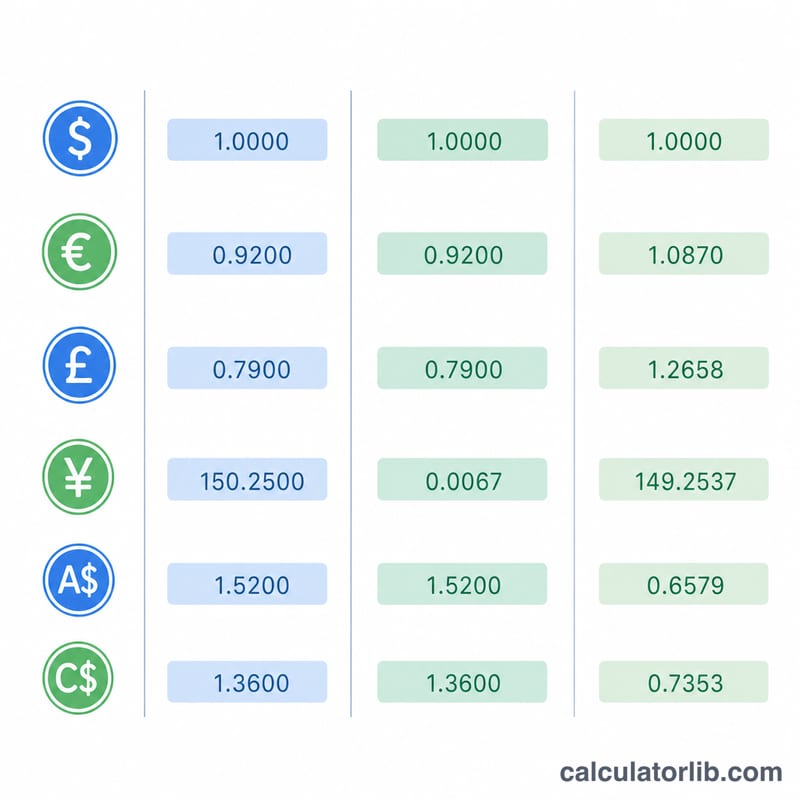
The USD Currency Conversion Table Calculator turns a single amount in your chosen base currency (USD by default) into its equivalent across many world currencies at once. For each currency it shows the converted amount, the exchange rate ("1 base ="), and the inverse rate ("1 unit = ... base"). It works like a printed currency board: pick what you hold, enter how much, and read off every column.
How to use it
Choose your Base Currency (the money you have or are pricing from), type an Amount, and pick a single target under Convert To — or leave it on "All" to see the complete table. When the amount is 1, the converted column is literally the per-unit exchange rate.
The formula explained
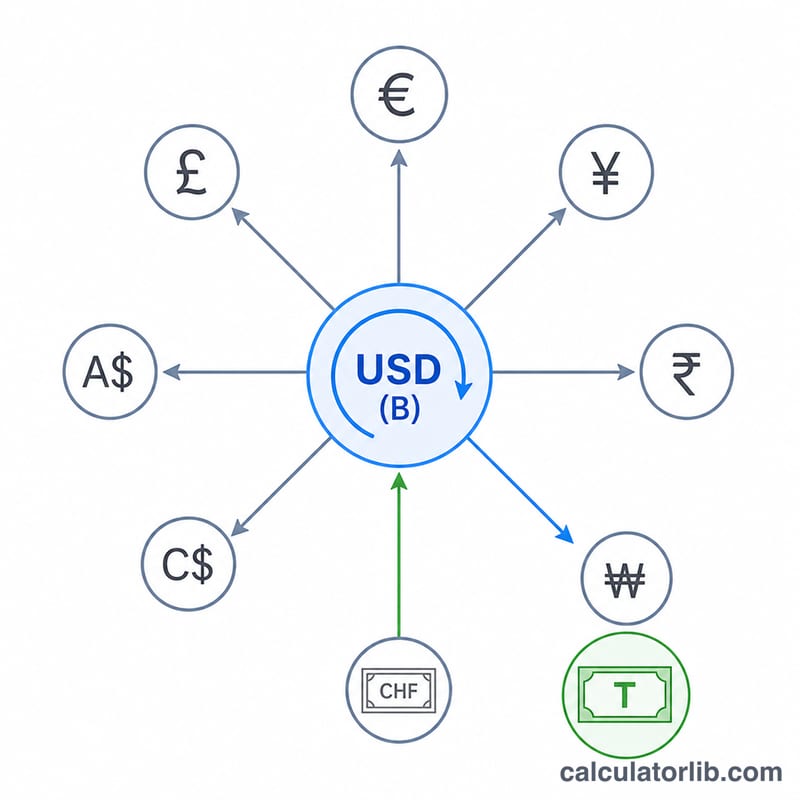
Every currency is stored as units per 1 USD. To convert between any two currencies B and T, divide their anchors: $$\text{rate}(B\to T) = \frac{\text{unitsPerUSD}[T]}{\text{unitsPerUSD}[B]}$$ The converted amount is \(\text{amount}\times\text{rate}\), and the inverse rate is simply \(\frac{1}{\text{rate}}\). When the base is USD, \(\text{unitsPerUSD}[B] = 1\), so the rate equals \(\text{unitsPerUSD}[T]\) directly.
Worked example
Base = USD, amount = 250, target = JPY. With \(\text{unitsPerUSD}[\text{JPY}] = 160.19\), the rate is 160.19 JPY per USD, the converted amount is $$250 \times 160.19 = 40{,}047.50 \text{ JPY}$$ and the inverse is $$\frac{1}{160.19} = 0.0062426 \text{ USD per JPY}$$ So 250 USD = 40,047.50 JPY.
FAQ
Are these live rates? No. They are indicative mid-market reference rates dated 15 June 2026, in the style of the European Central Bank daily fixing. Update the stored table to refresh.
Why do my bank and card give a different amount? Banks, cards and transfer services add spreads and fees on top of the mid-market rate, so the cash you actually receive is usually a little less.
Can I convert between two non-USD currencies? Yes. The cross-rate formula divides the two units-per-USD anchors, so any base-to-target pair works, for example EUR to GBP.