
What is a 30-60-90 Triangle?
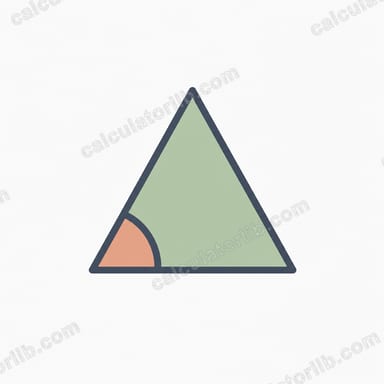
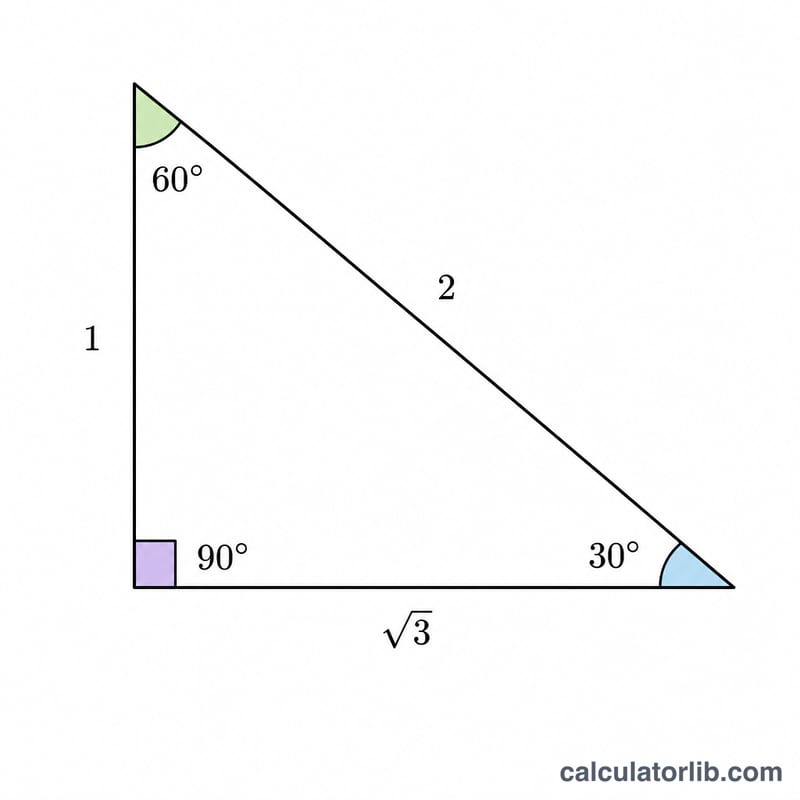
A 30-60-90 triangle is a special right triangle whose three angles measure 30°, 60°, and 90°. Because the angles are fixed, the three sides always keep the same proportions: 1 : √3 : 2. The side opposite the 30° angle (the short leg) is the smallest, the side opposite the 60° angle (the long leg) is √3 times longer, and the side opposite the 90° angle is the hypotenuse — exactly twice the short leg. This calculator takes the hypotenuse and instantly returns both legs.
How to Use the Calculator
Enter the length of the hypotenuse (the longest side, opposite the right angle) in any unit you like. The calculator returns the short leg and the long leg in the same unit. There is no need to choose units because the ratios are purely geometric.
The Formula Explained
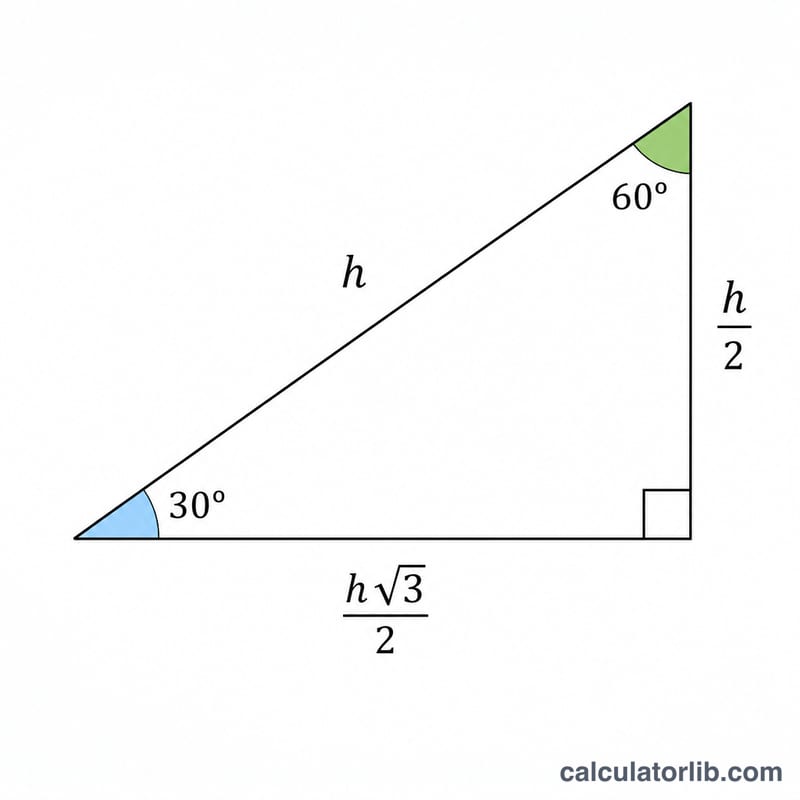
Starting from the ratio 1 : √3 : 2, divide every term by 2 to express the legs in terms of the hypotenuse h:
$$\text{short} = \frac{h}{2}, \quad \text{long} = \frac{h\sqrt{3}}{2}$$
Short leg = h ÷ 2 and Long leg = (h × √3) ÷ 2. Since \(\sqrt{3} \approx 1.7320508\), the long leg is about \(0.866 \times h\).
Worked Example
Suppose the hypotenuse is 10. The short leg is \(10 \div 2 = 5\). The long leg is $$\frac{10 \times 1.7320508}{2} = \frac{17.320508}{2} = 8.6602540.$$ So the triangle has sides 5, 8.66, and 10.
Hypotenuse to Legs: Quick Reference Scenarios
In a 30-60-90 right triangle the sides are always in the fixed ratio \(1 : \sqrt{3} : 2\). The short leg (opposite the 30° angle) is exactly half the hypotenuse, and the long leg (opposite the 60° angle) is the hypotenuse times \(\tfrac{\sqrt{3}}{2} \approx 0.8660254\). The table below applies these two formulas to a range of common hypotenuse values:
$$a = \frac{h}{2}, \qquad b = \frac{\sqrt{3}}{2}\,h \approx 0.8660254\,h$$| Hypotenuse \(h\) | Short leg \(a = h/2\) | Long leg \(b = 0.8660254\,h\) |
|---|---|---|
| 1 | 0.5 | 0.8660 |
| 2 | 1 | 1.7321 |
| 5 | 2.5 | 4.3301 |
| 10 | 5 | 8.6603 |
| 12 | 6 | 10.3923 |
| 20 | 10 | 17.3205 |
| 100 | 50 | 86.6025 |
Values are rounded to four decimal places where they are not exact. Notice that for an even hypotenuse the short leg is a whole number, while the long leg is always irrational (a multiple of \(\sqrt{3}\)). For comparison, a 45-45-90 triangle splits its hypotenuse differently — each equal leg is the 7.0711 for a hypotenuse of 10.
FAQ
Which side is the hypotenuse? It is always the longest side and sits opposite the 90° right angle.
Why is the long leg not double the short leg? Only the hypotenuse is exactly twice the short leg. The long leg is \(\sqrt{3}\) (≈1.732) times the short leg.
Can I work backward from a leg? Yes — but this tool starts from the hypotenuse. If you know the short leg, the hypotenuse is double it; if you know the long leg, divide by \(\sqrt{3}\) to get the short leg.