
What this calculator does
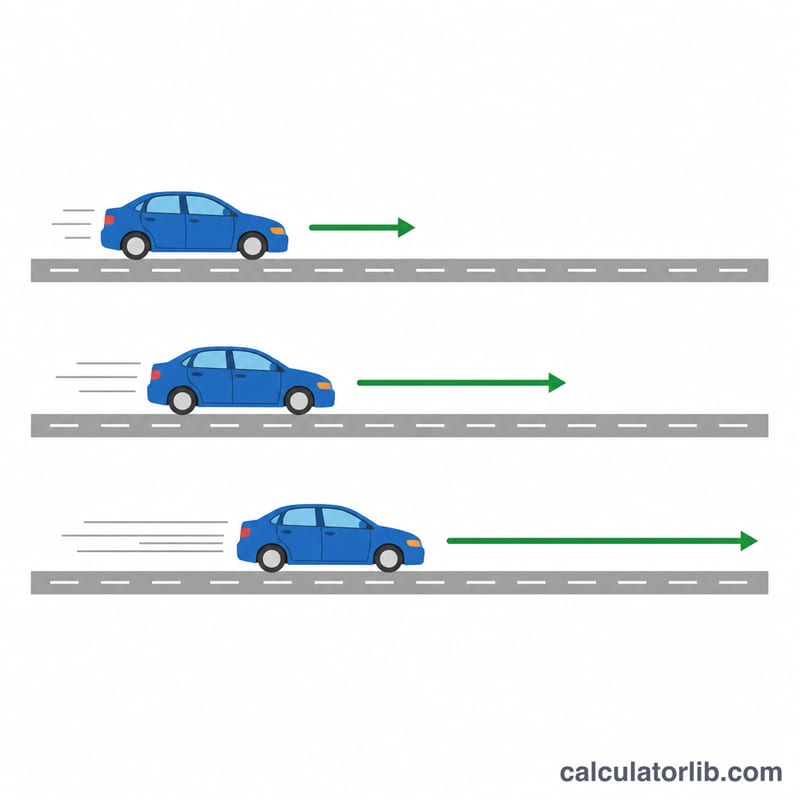
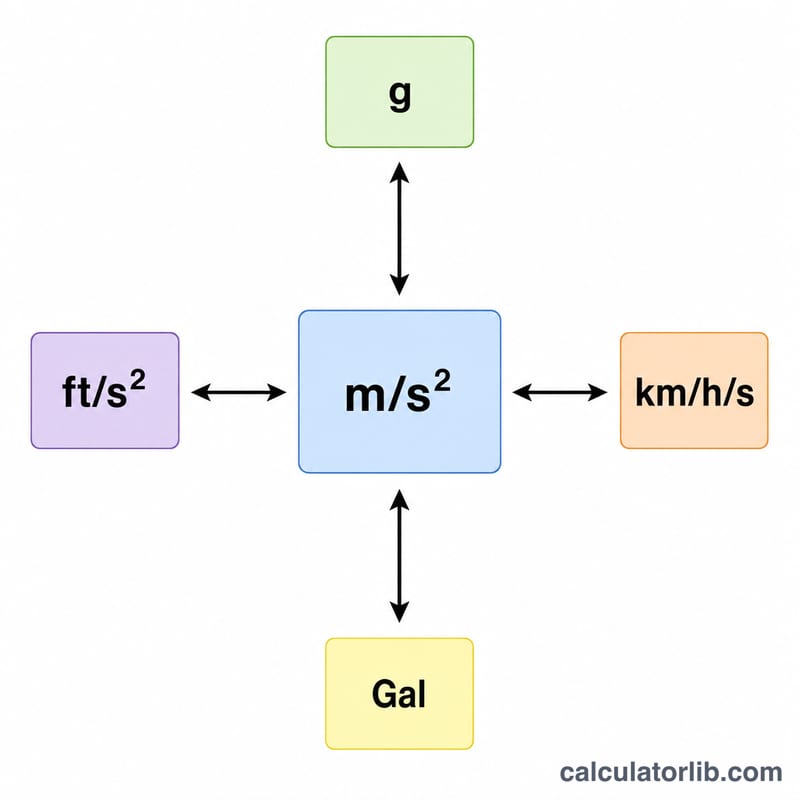
This tool converts a single acceleration value into eleven different acceleration units at once. Acceleration measures how quickly velocity changes over time, with the SI base unit being the metre per second squared (\(\text{m/s}^2\)). The same physical quantity can be expressed many ways: km/h/s, Gal, foot per second squared, mile per hour per second, knot per second, or in multiples of standard gravity (\(g\)). Because every conversion is a linear scaling, this tool applies identically everywhere and is not tied to any country.
How to use it
Enter your acceleration value, pick the unit it is currently expressed in, and choose how many significant digits you want in the results. The calculator first normalizes your value to SI, then re-expresses it in every supported unit. Negative values (deceleration) and zero work fine.
The formula explained
Each unit has a factor equal to how many of that unit make up one \(\text{m/s}^2\). To convert your input to SI, divide by the input unit's factor: $$a_{SI} = \frac{a_{in}}{f_{in}}$$ To express SI in any target unit, multiply: $$a_{out} = a_{SI} \times f_{out}$$ Key factors: km/h/s = 3.6, Gal = 100, \(\text{ft/s}^2\) = 3.2808398950131, \(\text{mi/s}^2\) = 6.2137119223733\text{e-}4, knot/s = 1.9438444924406, and \(g = 1/9.80665 = 0.101971621297793\) (since standard gravity \(g_0 = 9.80665\ \text{m/s}^2\) exactly).
Worked example
Suppose you have 2 g. Normalize to SI: $$a_{SI} = 2 \times 9.80665 = 19.6133\ \text{m/s}^2$$ Then \(\text{km/h/s} = 19.6133 \times 3.6 = 70.60788\), \(\text{ft/s}^2 = 19.6133 \times 3.2808398950131 = 64.34810\), and \(\text{mph/s} = 19.6133 \times 2.2369362920544 = 43.87320\).
Common Acceleration Values Compared
The following scenarios put acceleration figures in everyday and engineering context. Each value is shown in the SI unit (m/s²) alongside standard gravity (g), feet per second squared (ft/s²) and the rate of speed change in km/h per second (km/h/s). The reference for gravity is \(g_0 = 9.80665\,\text{m/s}^2\).
| Scenario | m/s² | g | ft/s² | km/h/s |
|---|---|---|---|---|
| Standard gravity (free fall on Earth) | 9.80665 | 1.0 | 32.17 | 35.30 |
| Gentle elevator start/stop | 1.0 | 0.102 | 3.28 | 3.6 |
| Family car, 0–100 km/h in 10 s | 2.78 | 0.283 | 9.11 | 10.0 |
| Sports car, 0–100 km/h in 4 s | 6.94 | 0.708 | 22.78 | 25.0 |
| Hard emergency braking | 8.0 | 0.816 | 26.25 | 28.8 |
| Fighter jet sustained turn | 88.3 | 9.0 | 289.6 | 317.7 |
The car-acceleration rows use the simple relation \(a = \Delta v / \Delta t\); for example, reaching 100 km/h (27.78 m/s) in 10 s gives \(27.78 / 10 = 2.78\,\text{m/s}^2\). The fighter-jet figure of 9 g reflects the sustained limit human pilots can typically tolerate with a g-suit.
FAQ
What is standard gravity? It is the conventional value of Earth's gravitational acceleration, defined exactly as \(9.80665\ \text{m/s}^2\). One \(g\) equals that value.
What is a Gal? A Gal (galileo) equals \(1\ \text{cm/s}^2\), so \(1\ \text{m/s}^2 = 100\ \text{Gal}\). It is common in geophysics and gravimetry.
Why are foot and mile results not perfectly round? They use exact definitions (1 ft = 0.3048 m, 1 mile = 1609.344 m) but display as rounded decimals.