
What is the VAT Calculator?
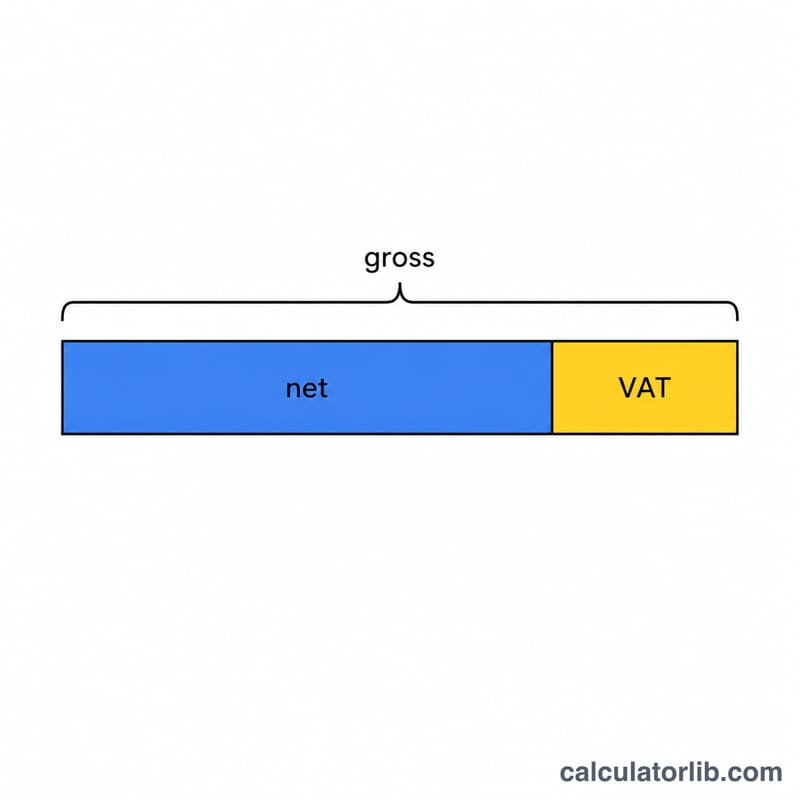
Value Added Tax (VAT) is a consumption tax applied as a percentage of a product's price in many countries, including the UK, EU member states, and others. This calculator works in two directions: it can add VAT to a net (tax-exclusive) price to find the gross price a customer pays, or remove VAT from a gross (tax-inclusive) price to find the net amount and the VAT portion. It works with any VAT rate, so it is not tied to one country's specific rate.
How to use it
Enter the amount and the VAT rate (for example 20%). Choose "Add VAT" if your amount excludes VAT, or "Remove VAT" if your amount already includes VAT. The calculator returns the net price, the VAT amount, and the gross price.
The formula explained
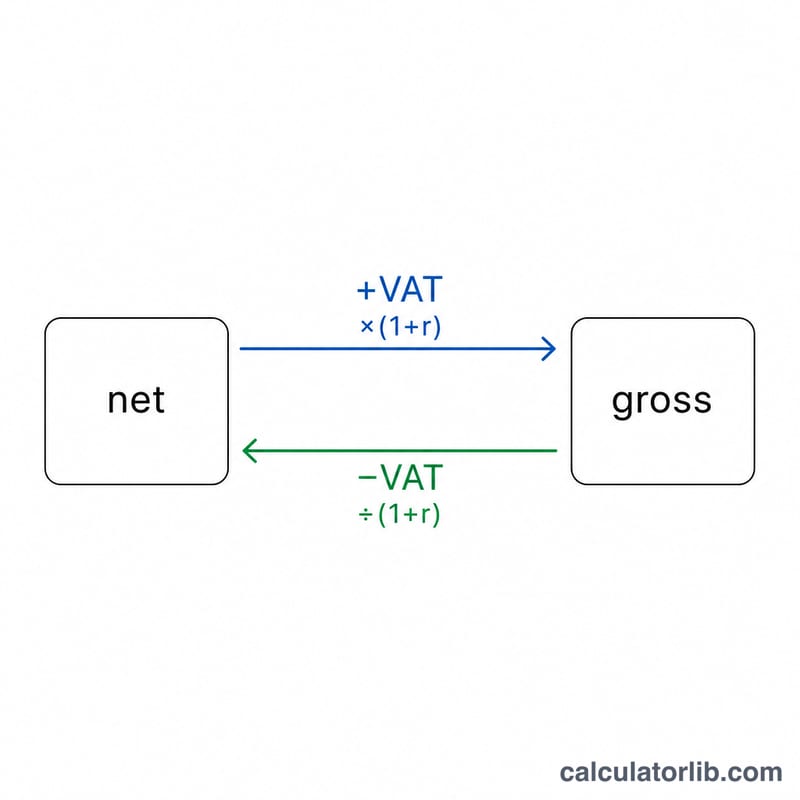
To add VAT, multiply the net price by one plus the rate as a decimal:
$$\text{gross} = \text{net} \times \left(1 + \frac{\text{vat}}{100}\right)$$To remove VAT, divide the gross price by the same factor:
$$\text{net} = \frac{\text{gross}}{1 + \frac{\text{vat}}{100}}$$The VAT amount is simply the difference between gross and net.
Worked example
A product has a net price of 100 and the VAT rate is 20%. Adding VAT: \(\text{gross} = 100 \times (1 + 0.20) = 120\). The VAT amount is \(120 - 100 = 20\). If instead you had a gross price of 120 and removed 20% VAT: \(\text{net} = 120 / 1.20 = 100\), and the VAT portion is again 20.
Standard VAT Rates by Country
Value Added Tax (VAT) is a consumption tax applied to most goods and services. The standard rate is the default rate that applies unless a good or service qualifies for a reduced, zero or exempt rate. The table below lists the standard VAT rates for several major jurisdictions, along with a note about commonly applied reduced rates.
| Country | Standard Rate | Common Reduced Rate(s) |
|---|---|---|
| United Kingdom | 20% | 5% (e.g. domestic energy); 0% (most food, children's clothing) |
| Germany | 19% | 7% (food, books, public transport) |
| France | 20% | 10%, 5.5% and 2.1% (food, books, some essentials) |
| Ireland | 23% | 13.5% and 9%; 0% (most food, children's clothing) |
| Spain | 21% | 10% and 4% (basic foodstuffs, books) |
| Italy | 22% | 10%, 5% and 4% (food, some essentials) |
| Netherlands | 21% | 9% (food, books, medicines) |
Rates change from time to time as set by each country's tax authority, and the precise category to which a reduced or zero rate applies varies by jurisdiction. Always confirm the current rate and applicable category with the relevant national tax authority before relying on it for invoicing or accounting.
VAT Amounts at Different Rates
The following table starts from a fixed net price of 100 (the price before VAT) and shows how much VAT is added and the resulting gross price at several common rates. The calculation is simply:
$$\text{VAT} = \text{Net} \times \frac{\text{Rate}}{100}, \qquad \text{Gross} = \text{Net} + \text{VAT}$$
| VAT Rate | Net Price | VAT Amount | Gross Price |
|---|---|---|---|
| 5% | 100.00 | 5.00 | 105.00 |
| 10% | 100.00 | 10.00 | 110.00 |
| 15% | 100.00 | 15.00 | 115.00 |
| 19% | 100.00 | 19.00 | 119.00 |
| 20% | 100.00 | 20.00 | 120.00 |
| 21% | 100.00 | 21.00 | 121.00 |
| 23% | 100.00 | 23.00 | 123.00 |
Because the net amount is fixed at 100, the VAT amount in each row is numerically equal to the rate itself — a handy mental shortcut for estimating VAT on round-number prices.
Key VAT Terms
- Net price (tax-exclusive price)
- The price of a good or service before VAT is added. This is the figure businesses typically quote to other VAT-registered businesses, since they can usually reclaim the VAT.
- Gross price (tax-inclusive price)
- The total price including VAT — the amount a final consumer actually pays. In consumer-facing retail, displayed prices are normally gross.
- VAT amount
- The tax itself: the difference between the gross and net prices. At a rate \(r\), it equals \(\text{Net} \times \frac{r}{100}\), or equivalently \(\text{Gross} \times \frac{r}{100+r}\).
- VAT rate
- The percentage applied to the net price to calculate VAT — for example 20% in the UK or 19% in Germany. Goods may attract the standard, reduced, zero or exempt rate.
- VAT fraction
- The fraction of a gross price that is VAT, used when removing VAT from a tax-inclusive amount. For a 20% rate it is \(\frac{20}{120} = \frac{1}{6} \approx 16.67\%\). So VAT on a gross price of 120 is \(120 \times \frac{1}{6} = 20\). Note this differs from the rate itself (20%) because it is calculated on the larger, gross figure.
- Tax-inclusive vs tax-exclusive pricing
- Tax-inclusive (gross) pricing shows the final amount the buyer pays with VAT already built in; tax-exclusive (net) pricing shows the price before VAT, with the tax shown or added separately. Which convention is required usually depends on whether the customer is a consumer or a business.
FAQ
Can I just take 20% off a gross price to remove VAT? No. Removing VAT is not the same as subtracting the rate. You divide by 1.20, which gives a VAT fraction of about 16.67% of the gross price.
Does this apply to a specific country? No — it accepts any VAT rate, so it works for the UK (20%), most EU rates, and any custom rate you enter.
What is the difference between net and gross? Net is the price before VAT; gross is the final price including VAT that the customer pays.