
What Is the Degrees to Radians Calculator?
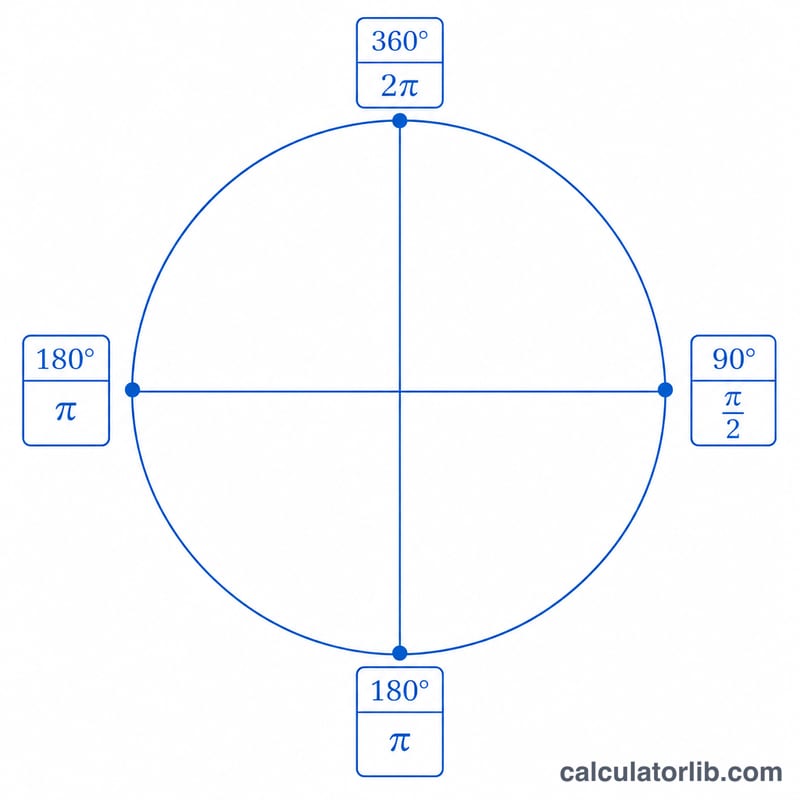
This calculator converts an angle measured in degrees into radians, the standard unit of angular measure used throughout higher mathematics, physics, and engineering. A full circle is 360 degrees, which is equal to 2π radians. The calculator also expresses the result as a clean multiple of π so you can recognise familiar angles at a glance.
How to Use It
Enter your angle in the Degrees field and submit. The tool returns the equivalent value in radians (decimal form) along with the same value written as a fraction of π. Negative angles and decimals are fully supported, so you can convert anything from −45° to 137.5°.
The Formula Explained
The conversion relies on the relationship that 180° equals π radians. To convert from degrees to radians, multiply the degree value by π/180:
$$\text{radians} = \text{degrees} \times \frac{\pi}{180}$$
To go the other way, multiply the radian value by \(\frac{180}{\pi}\). Because \(\pi \approx 3.14159265\), one degree is roughly \(0.01745\) radians.
Worked Example
Convert 90 degrees to radians. Multiply:
$$90 \times \frac{\pi}{180} = \frac{\pi}{2} \approx 1.570796 \text{ radians}$$Expressed as a multiple of π, 90° equals \(0.5 \times \pi\). Likewise, \(180° = \pi \approx 3.141593\) radians, and \(360° = 2\pi \approx 6.283185\) radians.
FAQ
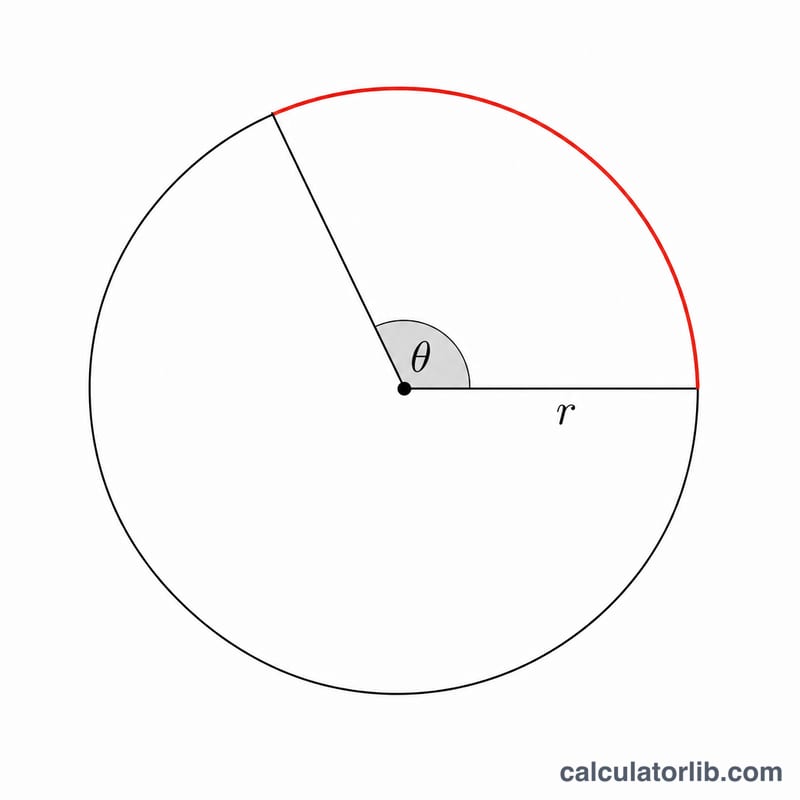
Why use radians instead of degrees? Radians arise naturally from the geometry of a circle (arc length ÷ radius) and make calculus formulas for trigonometric functions much simpler — for example, the derivative of \(\sin x\) equals \(\cos x\) only when \(x\) is in radians.
How many radians are in a full circle? A full revolution is \(2\pi\) radians, approximately \(6.283185\) radians, equal to 360 degrees.
Can I convert radians back to degrees? Yes. Multiply the radian value by \(\frac{180}{\pi}\). For instance, \(1\) radian \(\approx 57.2958\) degrees.