
What Is a Semicircle?
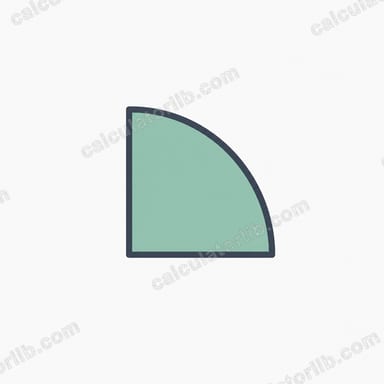
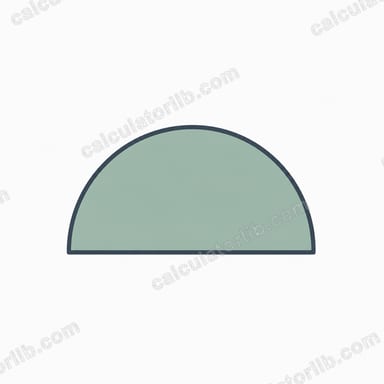
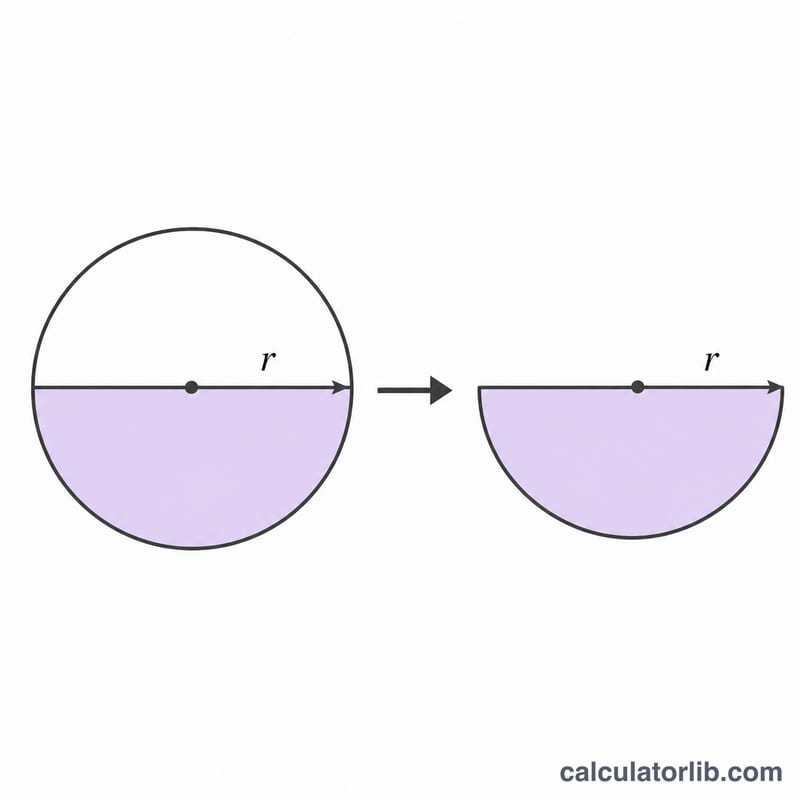
A semicircle is exactly half of a circle, formed by cutting a circle along a straight line through its center (the diameter). Because it is half a circle, its area is simply half the area of the full circle. This calculator finds the area of a semicircle instantly from the radius and also reports the diameter and the full perimeter.
How to Use the Calculator
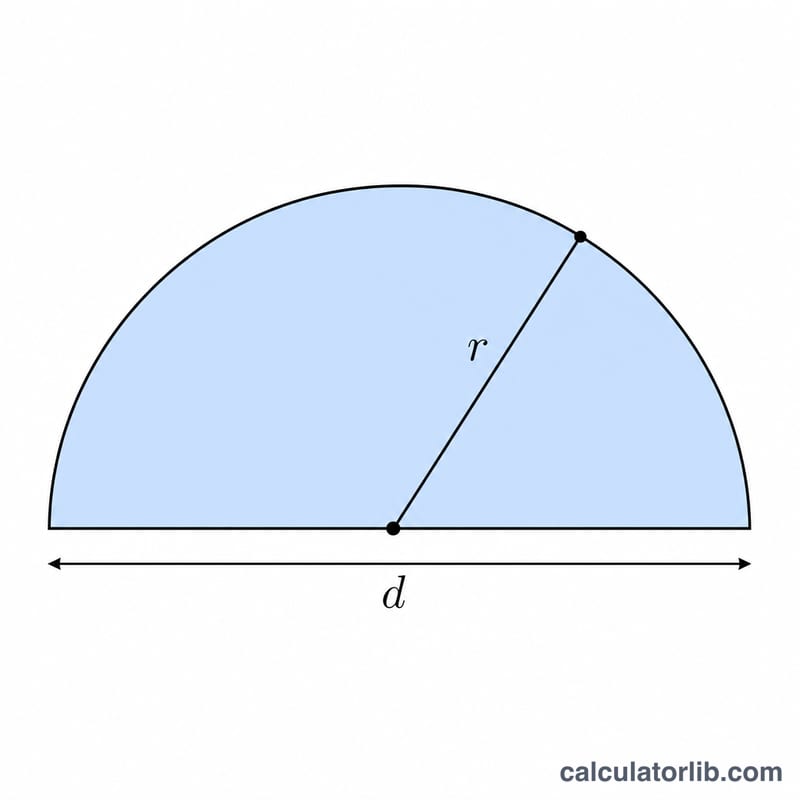
Enter the radius (\(r\)) of the semicircle in whatever units you are working with — centimeters, inches, meters, etc. Click calculate, and you will get the area in square units, along with the diameter and the perimeter. The radius is the distance from the center point of the straight edge to the curved boundary.
The Formula Explained
The area of a full circle is \(A = \pi r^{2}\). Since a semicircle is exactly half of that circle, its area is:
$$A = \frac{1}{2} \times \pi \times r^{2}$$
where \(\pi \approx 3.14159\) and \(r\) is the radius. The perimeter of a semicircle is not half the circle's circumference — it also includes the straight diameter edge. So the perimeter is the half-circumference (\(\pi r\)) plus the diameter (\(2r\)): \(P = \pi r + 2r\).
Worked Example
Suppose a semicircle has a radius of 5 units. The area is $$A = \frac{1}{2} \times \pi \times 5^{2} = \frac{1}{2} \times \pi \times 25 = 12.5\pi \approx 39.27 \text{ square units}.$$ The diameter is \(2 \times 5 = 10\) units, and the perimeter is \(\pi \times 5 + 10 \approx 15.708 + 10 = 25.71\) units.
Semicircle Area for Common Radii
A semicircle is exactly half of a full circle. Its area is found with \(A = \tfrac{1}{2}\pi r^{2}\), its straight edge (diameter) is \(d = 2r\), and its perimeter combines the curved half-circumference with the straight diameter: \(P = \pi r + 2r\). The table below lists these values for several common radii, rounded to two decimal places.
| Radius \(r\) | Area \(\tfrac{1}{2}\pi r^{2}\) | Diameter \(2r\) | Perimeter \(\pi r + 2r\) |
|---|---|---|---|
| 1 | 1.57 | 2 | 5.14 |
| 2 | 6.28 | 4 | 10.28 |
| 5 | 39.27 | 10 | 25.71 |
| 10 | 157.08 | 20 | 51.42 |
| 20 | 628.32 | 40 | 102.83 |
| 50 | 3926.99 | 100 | 257.08 |
| 100 | 15707.96 | 200 | 514.16 |
For reference, the area of the corresponding full circle is exactly double the semicircle area — for example, a radius of 10 gives a full-circle area of 314.16.
FAQ
Is the area of a semicircle half the area of a circle? Yes. A semicircle is one half of a circle, so its area equals exactly half the full circle's area.
Why isn't the perimeter just half the circumference? Because cutting the circle in half creates a new straight edge — the diameter. The full perimeter is the curved arc (\(\pi r\)) plus that diameter (\(2r\)).
What units does the result use? The area is in square units matching your radius unit. If radius is in cm, area is in cm². The tool is unit-agnostic, so use any consistent unit.