
What this calculator does
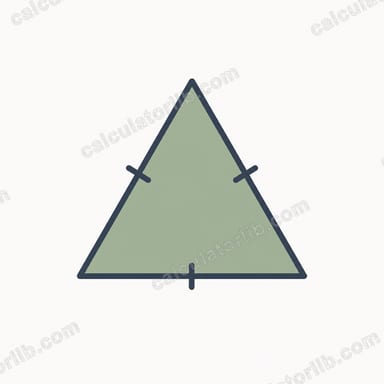
This tool finds the area of an isosceles triangle when you know the length of its base and the length of the two equal sides. It also returns the triangle's height (measured from the base to the apex) and its perimeter, giving you a complete picture of the shape from just two measurements.
How to use it
Enter the base length (b) and the length of one of the equal sides (a) in the same units. The calculator instantly outputs the area in square units, the height in linear units, and the perimeter. The two equal sides must each be longer than half the base, otherwise no valid triangle exists.
The formula explained
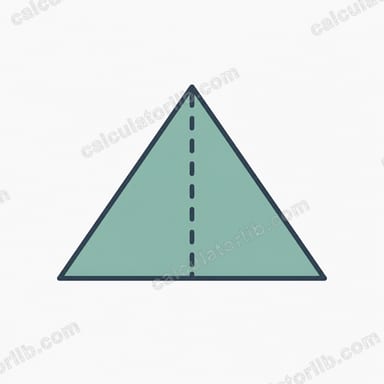
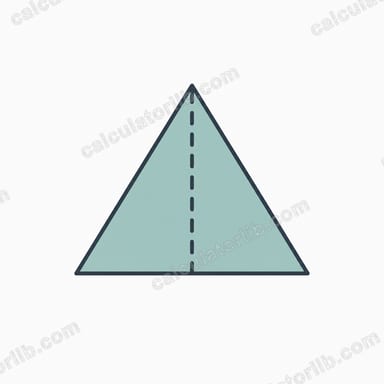
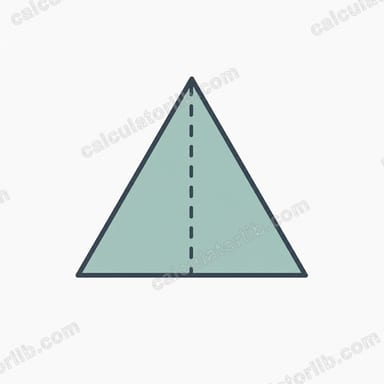
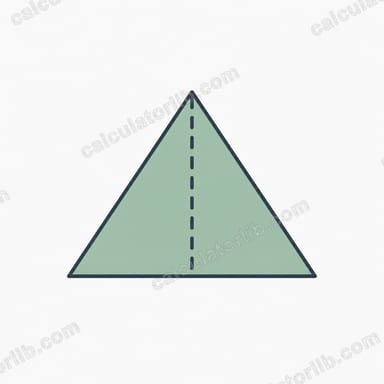
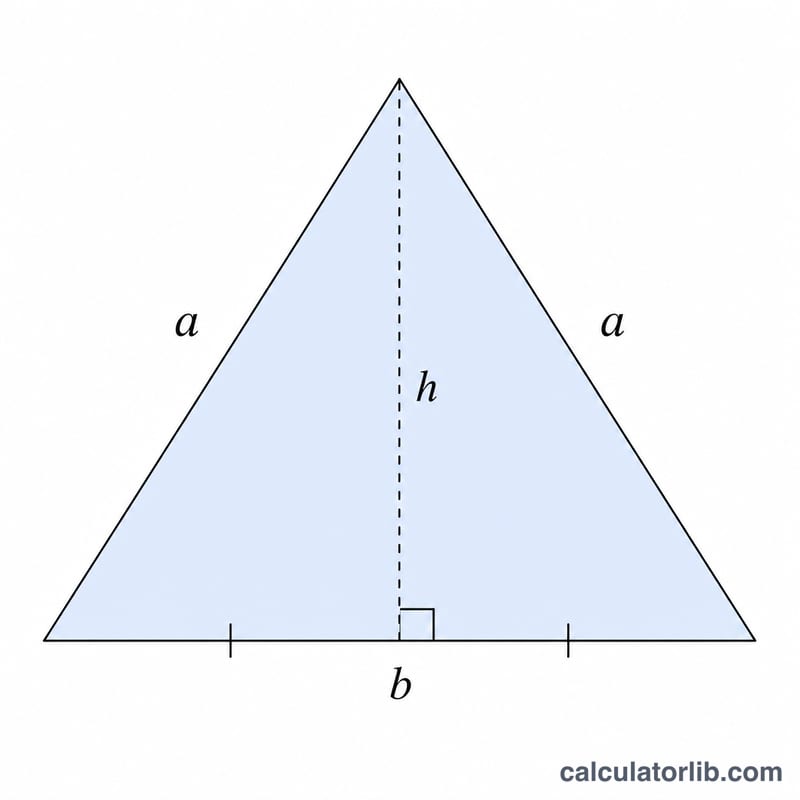
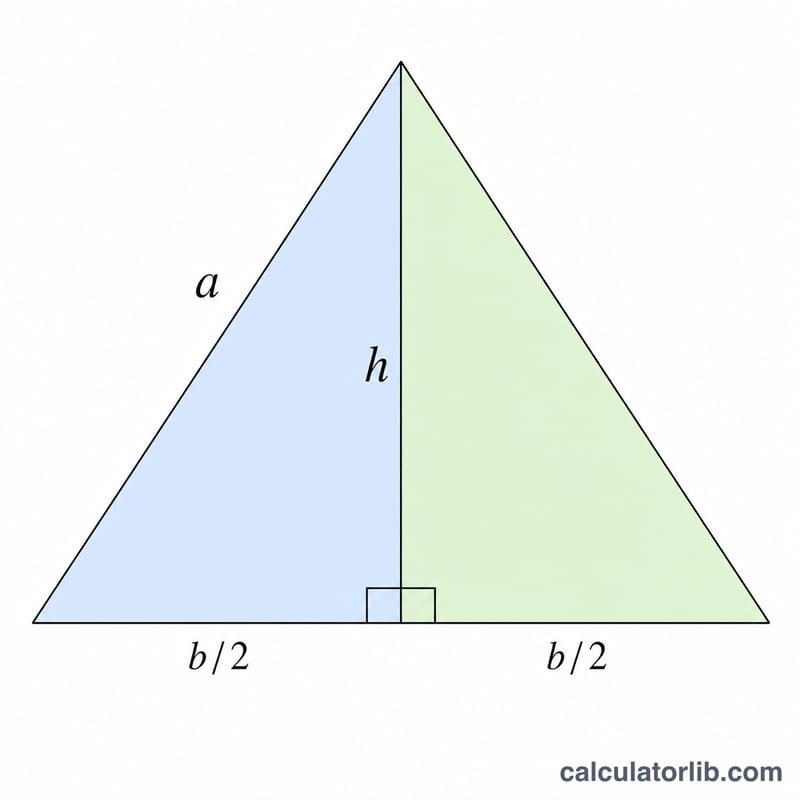
An isosceles triangle has two equal sides of length a and a base of length b. Dropping a perpendicular from the apex to the base splits the triangle into two right triangles, each with hypotenuse a and base b/2. The height is therefore \(h = \sqrt{a^{2} - (b/2)^{2}} = \frac{\sqrt{4a^{2} - b^{2}}}{2}\). The area is half the base times the height, which simplifies to:
$$A = \frac{b}{4}\sqrt{4a^{2} - b^{2}}$$
Worked example
Suppose the base is 6 and each equal side is 5. Then \(4a^{2} - b^{2} = 4 \cdot 25 - 36 = 100 - 36 = 64\). The square root of 64 is 8. So the area $$A = \frac{6}{4} \cdot 8 = 1.5 \cdot 8 = 12 \text{ square units}.$$ The height \(= 8/2 = 4\), and the perimeter \(= 6 + 2 \cdot 5 = 16\).
Area Across Different Isosceles Triangles
An isosceles triangle has a base \(b\) and two equal sides \(a\). Drop a perpendicular from the apex to the base and it splits the triangle into two congruent right triangles, each with hypotenuse \(a\) and a horizontal leg of \(b/2\). The height is therefore
$$h = \sqrt{a^{2} - \left(\tfrac{b}{2}\right)^{2}} = \frac{1}{2}\sqrt{4a^{2} - b^{2}}$$and the area follows directly:
$$A = \frac{b}{4}\sqrt{4a^{2} - b^{2}}, \qquad P = 2a + b.$$The table below applies these exact formulas to several base/side pairs. Each row requires \(a > b/2\) so the triangle can actually close.
| Base (b) | Side (a) | Height (h) | Area (A) | Perimeter (P) |
|---|---|---|---|---|
| 6 | 5 | 4 | 12 | 16 |
| 8 | 5 | 3 | 12 | 18 |
| 10 | 13 | 12 | 60 | 36 |
| 4 | 4 | ≈ 3.464 | ≈ 6.928 | 12 |
The last row (b=4, a=4) is also equilateral, so its height equals \(\tfrac{\sqrt{3}}{2}\cdot 4 \approx 3.464\) and its area matches the equilateral value of about 6.928.
FAQ
What if the side is too short? If \(4a^{2} - b^{2}\) is zero or negative, the two sides cannot meet above the base, so no triangle exists and the area is reported as 0.
Which side do I enter as the equal side? Enter the length of one of the two identical legs. Both legs are the same length in an isosceles triangle.
What units does the result use? The area is in square units of whatever unit you entered, and the height and perimeter are in those same linear units.