
What Is the AST/ALT Ratio?
The AST/ALT ratio, also known as the De Ritis ratio, compares two liver enzymes measured in a standard blood panel: aspartate aminotransferase (AST) and alanine aminotransferase (ALT). Both are reported in units per liter (U/L). The ratio is a simple dimensionless number that clinicians use as one clue when evaluating liver health.
How to Use This Calculator
Enter your AST value and your ALT value, each in U/L, exactly as printed on your lab report. The calculator divides AST by ALT and displays the resulting ratio along with a general interpretation. This tool is for educational reference only and does not replace professional medical advice.
The Formula Explained
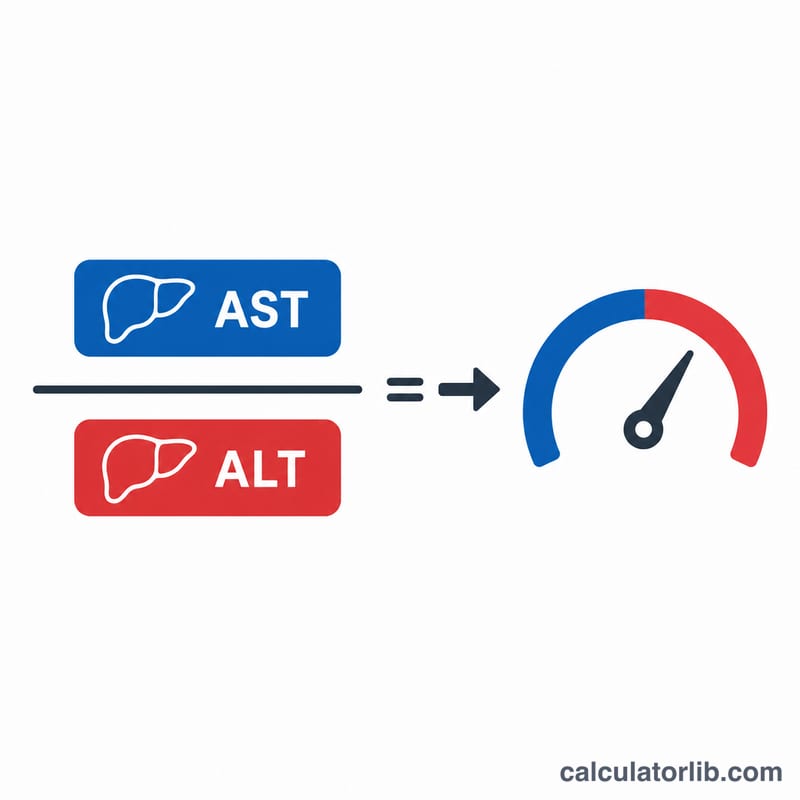
The calculation is straightforward division:
$$\text{AST/ALT Ratio} = \frac{\text{AST}}{\text{ALT}}$$
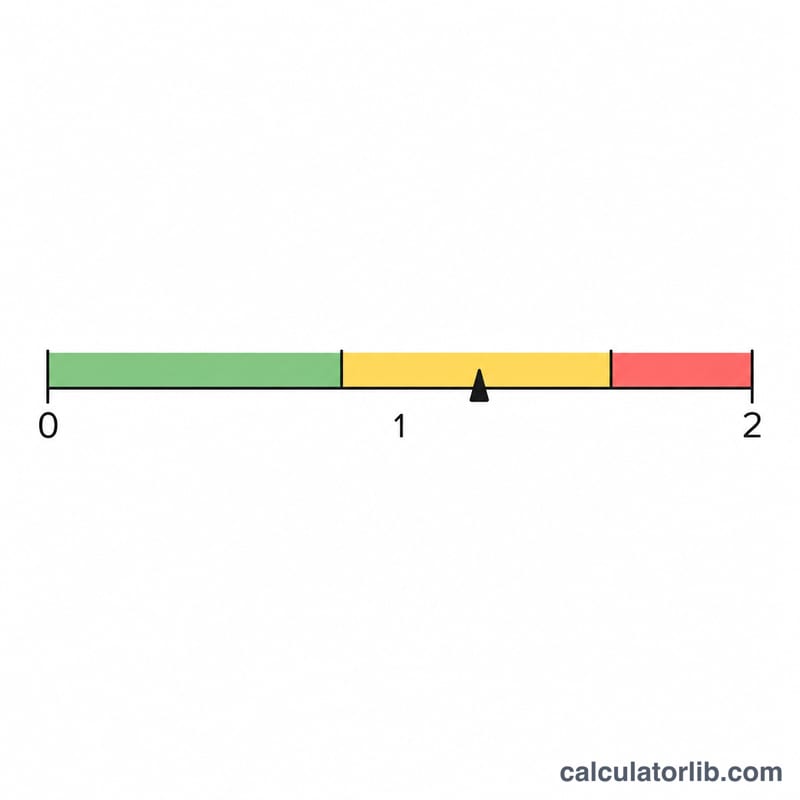
Because both enzymes share the same unit (U/L), the units cancel and the result is a pure number. A ratio below 1 is common in healthy individuals and in many forms of early or mild liver injury. A ratio above 2 is classically associated with alcoholic liver disease, while values between 1 and 2 may suggest chronic liver conditions or cirrhosis.
Worked Example
Suppose a lab report shows AST = 60 U/L and ALT = 30 U/L. The ratio is $$60 \div 30 = 2.0$$ A value of 2 or above is often discussed in the context of alcoholic liver disease and warrants follow-up with a physician.
Interpreting Your AST/ALT Ratio
The AST/ALT ratio (also called the De Ritis ratio) divides aspartate aminotransferase (AST) by alanine aminotransferase (ALT). The ratio is a pattern clue used alongside the actual enzyme values and the overall clinical picture — it is most informative when both AST and ALT are abnormal, and far less meaningful when both are normal.
As a general guide, the literature describes three broad patterns:
- Ratio below 1 (ALT higher than AST): This pattern is commonly seen in non-alcoholic fatty liver disease (NAFLD/MASLD) and in many forms of acute viral or toxic hepatitis, where hepatocellular injury raises ALT relatively more than AST.
- Ratio near 1: A ratio around 1 is non-specific and can occur in healthy individuals as well as in a variety of liver conditions. It often appears in chronic viral hepatitis before significant scarring develops.
- Ratio above 1 (AST higher than ALT): An elevated ratio, classically above 2, is a recognised sign of alcoholic liver disease. A ratio above 1 is also associated with advancing fibrosis or cirrhosis from many causes, because ALT often falls as functioning liver tissue declines. Note that AST is not liver-specific — it also rises with muscle injury, strenuous exercise, hemolysis, and some heart conditions, which can elevate the ratio without liver disease.
Worked example: with an AST of 60 U/L and an ALT of 30 U/L, the ratio is \(60 \div 30 = \) 2.0.
Important: The ratio alone is not a diagnosis. Absolute enzyme levels, trends over time, other liver tests (bilirubin, albumin, platelet count, GGT, alkaline phosphatase), and your full medical history all matter. Always have your results interpreted by a qualified clinician. This is general information, not medical advice.
Key Terms Explained
- AST (aspartate aminotransferase)
- An enzyme found in the liver but also in heart and skeletal muscle, kidneys, and red blood cells. Because it is present outside the liver, elevated AST is not specific to liver injury.
- ALT (alanine aminotransferase)
- An enzyme found mainly in the liver, making it a more liver-specific marker of hepatocellular injury than AST.
- De Ritis ratio
- The ratio of AST to ALT, first described by Fernando De Ritis in 1957. Calculated as \(\text{AST} \div \text{ALT}\), it is used as a pattern indicator across various liver and non-liver conditions.
- U/L (units per litre)
- The standard unit for reporting enzyme activity in blood — the amount of enzyme activity measured per litre of serum. Both AST and ALT are reported in U/L, so the ratio is dimensionless.
- Aminotransferases (transaminases)
- The class of enzymes — including AST and ALT — that transfer amino groups between molecules. When liver cells are damaged, these enzymes leak into the bloodstream, raising their measured levels.
- Cirrhosis
- Late-stage scarring (fibrosis) of the liver from many causes, in which healthy tissue is progressively replaced by scar tissue, impairing liver function. An AST/ALT ratio above 1 can accompany advancing fibrosis.
- Alcoholic liver disease
- Liver damage caused by chronic excessive alcohol intake, ranging from fatty liver to alcoholic hepatitis and cirrhosis. It is classically associated with an AST/ALT ratio greater than 2.
FAQ
What is a normal AST/ALT ratio? In healthy people the ratio is usually around 0.8 to 1.0, though reference points vary by laboratory.
Why might my ratio be high? Ratios above 2 are frequently linked to alcohol-related liver damage, while moderately elevated ratios can reflect chronic disease. Many factors influence enzyme levels.
Is this a diagnosis? No. The ratio is one of many pieces of information. Always discuss your results with a qualified healthcare provider.