
What is the binomial theorem?
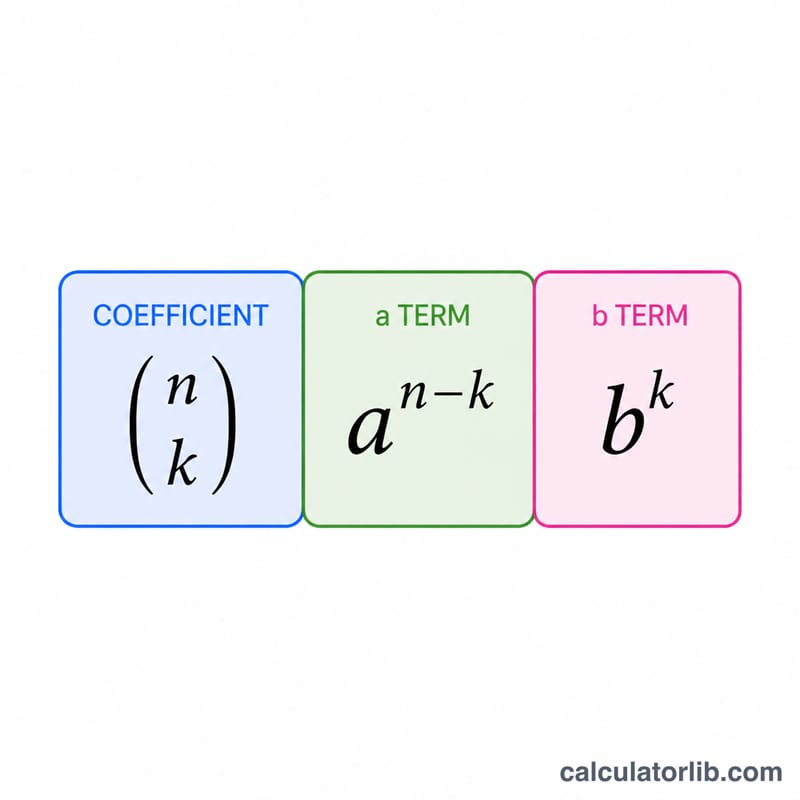
The binomial theorem gives a fast way to expand an expression of the form \((a+b)^n\) without multiplying it out term by term. It states that the expansion is a sum of \(n+1\) terms, each built from a binomial coefficient and decreasing and increasing powers of the two terms:
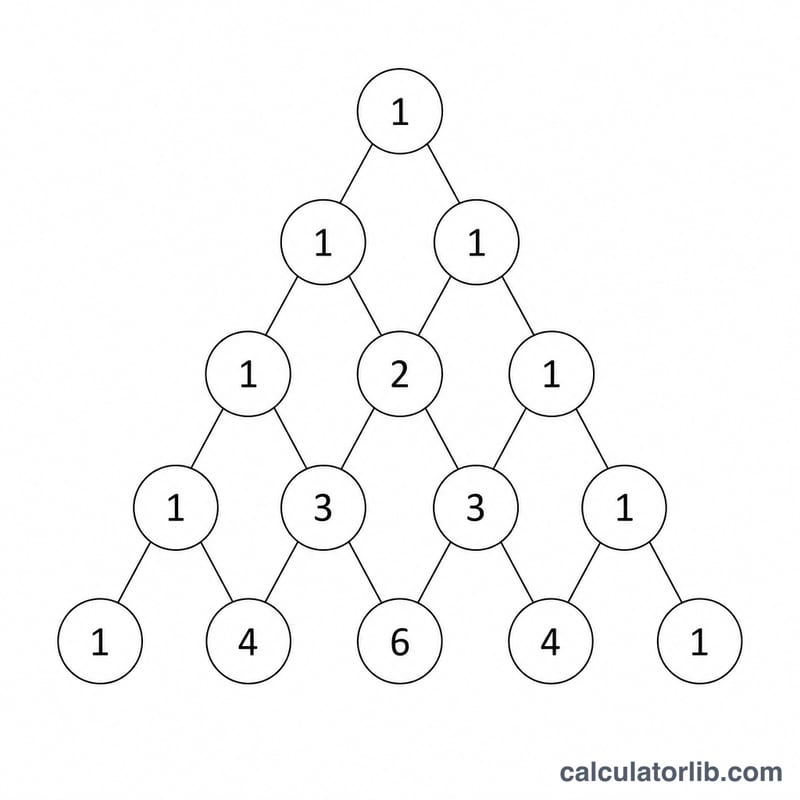
$$ (a+b)^n = \sum_{k=0}^{n} \binom{n}{k}\, a^{n-k}\, b^{k} $$Here \(a\) and \(b\) are the two terms, \(n\) is a non-negative integer exponent, and \(\binom{n}{k}\) is the binomial coefficient that also appears in Pascal triangle.
How to use this calculator
Enter the first term \(a\), the second term \(b\), and the whole-number exponent \(n\). The calculator returns the total value of \((a+b)^n\) and a full breakdown table listing each term index \(k\), its coefficient \(\binom{n}{k}\), the powers \(a^{n-k}\) and \(b^{k}\), and the resulting term value. This makes it useful both for a quick numeric answer and for learning how each term is formed.
The formula explained
Each coefficient is computed with \(\binom{n}{k} = \frac{ {n!}}{k!\,(n-k)!}\). Rather than recomputing factorials, the calculator builds coefficients iteratively using \(\binom{n}{k+1} = \binom{n}{k}\times\frac{n-k}{k+1}\), which keeps every value an exact integer.
Worked example
Expand \((2+3)^2\). With \(n=2\) there are three terms:
$$ (2+3)^2 = \binom{2}{0}2^{2} + \binom{2}{1}2^{1}3^{1} + \binom{2}{2}3^{2} = 4 + 12 + 9 = 25 $$This matches \(5^2 = 25\), confirming the expansion.
Pascal's Triangle: Binomial Coefficients by Row
The binomial coefficients \(\binom{n}{k}\) that appear when you expand \((a + b)^n\) are exactly the entries of Pascal's triangle. Row \(n\) holds the coefficients for the expansion of power \(n\), reading from \(k = 0\) on the left to \(k = n\) on the right. Row \(n\) always has \(n + 1\) entries, and every row begins and ends with 1. Each interior entry is the sum of the two entries directly above it, which restates the identity \(\binom{n}{k} = \binom{n-1}{k-1} + \binom{n-1}{k}\).
| \(n\) | Binomial coefficients \(\binom{n}{0}, \binom{n}{1}, \dots, \binom{n}{n}\) | Entries |
|---|---|---|
| 0 | 1 | 1 |
| 1 | 1 1 | 2 |
| 2 | 1 2 1 | 3 |
| 3 | 1 3 3 1 | 4 |
| 4 | 1 4 6 4 1 | 5 |
| 5 | 1 5 10 10 5 1 | 6 |
| 6 | 1 6 15 20 15 6 1 | 7 |
| 7 | 1 7 21 35 35 21 7 1 | 8 |
| 8 | 1 8 28 56 70 56 28 8 1 | 9 |
| 9 | 1 9 36 84 126 126 84 36 9 1 | 10 |
| 10 | 1 10 45 120 210 252 210 120 45 10 1 | 11 |
Notice that each row reads the same forwards and backwards. This is the symmetry property \(\binom{n}{k} = \binom{n}{n-k}\): choosing which \(k\) factors contribute a \(b\) is equivalent to choosing which \(n - k\) factors contribute an \(a\). The entries of row \(n\) also sum to \(2^n\), which is the value of \((1 + 1)^n\).
More Worked Examples
Each expansion below uses the coefficients from the matching row of Pascal's triangle, with the power of the first term descending from \(n\) to 0 while the power of the second term ascends from 0 to \(n\).
Example 1: \((x + y)^3\)
Row 3 gives the coefficients \(1, 3, 3, 1\). Substituting \(a = x\), \(b = y\), \(n = 3\):
$$(x + y)^3 = \binom{3}{0}x^3 + \binom{3}{1}x^2 y + \binom{3}{2}x y^2 + \binom{3}{3}y^3$$$$= x^3 + 3x^2 y + 3x y^2 + y^3$$The powers of \(x\) descend \(3, 2, 1, 0\) while the powers of \(y\) ascend \(0, 1, 2, 3\), and each pair sums to 3.
Example 2: \((a - 2)^4\) — a negative second term
Write the binomial as \((a + (-2))^4\) so the second term is \(b = -2\). Row 4 gives coefficients \(1, 4, 6, 4, 1\):
$$(a - 2)^4 = \binom{4}{0}a^4 + \binom{4}{1}a^3(-2) + \binom{4}{2}a^2(-2)^2 + \binom{4}{3}a(-2)^3 + \binom{4}{4}(-2)^4$$Evaluating the powers of \(-2\) gives \((-2)^2 = 4\), \((-2)^3 = -8\), and \((-2)^4 = 16\):
$$= a^4 - 8a^3 + 24a^2 - 32a + 16$$Because \(b\) is negative, the signs alternate: \(+, -, +, -, +\). Every term with an odd power of \(b\) is negative, and every term with an even power of \(b\) is positive.
Example 3: \((1 + 0.5)^3\) — a numeric check
With \(a = 1\), \(b = 0.5\), \(n = 3\), the coefficients are again \(1, 3, 3, 1\):
$$(1 + 0.5)^3 = 1^3 + 3\,(1)^2(0.5) + 3\,(1)(0.5)^2 + (0.5)^3$$$$= 1 + 1.5 + 0.75 + 0.125$$Adding the terms gives \((1 + 0.5)^3 = \) 3.375. This matches the direct evaluation \(1.5^3 = 3.375\), confirming the expansion.
FAQ
Can a and b be negative or decimals? Yes. The calculator accepts any real values for \(a\) and \(b\); only the exponent \(n\) must be a non-negative integer.
How many terms are there? A binomial raised to the power \(n\) always expands into exactly \(n+1\) terms.
What are the coefficients? They are the entries in row \(n\) of Pascal triangle, symmetric so that \(\binom{n}{k} = \binom{n}{n-k}\).