
What Is Free Cash Flow?
Free Cash Flow (FCF) is the cash a company generates from its operations after paying for the capital investments needed to maintain and grow the business. It is one of the most important measures of financial health because, unlike accounting profit, it reflects the actual cash available to repay debt, pay dividends, buy back shares, or reinvest. This calculator works for any business in any currency — simply enter values in the same currency.
How to Use This Calculator
Enter two figures, both taken from the cash flow statement: Operating Cash Flow (OCF) — net cash provided by operating activities — and Capital Expenditures (CapEx) — money spent on property, plant, and equipment. The tool subtracts CapEx from OCF and also shows the FCF margin, which tells you how much of every dollar of operating cash survives after capital spending.
The Formula Explained
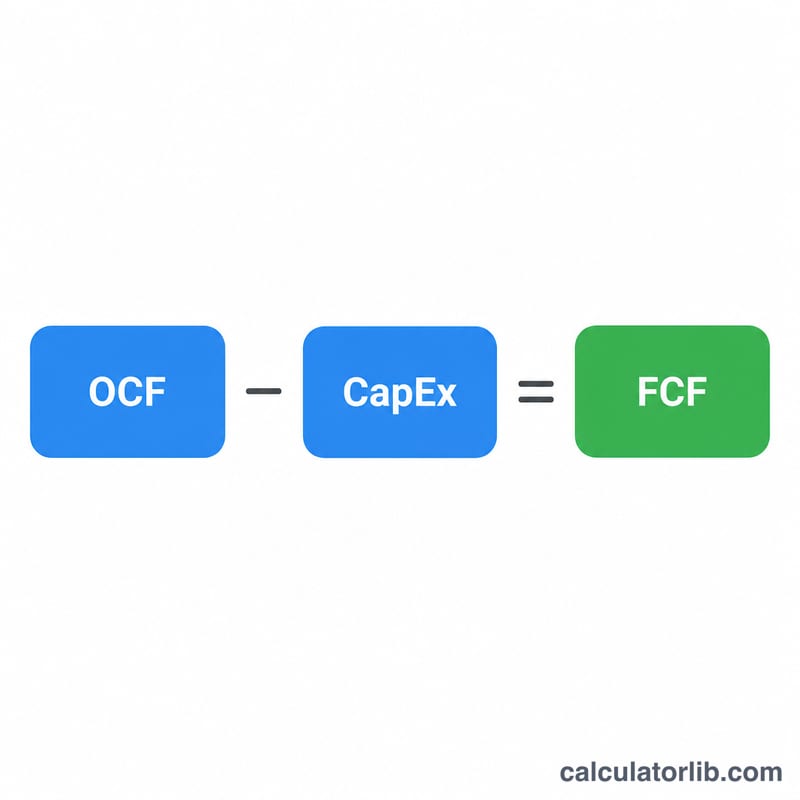
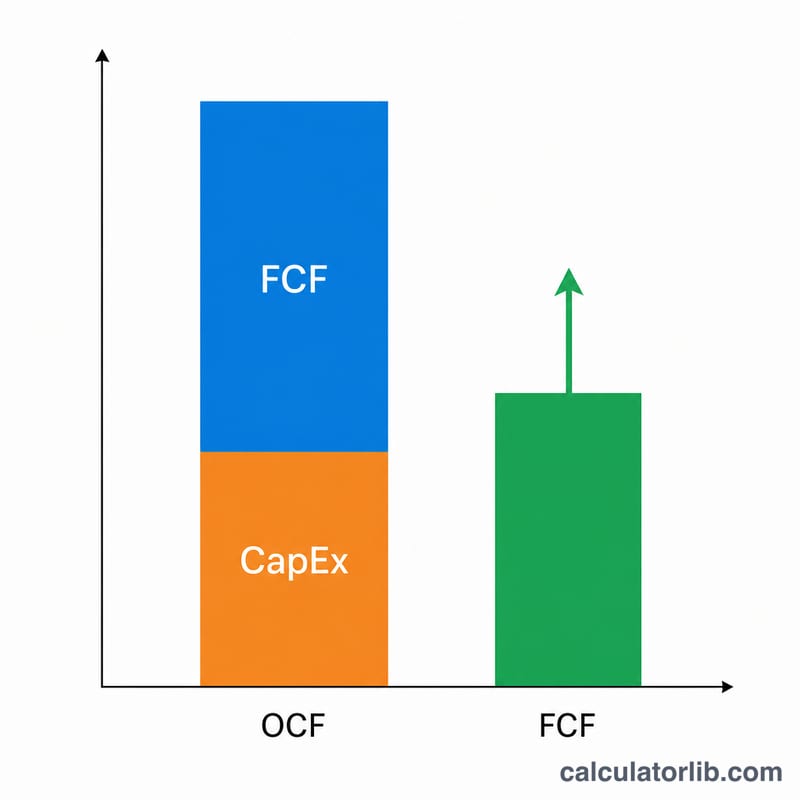
The core formula is simple: $$\text{FCF} = \text{OCF} - \text{CapEx}$$ Operating cash flow comes from the top of the cash flow statement, while capital expenditures appear under investing activities (often labelled "purchases of property and equipment"). A positive FCF means the company funds its growth and still has cash left over; a negative FCF means it is spending more than it earns from operations.
Worked Example
Suppose a company reports operating cash flow of $1,000,000 and capital expenditures of $300,000. $$\text{FCF} = \$1{,}000{,}000 - \$300{,}000 = \$700{,}000$$ The FCF margin is $$\$700{,}000 \div \$1{,}000{,}000 = 70\%$$ meaning 70 cents of every operating-cash dollar is truly free.
FAQ
Where do I find OCF and CapEx? Both are on the cash flow statement: OCF at the bottom of operating activities, CapEx within investing activities.
Is a higher FCF always better? Generally yes, but very high FCF with very low CapEx can signal under-investment in future growth.
Can FCF be negative? Yes. Fast-growing companies often have negative FCF because they invest heavily, which is not always a bad sign.