What this calculator does
The Days Until Winter Calculator tells you exactly how many days remain until the start of astronomical winter in the Northern Hemisphere, which begins at the December solstice — on or around December 21 each year. Enter any starting date and the tool counts forward to the next occurring solstice.
Note: this calculator uses the Northern Hemisphere definition of winter. In the Southern Hemisphere, December marks the start of summer instead.
How to use it
Pick the date you want to count from (it defaults to today) and submit. The result shows the number of whole days remaining and the exact date winter begins. If December 21 has already passed in your chosen year, the calculator automatically rolls over to next year's solstice so you always get a positive countdown.
The formula explained
The calculation is a simple date difference. Both dates are normalized to midnight, converted to milliseconds, subtracted, and divided by the number of milliseconds in a day (86,400,000). The result is rounded to the nearest whole day:
$$\text{daysUntil} = \left\lfloor \frac{\text{solstice} - \text{fromDate}}{86{,}400{,}000} \right\rceil$$
We fix the solstice at December 21 as a practical approximation; the true astronomical solstice varies between December 20 and 22 depending on the year and time zone.
Worked example
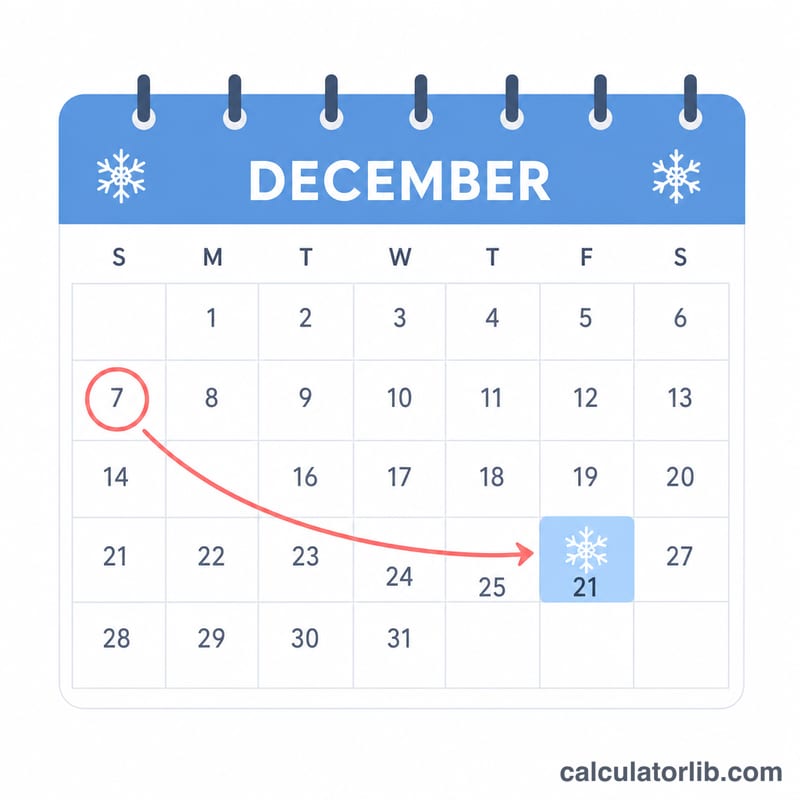
Suppose today is December 1, 2024. Winter begins December 21, 2024. The difference is 20 days, so the calculator returns 20 days remaining. If instead you entered December 25, 2024 — after the solstice — it would count to December 21, 2025, giving 361 days.
December Solstice Dates and Winter Start Definitions
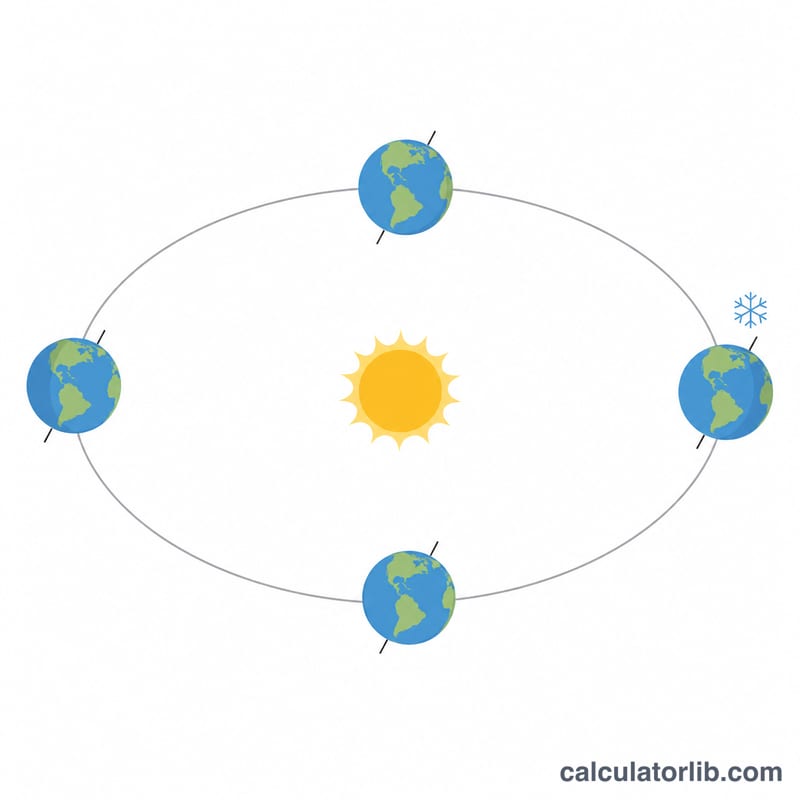
"Winter" has two common definitions. Astronomical winter is set by Earth's orbit and tilt and begins at the solstice. Meteorological winter uses whole calendar months so that climate statistics are easier to compare. This calculator counts to the astronomical start of Northern Hemisphere winter, approximated as December 21.
| Definition | Hemisphere | Winter starts | Winter ends |
|---|---|---|---|
| Astronomical | Northern | December solstice (Dec 20–22, usually Dec 21 or 22) | March equinox (about Mar 20) |
| Meteorological | Northern | December 1 | Last day of February (Feb 28, or Feb 29 in leap years) |
| Astronomical | Southern | June solstice (about Jun 20–22) | September equinox (about Sep 22–23) |
| Meteorological | Southern | June 1 | August 31 |
The exact solstice moment changes from year to year because the calendar year does not match the orbital period exactly. It also falls on different calendar dates depending on your time zone. Using Dec 21 is a convenient approximation, so a count may be off by a day from the true solstice date. Meteorological winter covers Dec–Feb in the Northern Hemisphere, so by that definition winter starts about three weeks earlier than the astronomical one.
Days Until Winter from Different Start Dates
The table counts days to December 21, 2025, the calculator's approximation of the Northern Hemisphere solstice. 2025 is not a leap year. In a leap year, any start date on or before Feb 28 gains one extra day because February 29 falls inside the interval. Start dates from March 1 onward are unchanged.
| From date | Days until Dec 21 | Note |
|---|---|---|
| Jan 1, 2025 | 354 | In a leap year this would be 355 |
| Mar 20, 2025 | 276 | March equinox |
| Jun 21, 2025 | 183 | June solstice |
| Sep 22, 2025 | 90 | September equinox |
| Oct 31, 2025 | 51 | Halloween |
| Nov 28, 2025 | 23 | Late November |
| Dec 1, 2025 | 20 | Start of meteorological winter |
| Dec 22, 2025 | 364 | Rolls over to Dec 21, 2026 |
Worked check for Oct 31: October has 31 days, so there is 0 days left in October after the 31st. Then 30 days of November plus 21 days of December gives \(30 + 21 = 51\) days. Check for Dec 1: \(21 - 1 = 20\) days.
For a date after Dec 21, the next solstice is in the following year. From Dec 22, 2025 to Dec 21, 2026 is \(365 - 1 = 364\) days.
FAQ
When does winter officially start? Astronomical winter in the Northern Hemisphere starts at the December solstice, usually December 21 (sometimes the 20th or 22nd).
Why does my count jump to next year? Once December 21 has passed for the current year, the next winter is in the following year, so the countdown targets that date.
Is this meteorological or astronomical winter? This tool uses astronomical winter (the solstice). Meteorological winter begins December 1.