
What this calculator does
When you weigh out a solid, dissolve it, and top up to a known final volume in a volumetric flask, you create a solution of a specific molar concentration. This calculator computes that final molarity from the mass of solute you used, its molecular weight, and the final volume you diluted to. It works for any compound and any laboratory volume scale.
How to use it
Enter the mass of the solid in grams, the molecular weight (molar mass) of the compound in grams per mole, and the final volume you made the solution up to. Choose whether your volume is in liters, milliliters, or microliters. The calculator converts the volume to liters internally and reports the molarity in mol/L (M), along with the total moles dissolved and the concentration in millimolar (mM).
The formula explained
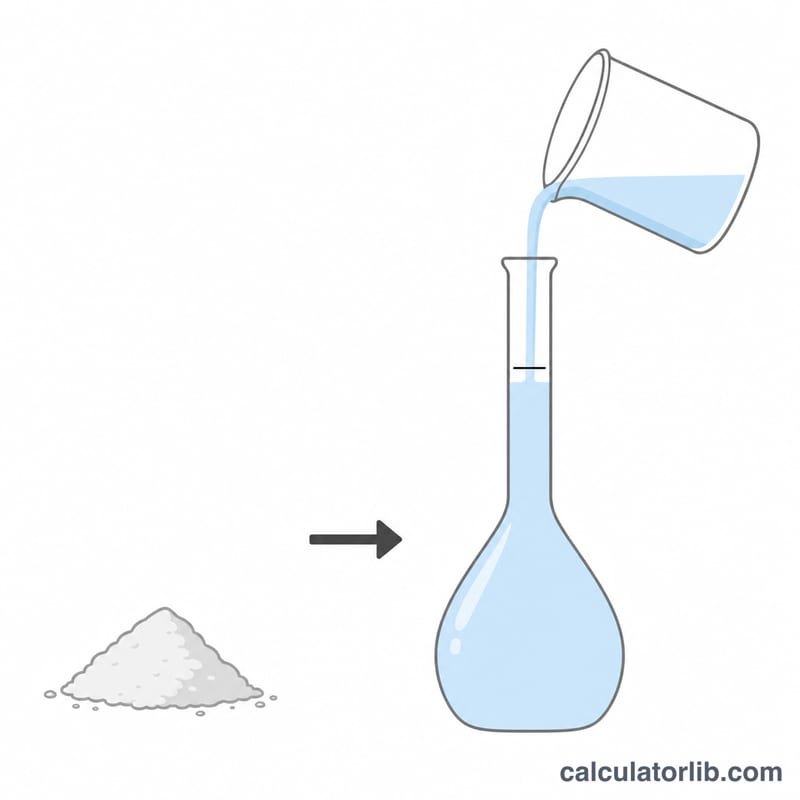
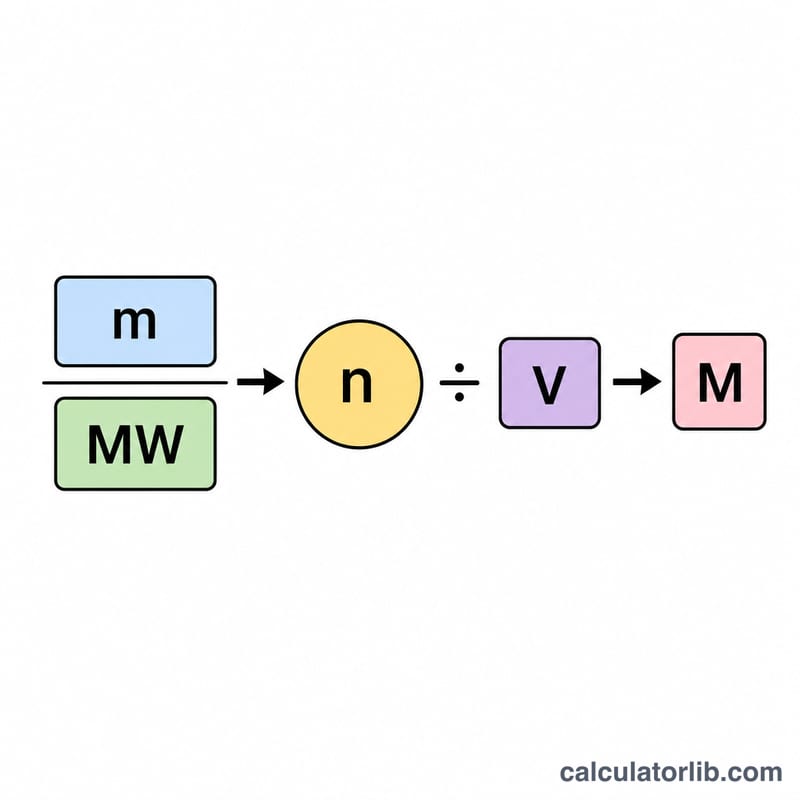
Molarity is moles of solute per liter of solution. The number of moles equals the mass divided by the molecular weight, so $$M = \dfrac{\text{Mass (g)} / \text{MW (g/mol)}}{\text{Volume (L)}}$$ where \(V_\text{final}\) is the total final volume in liters. Note this uses the final volume of the solution, not the volume of solvent added — which is why volumetric flasks are filled to the mark after the solid dissolves.
Worked example
Suppose you dissolve 5 g of sodium chloride (MW = 58.44 g/mol) and make it up to 1 L. Moles = $$\frac{5}{58.44} = 0.08556 \text{ mol}.$$ Molarity = $$\frac{0.08556}{1} = 0.0856 \text{ M},$$ or about 85.6 mM.
FAQ
Does it matter how much water I add first? No — only the final total volume matters. Always dissolve fully, then top up to the calibration mark.
What if I only know the formula weight? Formula weight and molecular weight are interchangeable here; use whichever your reagent bottle lists in g/mol.
Can I work backwards to find the mass needed? Yes — rearrange to \(\text{mass} = M \times V_\text{final} \times \text{MW}\), but this tool starts from a known mass.