What This Calculator Does
The Dog Food Bag Duration Calculator estimates how long a single bag of dry dog food (kibble) will last based on how much your dog eats each day. Knowing this helps you budget, time your reorders, and avoid running out of food unexpectedly. It works for any country and any brand because it relies only on the bag weight and your feeding amount.
How to Use It
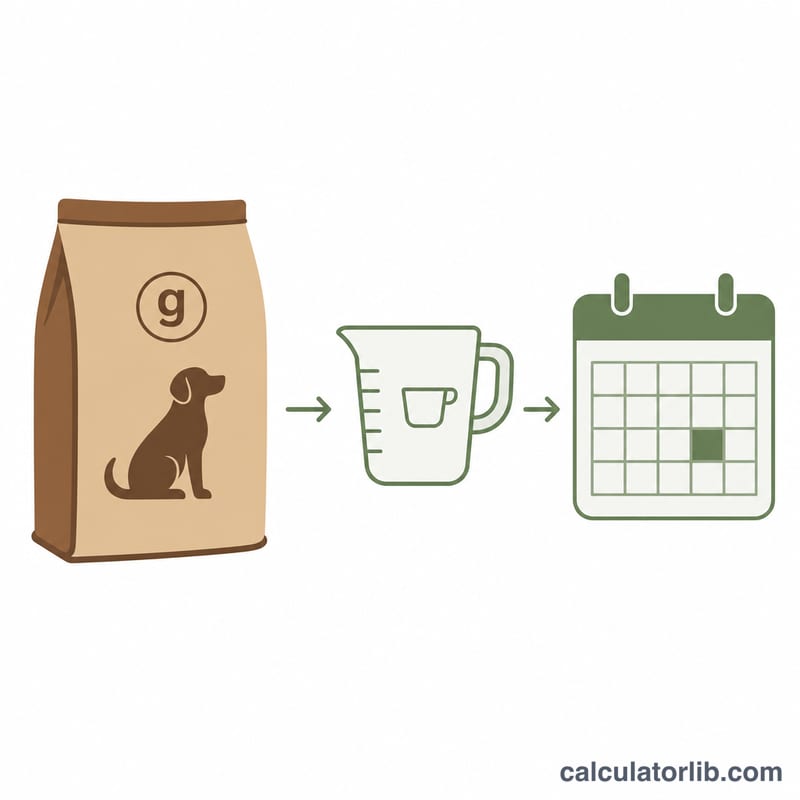
Enter three values: the bag weight in kilograms (shown on the package), the number of cups of food you serve per day across all meals, and the grams per cup of your specific kibble. A standard 8 oz measuring cup of dry dog food typically weighs about 100–130 grams, but this varies by kibble size and density — check your bag or weigh a cup on a kitchen scale for the most accurate result.
The Formula Explained
First the calculator converts the bag weight to grams (1 kg = 1000 g). It then multiplies the cups fed per day by the grams per cup to find the daily food intake in grams. Finally it divides the total grams in the bag by the daily grams to get the number of days the bag will last:
$$\text{Days} = \frac{1000 \times \text{Bag Weight (kg)}}{\text{Cups Per Day} \times \text{Grams Per Cup}}$$
The result is also shown in weeks (days ÷ 7) and months (days ÷ 30.44).
Worked Example
Suppose you buy a 15 kg bag and feed your dog 2 cups per day, with each cup weighing 120 g. Daily intake = \(2 \times 120 = 240\) g. The bag holds \(15 \times 1000 = 15{,}000\) g. So \(15{,}000 \div 240 = 62.5\) days — roughly 8.9 weeks or about 2 months per bag.
Typical Grams Per Cup by Kibble Type
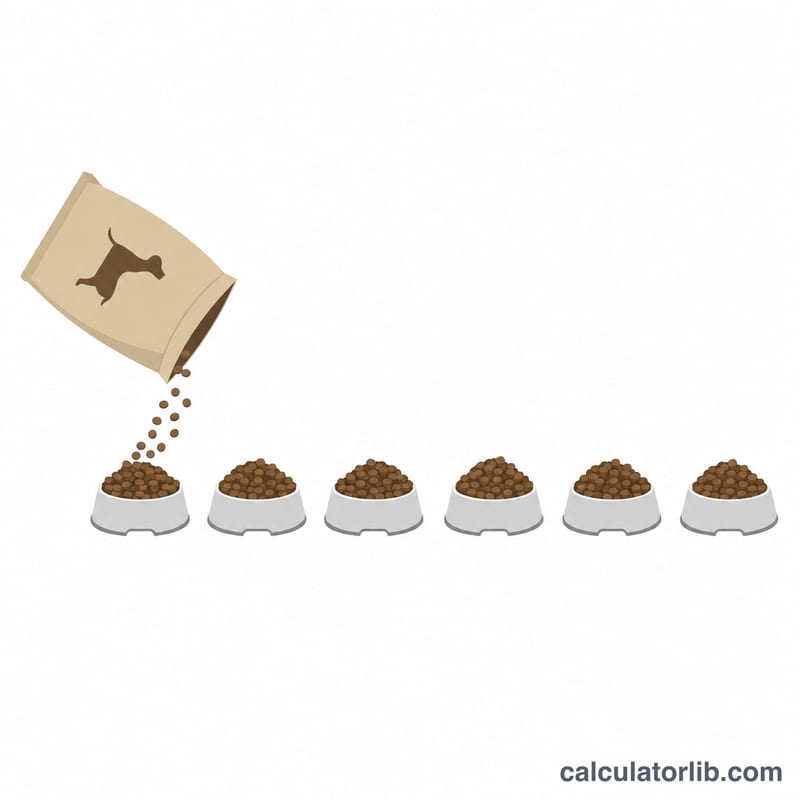
The calculator needs a weight per cup, but a "cup" is a volume measure — so the same cup holds different masses depending on how dense the kibble is. Dense, small, tightly-packed pieces fill a cup with more grams than large, airy chunks. The ranges below are for a level 8 fl oz (US) dry measuring cup, roughly 237 ml; a 250 ml metric cup holds about 5–6% more.
| Kibble characteristic | Typical grams per level 8 oz cup | Notes |
|---|---|---|
| Small-breed / dense small kibble | ~110–130 g (typical range, not a brand specification) | Small pieces pack tightly with little air space, so the cup weighs the most. |
| Standard adult kibble | ~100–120 g (typical range, not a brand specification) | The most common case; ~110 g is a reasonable starting assumption. |
| Large-breed / large chunky kibble | ~85–105 g (typical range, not a brand specification) | Big pieces leave gaps, so the same cup holds fewer grams. |
| Air-dried, puffed, baked or light grain-free kibble | ~75–95 g (typical range, not a brand specification) | Low bulk density; a cup can weigh a third less than dense small kibble. |
These are approximations for planning only. Bulk density varies between recipes from the same manufacturer, and many bags print the cup weight on the label or in the feeding chart. Weighing one level cup on a kitchen scale overrides any table value — place the empty cup on the scale, tare to zero, fill it level, and read the grams. That single measurement makes the duration result specific to your bag.
Example with a measured value: a 12 kg bag fed at 2 cups per day with a measured 120 g per cup lasts 50 days, because
$$\text{Days} = \frac{1000 \times 12}{2 \times 120} = \frac{12000}{240} = 50$$Had the same bag been fed with an airy kibble at 90 g per cup, the result would be \(12000 / (2 \times 90) \approx 66.7\) days — a difference of more than two weeks from the cup weight alone.
Bag Weight and Cup Conversions
The calculator takes bag weight in kilograms. Bags sold in the United States and Canada are usually labelled in pounds, so convert first. Note that these are the labelled net weights; the actual fill can vary slightly.
| Retail bag (lb) | ≈ kg | Metric bag sizes commonly sold |
|---|---|---|
| 4 lb | ≈ 1.8 kg | 2 kg |
| 5 lb | ≈ 2.3 kg | 3 kg |
| 15 lb | ≈ 6.8 kg | 7.5 kg |
| 24 lb | ≈ 10.9 kg | 12 kg |
| 30 lb | ≈ 13.6 kg | 15 kg |
| 40 lb | ≈ 18.1 kg | 18 kg |
| 50 lb | ≈ 22.7 kg | — |
Exact mass factors:
$$1\ \text{lb} = 0.4536\ \text{kg} \qquad 1\ \text{kg} = 2.2046\ \text{lb}$$So a 30 lb bag is \(30 \times 0.4536 = 13.608\) kg, which rounds to 13.6 kg for entry into the calculator.
Measuring cup volumes
A feeding "cup" is a volume, and the standard differs by country — a US customary cup is smaller than a metric cup, so the same scoop of kibble weighs more in Australia or Europe than in the United States.
| Cup standard | Volume | Relative to 1 US cup |
|---|---|---|
| 1 US customary cup | 8 US fl oz = 236.6 ml | 1.000 |
| 1 metric cup (Australia, NZ, much of Europe) | 250 ml | ≈ 1.057 |
Two cautions. First, the "8 oz" on a dry measuring cup is 8 fluid ounces of volume, not 8 ounces of weight — a cup of kibble typically weighs about 3–4.5 oz (85–130 g), not 8 oz. Second, if you feed with a metric 250 ml cup, your grams-per-cup figure will be roughly 6% higher than a US-cup figure for the same food, which is exactly why weighing your own cup is more reliable than copying a number.
Practical Reordering Tips
The duration figure is a supply-planning number, not a feeding recommendation. How much your dog should eat is a question for your veterinarian and the feeding chart on the bag — this calculator only tells you how long the amount you already feed will last.
- Set the reorder date 5–7 days before the bag runs out. Subtract that buffer from the calculated duration so delivery delays, backorders or a recipe being out of stock never force an abrupt food switch. A bag calculated at 45 days becomes a day-38 to day-40 reorder.
- Round the daily portion up, not down. If the cup is scooped heaped rather than levelled, it can hold 10–20% more than your measured level-cup weight, and the bag will empty sooner than the formula predicts. Entering a slightly higher cups-per-day or grams-per-cup value keeps the estimate conservative.
- Add an allowance for treats, chews and training rewards. The formula counts only kibble measured into the bowl. If you use kibble as training rewards, count those cups too — a handful several times a day is easily an extra half cup.
- Check the duration against freshness, not just cost. Once a bag is opened, dry food is generally best used within about four to six weeks, since exposure to air, warmth and light degrades the fats and fat-soluble vitamins. If the calculator says a 15 kg bag will last 120 days for a small dog, the lower price per kilogram is false economy — a smaller bag at a higher unit price may be the better buy. Use the result to pick the bag size whose duration lands inside your freshness window.
- Store the food in its original bag, placed inside an airtight container. The bag's liner is designed as a fat and moisture barrier and carries the batch code and best-before date; pouring kibble loose into a bin leaves fat residue on the walls that goes rancid and contaminates the next bag. Keep the container cool, dry and out of direct sun, and roll or clip the bag closed between meals.
- Recalculate after any change. A new recipe, a different kibble size, a growing puppy's increased portion or a vet-directed portion change all alter the inputs. Re-run the numbers rather than assuming the last bag's timeline still applies.
Worked reorder example
A 15 kg bag, fed at 3 cups per day, with one level cup weighed at 110 g:
$$\text{Days} = \frac{1000 \times 15}{3 \times 110} = \frac{15000}{330} \approx 45.5$$That is about 45.45 days, or roughly 6.5 weeks. Subtracting a 7-day buffer puts the reorder on about day 38. Because 45 days is just over six weeks, this bag also sits right at the edge of the usual four-to-six-week open-bag freshness window, so a 12 kg bag would finish comfortably inside it.
This section is general planning information, not veterinary or professional advice. For anything concerning your dog's diet, portion size, weight or health, consult your veterinarian.
FAQ
How many grams is one cup of dog food? Most dry kibble runs 100–130 g per 8 oz cup, but small or dense kibble can be higher. Weigh a cup for accuracy.
Can I use pounds instead of kilograms? This tool uses kilograms. Convert pounds to kg by dividing by 2.205 (e.g. 30 lb ≈ 13.6 kg).
Why does my bag run out faster than predicted? Treats, free feeding, spillage, and overfilled cups all add up. Measure portions precisely and account for treats.