
What Is the Mass to Moles Calculator?
This calculator converts a sample mass (in grams) into the amount of substance in moles. It is a fundamental conversion in chemistry, letting you move from a quantity you can weigh on a balance to a quantity you can use in stoichiometry, solution preparation, and reaction calculations.
How to Use It
Enter the mass of your sample in grams and its molar mass in grams per mole (g/mol). The molar mass is the sum of the atomic masses of every atom in the chemical formula — for example, NaCl is about 58.44 g/mol. The calculator divides the mass by the molar mass and returns the number of moles.
The Formula Explained
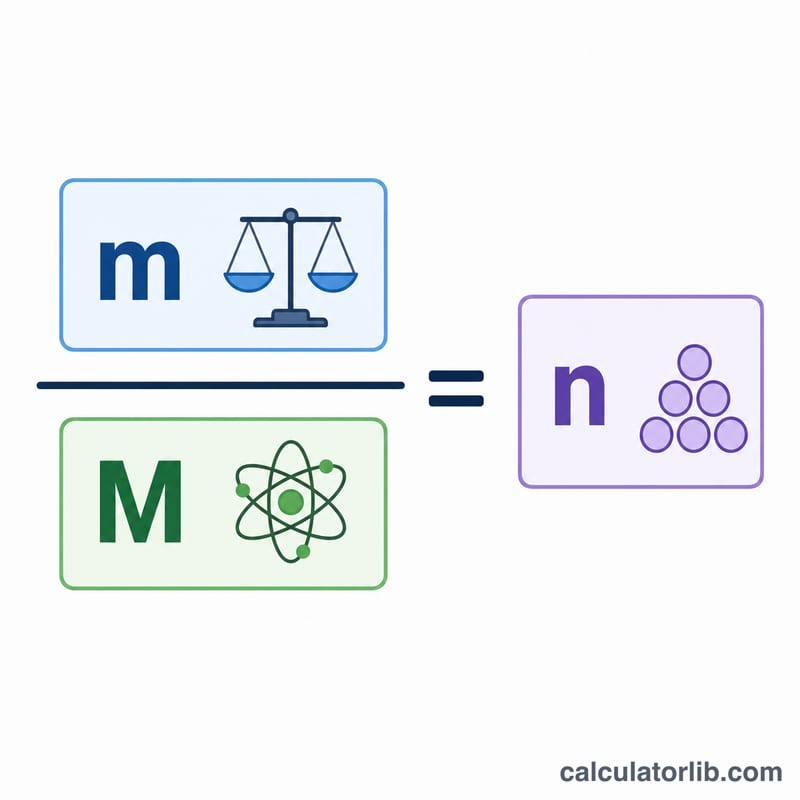
The relationship is $$n = \frac{m}{M}$$ where n is the number of moles (mol), m is the mass of the substance (g), and M is its molar mass (g/mol). Because the grams cancel, the result is in moles. Rearranged, you can also find mass with \(m = n \times M\), or molar mass with \(M = \frac{m}{n}\).
Worked Example
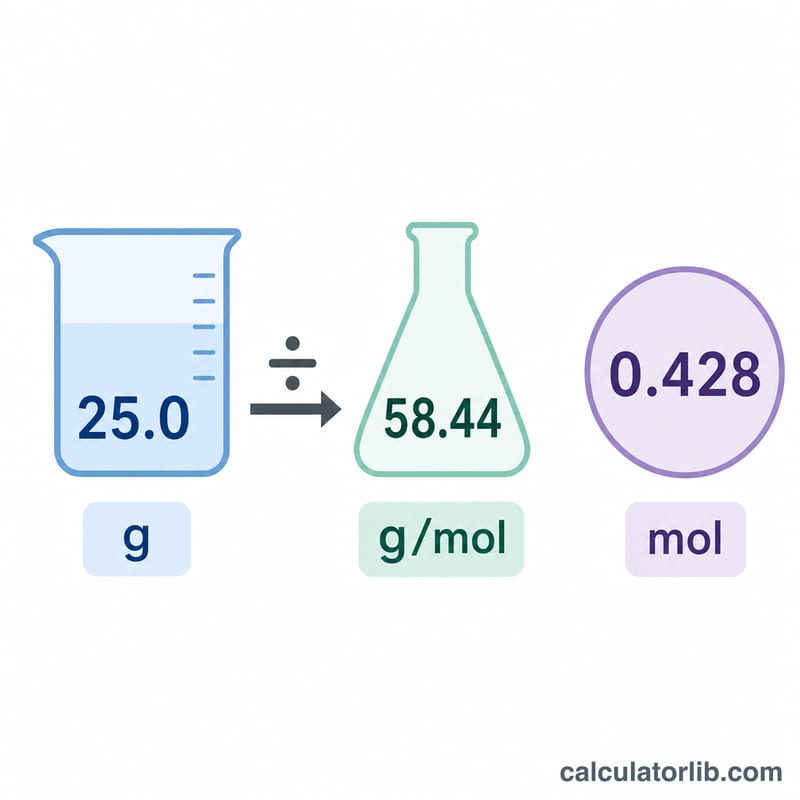
Suppose you weigh out 11.688 g of sodium chloride (NaCl), which has a molar mass of 58.44 g/mol. Then $$n = \frac{11.688}{58.44} = 0.2 \text{ mol}$$ So your sample contains 0.2 moles of NaCl.
FAQ
Where do I find the molar mass? Add up the atomic masses (from the periodic table) of each atom in the formula. Water (H₂O) = \(2 \times 1.008 + 16.00 \approx 18.02\) g/mol.
Can I use it for elements? Yes. Use the element's atomic mass as the molar mass — for carbon use about 12.01 g/mol.
How do I get molarity from this? Divide the moles by the solution volume in liters: \(\text{molarity (mol/L)} = \frac{n}{V}\).