
What this calculator does
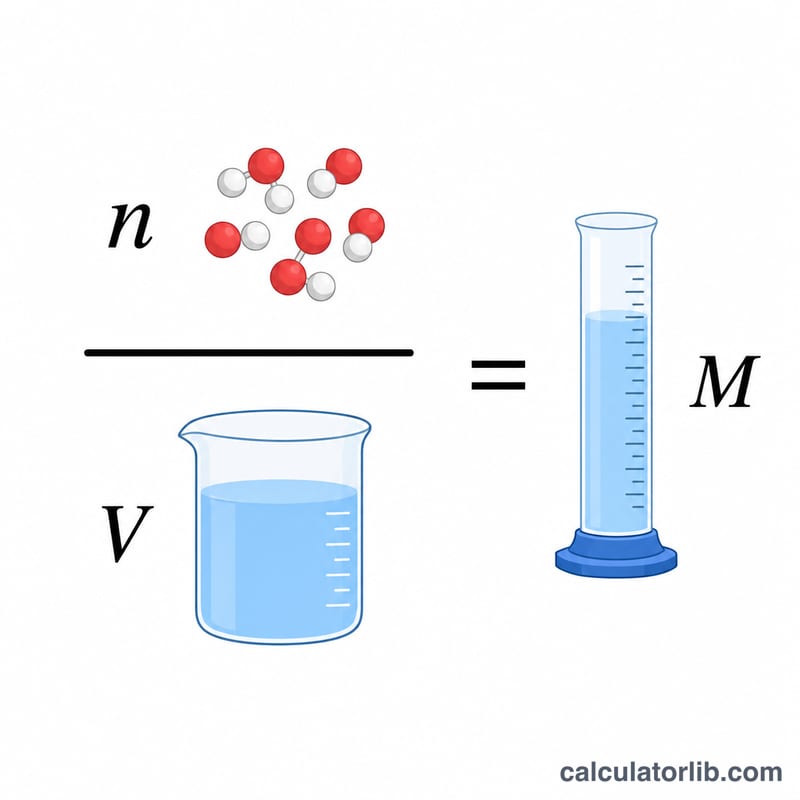
This tool computes the molar concentration (molarity) of a solution from the number of moles of dissolved solute and the total volume of the solution. Molarity, symbol M, is one of the most common ways chemists express concentration and is measured in moles per liter (mol/L).
How to use it
Enter the amount of solute in moles, then enter the solution volume and choose whether that volume is in liters or milliliters. The calculator converts the volume to liters if needed and divides the moles by the volume to give the concentration in mol/L.
The formula explained
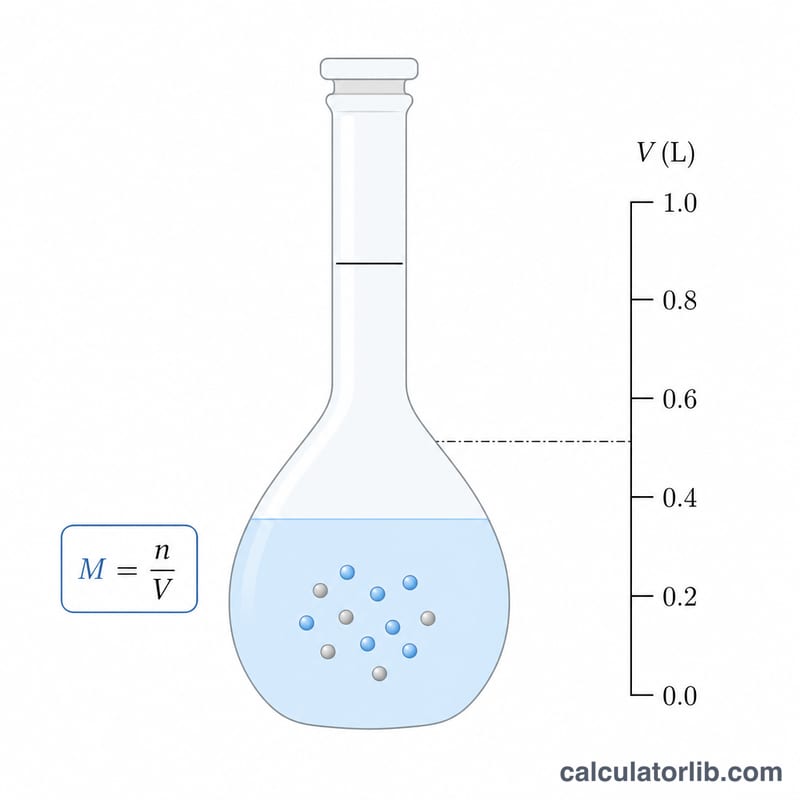
The defining equation of molarity is \(M = n / V\), where n is the amount of solute in moles and V is the volume of the solution in liters. If your volume is in milliliters, divide by 1000 first: $$V(\text{L}) = V(\text{mL}) / 1000$$ Note that the volume is the total volume of the final solution, not just the volume of solvent added.
Worked example
Suppose you dissolve 0.5 mol of sodium chloride to make 250 mL of solution. First convert the volume: $$250 \text{ mL} / 1000 = 0.25 \text{ L}$$ Then divide: $$0.5 \text{ mol} / 0.25 \text{ L} = 2 \text{ mol/L}$$ The solution is therefore 2 M.
FAQ
What is the difference between molarity and molality? Molarity (mol/L) uses the volume of the solution, while molality (mol/kg) uses the mass of the solvent. Molarity changes slightly with temperature because volume expands; molality does not.
Do I use the solvent volume or the solution volume? Always use the total volume of the finished solution, since the dissolved solute itself contributes to the volume.
How do I get moles if I only know mass? Divide the mass in grams by the molar mass in g/mol to obtain the number of moles, then use this calculator.