
What Is the Incidence Rate?
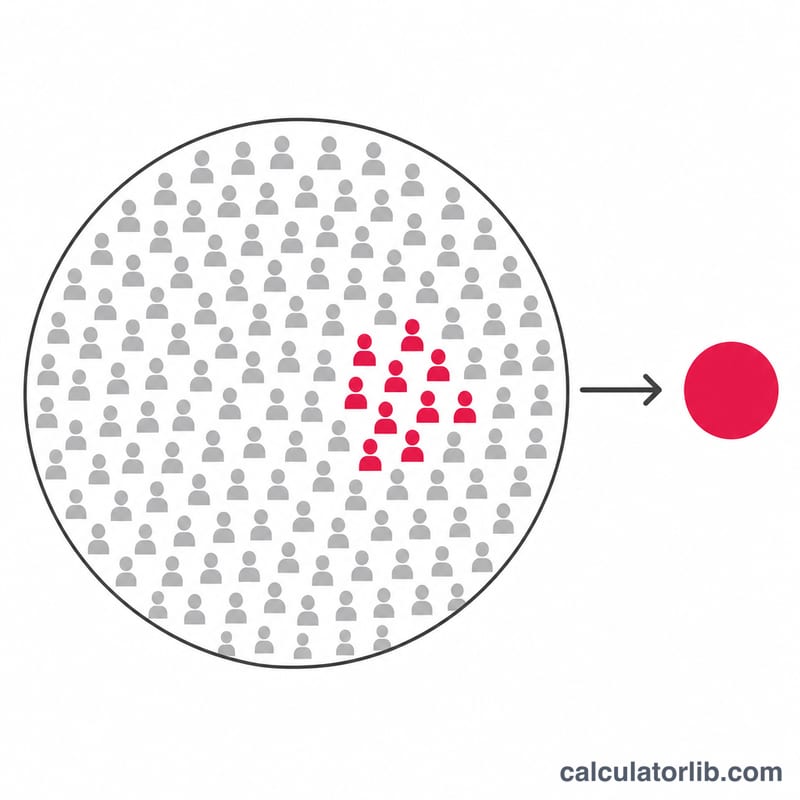
Incidence rate is an epidemiological measure of how frequently new cases of a disease, condition, or event occur in a population over a period of time. Unlike prevalence (which counts all existing cases), incidence focuses only on new cases among the population at risk. Because raw counts are hard to compare across populations of different sizes, incidence is usually expressed per a standard number of people — commonly per 1,000, per 10,000, or per 100,000.
How to Use This Calculator
Enter the number of new cases observed, the size of the population at risk, and choose the multiplier you want to report against. The calculator divides cases by population and scales the result, giving you a rate that can be compared across regions, time periods, or studies. It also shows the incidence proportion as a simple percentage.
The Formula Explained
The core equation is:
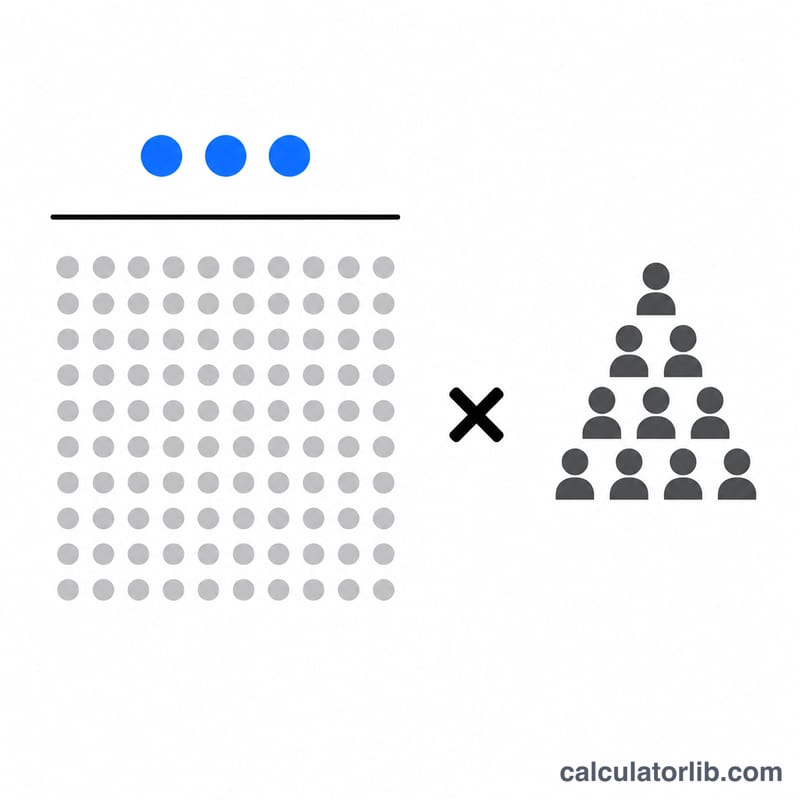
$$\text{Incidence Rate} = \frac{\text{New Cases}}{\text{Population at Risk}} \times \text{Multiplier}$$
The fraction (cases ÷ population) is the incidence proportion — the probability that a given individual develops the condition during the period. Multiplying by a factor such as 100,000 simply rescales that small fraction into an easy-to-read whole number.
Worked Example
Suppose a town of 100,000 people records 250 new flu cases over one year. The incidence proportion is $$250 \div 100{,}000 = 0.0025,$$ or 0.25%. Multiplied by 100,000, the incidence rate is 250 cases per 100,000 people per year.
FAQ
What is the difference between incidence and prevalence? Incidence counts only new cases that appear during a period; prevalence counts all cases (new and existing) at a point in time.
Which multiplier should I use? Use the one common in your field or that gives a readable number. Rare conditions are often reported per 100,000, while more common events may use per 1,000.
Who counts as the population at risk? Only people who could actually develop the condition — typically excluding those already affected or otherwise not susceptible.