
What this calculator does
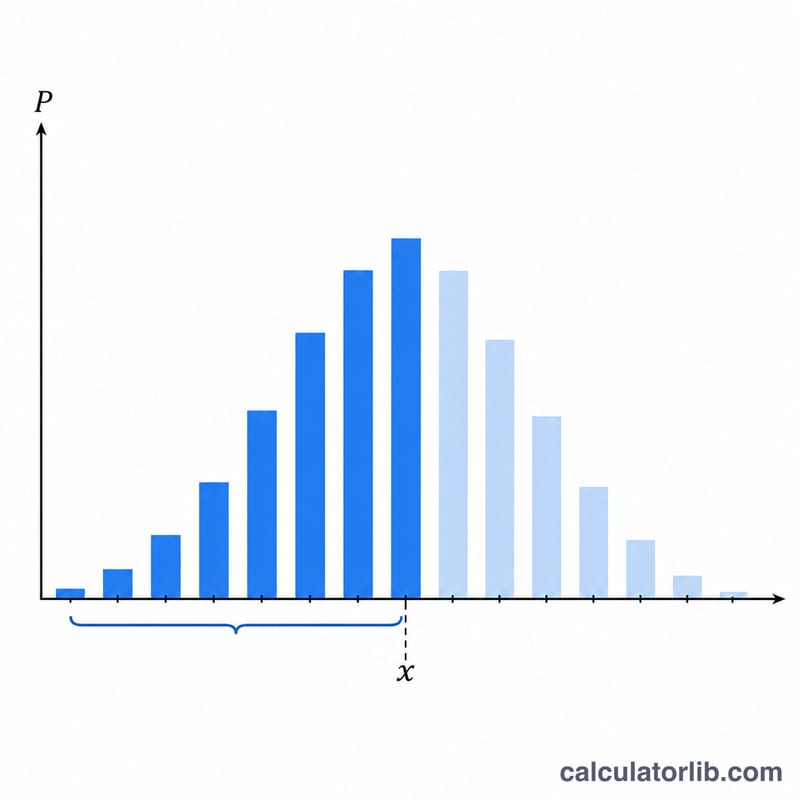
This tool computes the percentile point of a Poisson distribution. Given a mean (lambda) and a target cumulative probability, it returns the integer event count x that corresponds to that probability. It is the inverse of the Poisson cumulative distribution function (CDF) and works in two modes: lower cumulative P and upper cumulative Q.
How to use it
Pick a cumulative mode. In Lower cumulative P mode, enter the target lower-tail probability P; the calculator returns the smallest integer x with \(P(x, \lambda) \ge P\). In Upper cumulative Q mode, enter the upper-tail probability Q; it returns the largest x with \(Q(x, \lambda) \ge Q\), using this site's inclusive-of-x convention \(Q(x) = 1 - P(x-1)\). Then enter the mean lambda (expected number of events). All inputs are dimensionless.
The formula explained
The probability mass function is $$f(t, \lambda) = e^{-\lambda} \cdot \frac{\lambda^{t}}{t!}.$$ The terms are built iteratively for stability: \(\text{term}(0) = e^{-\lambda}\) and \(\text{term}(t) = \text{term}(t-1) \cdot \frac{\lambda}{t}\), avoiding overflow from \(\lambda^{t}\) and \(t!\). The lower cumulative is the running sum of these terms; the upper cumulative is 1 minus the lower cumulative shifted by one index.
$$x^{*} = \min\left\{\, x \in \mathbb{Z}_{\ge 0} : \sum_{k=0}^{x} \frac{e^{-\lambda}\,\lambda^{k}}{k!} \ge \text{p} \,\right\}, \quad \lambda = \text{Mean } \lambda$$$$x^{*} = \max\left\{\, x \in \mathbb{Z}_{\ge 0} : 1 - \sum_{k=0}^{x-1} \frac{e^{-\lambda}\,\lambda^{k}}{k!} \ge \text{p} \,\right\}, \quad \lambda = \text{Mean } \lambda$$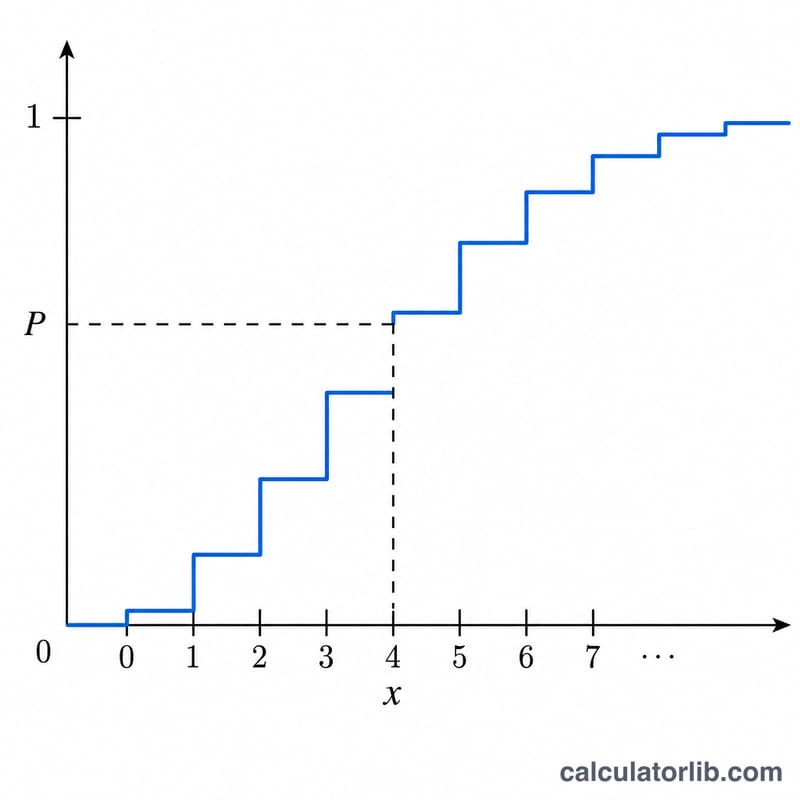
Worked example
With \(P = 0.3\) and \(\lambda = 5\) in lower mode, the running cumulative is \(P(0)=0.0067\), \(P(1)=0.0404\), \(P(2)=0.1247\), \(P(3)=0.2650\), \(P(4)=0.4405\). The first x reaching 0.3 is \(x = 4\). In upper mode with \(Q = 0.3\) and \(\lambda = 5\), \(Q(6)=0.384\) and \(Q(7)=0.238\), so the largest x with \(Q \ge 0.3\) is \(x = 6\).
FAQ
Why does upper mode include x in the sum? This site defines \(Q(x) = \sum_{t=x}^{\infty}\), i.e. \(Q(x) = 1 - P(x-1)\), which differs from the common \(P(X > x)\) convention.
What happens when lambda = 0? All mass sits at \(t = 0\), so the lower percentile is 0 and \(Q(x)=0\) for any \(x \ge 1\).
What if I enter a probability outside 0 to 1? The calculator flags it as invalid; probabilities must satisfy \(0 \le P, Q \le 1\) and \(\lambda \ge 0\).