
What is significant-figure rounding?
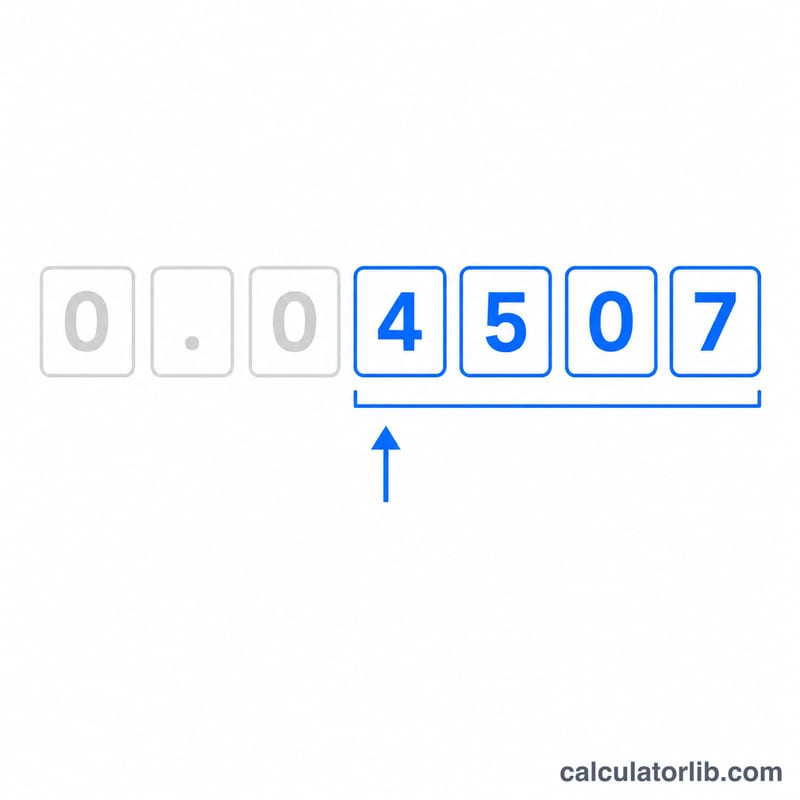
Significant figures (sig figs) are the digits in a number that carry meaningful precision. This calculator rounds any number you enter to a chosen number of significant figures. It accepts whole numbers, decimals, and scientific notation written as 3.5e3, 3.5 x 10^3, or 3.5*10^3. It returns both the rounded value and a presentation string that makes the precision unambiguous using an overline on the last significant digit.
How to use it
Type the number you want to round in the "Round:" box. Enter how many significant figures you want to keep in the second box. Click calculate. The big number is your rounded answer; the table shows a presentation that marks the last significant digit with an overline whenever trailing zeros to the left of the decimal point are not significant.
The formula explained
Let \(V\) be the input and \(N\) the requested significant figures. We take the order of magnitude of the leading digit, \(d = \lfloor \log_{10}|V| \rfloor\). The rounding power is \(p = d - (N - 1)\). We then compute $$\text{Rounded} = \operatorname{sign}(V)\cdot\left\lfloor\frac{|V|}{10^{\,p}}+0.5\right\rfloor\cdot 10^{\,p}$$ which is standard round-half-up. The result is reformatted to \(\max(0, -p)\) decimal places to remove floating-point artifacts.
Worked example
Round 305.459 to 5 significant figures. Here \(d = \lfloor \log_{10}(305.459) \rfloor = 2\), so \(p = 2 - (5 - 1) = -2\) and \(10^p = 0.01\). Then \(305.459 / 0.01 = 30545.9\); \(\lfloor 30545.9 + 0.5 \rfloor = 30546\); multiply back by \(0.01\) to get \(305.46\). To 2 sig figs the same number rounds to 310, presented as 3 1̅ 0 because the trailing zero is not significant.
FAQ
Why is there a line over one digit? When an integer like 360 keeps only 2 significant figures, the trailing zero is ambiguous. The overline on the 6 shows it is the last significant digit.
What rounding rule is used? Round half up: the digit after the cutoff rounds up if it is 5 or more, otherwise it is dropped.
What happens with 999.6 to 3 sig figs? It carries to 1000, gaining an extra leading digit. This is mathematically correct and is shown as-is.