What the LCM Calculator Does
The LCM Calculator finds the Least Common Multiple of a set of whole numbers — the smallest positive integer that every number you enter divides into evenly. It accepts a list of integers in a single field and returns one result: their combined LCM. This is handy for adding fractions with different denominators, scheduling repeating events, and solving number-theory problems.
How to Use It
- Numbers — type two or more integers into the input box.
- Separate them with commas, semicolons, or spaces — the calculator splits on commas (both English and full-width), semicolons, and any whitespace.
- Negative integers are accepted; only valid whole numbers (matching the pattern
-?\d+) are kept, so stray text is ignored.
For example, entering 4, 6, 8 is read as the list [4, 6, 8].
The Formula Explained
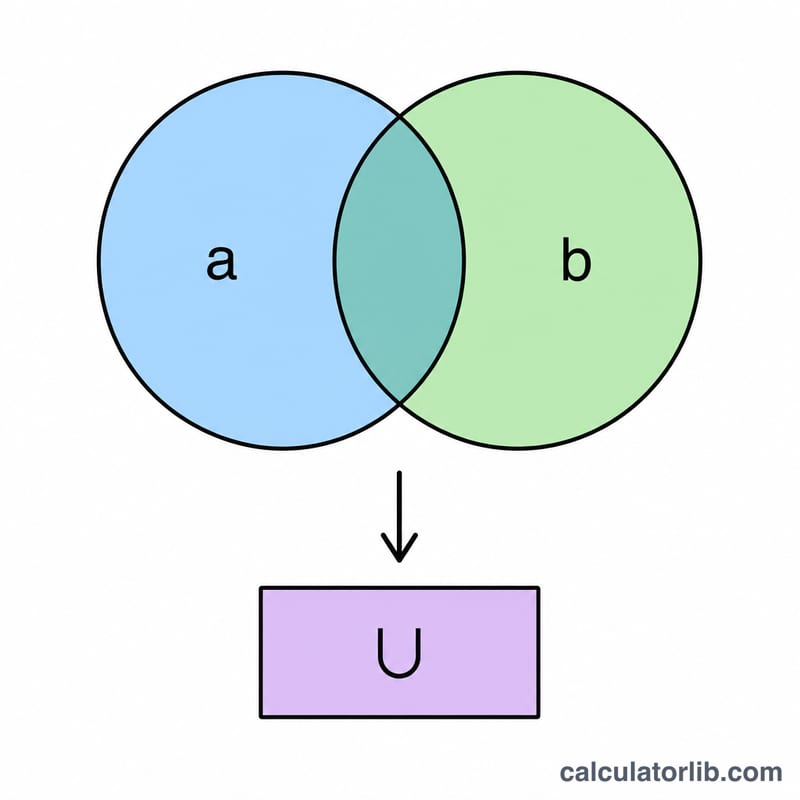
For two numbers the calculator uses the classic relationship between LCM and the Greatest Common Divisor (GCD):
$$\text{LCM}(a, b) = \frac{|a \cdot b|}{\gcd(a,\,b)}$$
When you supply more than two numbers, it folds the operation across the list — computing the LCM of the first two, then taking the LCM of that result with the next number, and so on. In code terms this is a reduce/inject: LCM(a, b, c) = LCM(LCM(a, b), c).
Worked Example
Suppose you enter 4, 6, 8:
- Step 1: \(\gcd(4, 6) = 2\), so $$\text{LCM}(4, 6) = \frac{4 \times 6}{2} = \frac{24}{2} = 12.$$
- Step 2: \(\gcd(12, 8) = 4\), so $$\text{LCM}(12, 8) = \frac{12 \times 8}{4} = \frac{96}{4} = 24.$$
The calculator returns 24 — the smallest number that 4, 6, and 8 all divide into evenly.
More Worked Examples
Every example below uses the same identity the calculator applies internally: for two integers, \(\operatorname{LCM}(a,b) = \dfrac{|a \times b|}{\gcd(a,b)}\). For lists of three or more numbers, the pair rule is folded from left to right.
Example 1 — A coprime pair: LCM(7, 9)
- Find the GCD. The divisors of 7 are 1 and 7; the divisors of 9 are 1, 3 and 9. The only shared divisor is 1, so \(\gcd(7,9)=1\). The numbers are coprime.
- Apply the identity: \(\operatorname{LCM}(7,9) = \dfrac{|7 \times 9|}{1} = \dfrac{63}{1} = 63\).
- Check by listing: multiples of 7 are 7, 14, 21, 28, 35, 42, 49, 56, 63; 63 = 9 × 7, so it is also a multiple of 9.
Answer: LCM(7, 9) = 63. Whenever the GCD is 1, the LCM is simply the product of the two numbers — nothing cancels out.
Example 2 — One number divides the other: LCM(5, 15)
- Find the GCD. Since \(15 = 5 \times 3\), the number 5 divides 15 exactly, so \(\gcd(5,15) = 5\).
- Apply the identity: \(\operatorname{LCM}(5,15) = \dfrac{|5 \times 15|}{5} = \dfrac{75}{5} = 15\).
- Sanity check: 15 is a multiple of itself and 15 = 5 × 3 is a multiple of 5, and no smaller positive multiple of 15 exists.
Answer: LCM(5, 15) = 15. This is the general rule: if \(a\) divides \(b\), then \(\operatorname{LCM}(a,b) = |b|\), the larger number itself.
Example 3 — A four-number list: LCM(3, 4, 5, 6)
Fold the pair rule left to right, carrying the running result forward:
- \(\gcd(3,4) = 1 \;\Rightarrow\; \operatorname{LCM}(3,4) = \dfrac{12}{1} = 12\).
- \(\gcd(12,5) = 1 \;\Rightarrow\; \operatorname{LCM}(12,5) = \dfrac{60}{1} = 60\).
- \(\gcd(60,6) = 6 \;\Rightarrow\; \operatorname{LCM}(60,6) = \dfrac{360}{6} = 60\).
Cross-check with prime factorization: \(3 = 3\), \(4 = 2^2\), \(5 = 5\), \(6 = 2 \cdot 3\). The highest power of each distinct prime is \(2^2\), \(3^1\) and \(5^1\), giving \(4 \cdot 3 \cdot 5 = 60\) — the same value.
Answer: LCM(3, 4, 5, 6) = 60. Notice that adding 6 to the list changed nothing, because 6 already divides 60.
Example 4 — A negative input: LCM(−4, 6)
- The GCD is taken as a positive value: \(\gcd(-4, 6) = \gcd(4, 6) = 2\).
- The absolute value in the numerator keeps the result positive: \(\operatorname{LCM}(-4,6) = \dfrac{|-4 \times 6|}{2} = \dfrac{24}{2} = 12\).
Answer: LCM(−4, 6) = 12. By the standard convention the least common multiple is reported as a non-negative number, so the sign of an input never changes the answer — only its magnitude matters.
How to Find the LCM by Hand
There are two reliable hand methods, plus a quick listing check for small numbers. Both methods always give the same answer; pick whichever is faster for the numbers in front of you.
Method A — Prime factorization
- Factor each number into primes, writing repeated primes as powers.
- Collect every distinct prime that appears in any factorization.
- Take each prime to its highest exponent found across all the numbers (not the sum of the exponents).
- Multiply those prime powers together. The product is the LCM.
Demonstration with 12 and 18:
$$12 = 2^2 \cdot 3, \qquad 18 = 2 \cdot 3^2$$
The distinct primes are 2 and 3. The highest power of 2 is \(2^2\) (from 12); the highest power of 3 is \(3^2\) (from 18). Therefore
$$\operatorname{LCM}(12,18) = 2^2 \cdot 3^2 = 4 \cdot 9 = 36$$
Prime factorization scales naturally to long lists — you simply scan all the factorizations for the largest exponent of each prime — but it becomes slow once the numbers are large and hard to factor.
Method B — The GCD route (Euclidean algorithm)
- Find the GCD of the two numbers using the Euclidean algorithm: repeatedly replace the pair \((a, b)\) with \((b,\; a \bmod b)\) until the second entry is 0. The remaining first entry is the GCD.
- Divide the product by the GCD: \(\operatorname{LCM}(a,b) = \dfrac{|a \cdot b|}{\gcd(a,b)}\).
- Divide before multiplying if the numbers are large — computing \((a / \gcd) \cdot b\) gives the same result while keeping the intermediate value smaller.
Demonstration with 48 and 18. The Euclidean steps are:
| Step | Pair \((a, b)\) | \(a \bmod b\) | New pair |
|---|---|---|---|
| 1 | (48, 18) | 48 mod 18 = 12 | (18, 12) |
| 2 | (18, 12) | 18 mod 12 = 6 | (12, 6) |
| 3 | (12, 6) | 12 mod 6 = 0 | (6, 0) → stop |
The second entry has reached 0, so \(\gcd(48,18) = 6\). Now apply the identity:
$$\operatorname{LCM}(48,18) = \frac{|48 \times 18|}{6} = \frac{864}{6} = 144$$
Answer: LCM(48, 18) = 144.
Handling three or more numbers
The LCM is associative, so a list is handled by folding the pair rule from left to right:
$$\operatorname{LCM}(a, b, c, d) = \operatorname{LCM}\bigl(\operatorname{LCM}(\operatorname{LCM}(a,b),\, c),\, d\bigr)$$
- Compute the LCM of the first two numbers.
- Take that result and the third number, and compute their LCM.
- Repeat until the list is exhausted. The order of the numbers does not affect the final answer.
Quick check — listing multiples
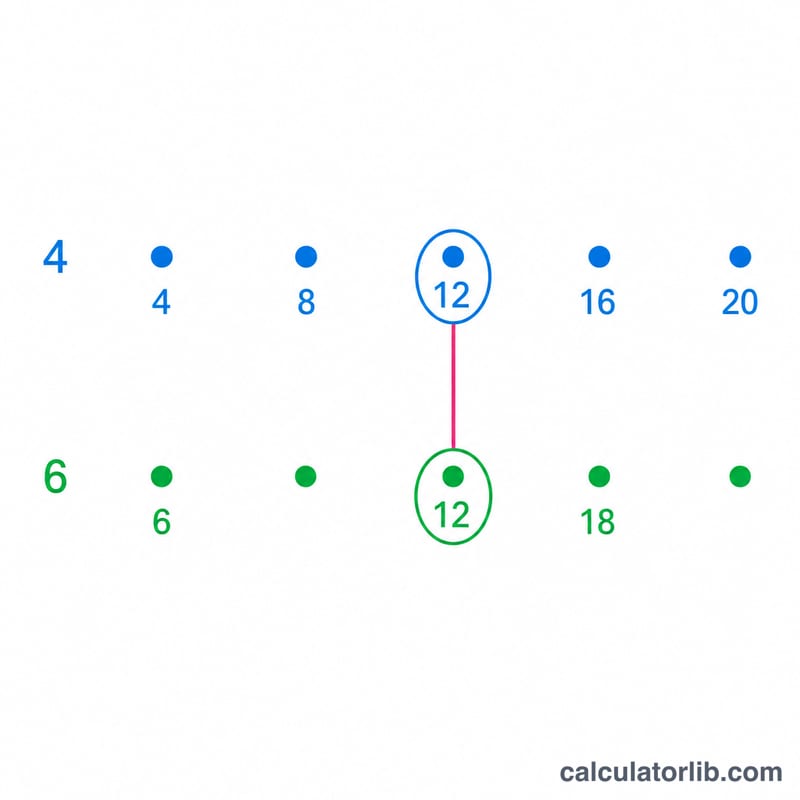
For small numbers, write out the multiples of each and find the first value common to all lists. For 4 and 6:
- Multiples of 4: 4, 8, 12, 16, 20, 24, …
- Multiples of 6: 6, 12, 18, 24, …
The smallest shared entry is 12, so \(\operatorname{LCM}(4,6) = 12\). This method is intuitive and good for verifying a result, but it is impractical once the numbers exceed about two digits — the lists grow long before they intersect.
Key Terms Explained
| Term | Meaning |
|---|---|
| Multiple | Any number of the form \(n \cdot k\) where \(k\) is an integer. The multiples of 6 are …, −12, −6, 0, 6, 12, 18, … In LCM work we normally consider only the positive multiples. |
| Common multiple | A number that is a multiple of every number in the given set at the same time. 24, 48 and 72 are all common multiples of 8 and 12. |
| Least common multiple (LCM) | The smallest positive common multiple of the set. For 8 and 12 it is 24. Every other common multiple is itself a multiple of the LCM. |
| Divisor / factor | An integer that divides another with no remainder. 3 is a divisor of 12 because \(12 \div 3 = 4\) exactly. "Divisor" and "factor" mean the same thing here. |
| Greatest common divisor (GCD, also HCF) | The largest positive integer that divides all the given numbers. \(\gcd(8,12) = 4\). In British usage this is often called the highest common factor. |
| Coprime (relatively prime) | Two numbers whose only common positive divisor is 1, i.e. \(\gcd(a,b) = 1\). For coprime numbers the LCM equals the product: \(\operatorname{LCM}(7,9) = 63\). |
| Prime factorization | Writing a number as a product of prime powers, e.g. \(180 = 2^2 \cdot 3^2 \cdot 5\). By the fundamental theorem of arithmetic this decomposition is unique for every integer greater than 1. |
| Euclidean algorithm | An ancient, very fast procedure for the GCD: replace \((a, b)\) with \((b,\; a \bmod b)\) repeatedly until \(b = 0\); the surviving value is the GCD. It never needs the numbers to be factored. |
| Reduced fraction / common denominator | Two everyday uses of these ideas: the GCD reduces a fraction to lowest terms, while the LCM of the denominators gives the least common denominator for adding fractions. |
The product identity
For any two integers \(a\) and \(b\), the LCM and GCD together account for exactly the product:
$$\operatorname{LCM}(a,b) \times \gcd(a,b) = |a \cdot b|$$
This is why the calculator can find the LCM by computing the (cheap) GCD first and then dividing. Worth noting: the identity holds for pairs only — for three or more numbers, \(\operatorname{LCM}(a,b,c) \times \gcd(a,b,c)\) is generally not equal to \(|a \cdot b \cdot c|\).
Edge-case conventions
- \(\operatorname{LCM}(a, 1) = |a|\) — every integer is a multiple of 1, so 1 never changes the result.
- \(\operatorname{LCM}(a, 0) = 0\) — zero is a multiple of every integer, and 0 is the standard convention here (it also keeps the identity consistent, since \(\gcd(a,0) = |a|\)).
- Negative inputs are handled through the absolute value, so the LCM reported is always non-negative: \(\operatorname{LCM}(-4, 6) = 12\).
- \(\operatorname{LCM}(a, a) = |a|\) — a repeated value in the list adds nothing new.
Frequently Asked Questions
Can I enter more than two numbers? Yes. There is no fixed limit — the tool processes the entire list and applies the LCM pairwise until a single answer remains.
What happens with negative numbers? Negatives are allowed and parsed correctly. Because the formula uses the absolute value of the product, the LCM is always reported as a positive integer.
What if I include letters or symbols? Non-numeric tokens are filtered out automatically. Only entries matching a valid integer pattern are used, so 4, x, 6 is treated the same as 4, 6.