What is the Length Conversion Calculator?
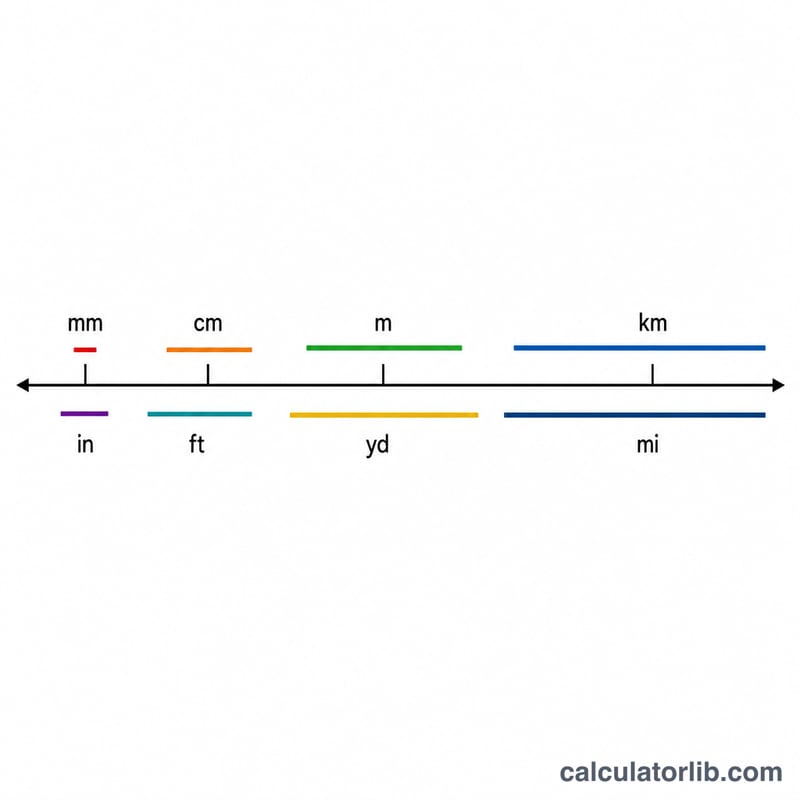
This tool converts a length measurement from one unit to another across both the metric and imperial systems. It supports millimeters (mm), centimeters (cm), meters (m), kilometers (km), inches (in), feet (ft), yards (yd) and miles (mi). Conversions are universal and not tied to any country, using internationally agreed exact factors.
How to use it
Enter the numeric value, choose the unit you are converting from, then choose the unit you want to convert to. The calculator instantly shows the converted length plus the equivalent in meters as a reference.
The formula explained
Every unit has a factor equal to its size in meters: \(1\,\text{in} = 0.0254\,\text{m}\), \(1\,\text{ft} = 0.3048\,\text{m}\), \(1\,\text{yd} = 0.9144\,\text{m}\), \(1\,\text{mi} = 1609.344\,\text{m}\), \(1\,\text{km} = 1000\,\text{m}\), \(1\,\text{cm} = 0.01\,\text{m}\), \(1\,\text{mm} = 0.001\,\text{m}\). The value is first converted to meters by multiplying by the source factor, then divided by the target factor:
$$\text{result} = \frac{\text{value} \times \text{factor}_{\text{from}}}{\text{factor}_{\text{to}}}$$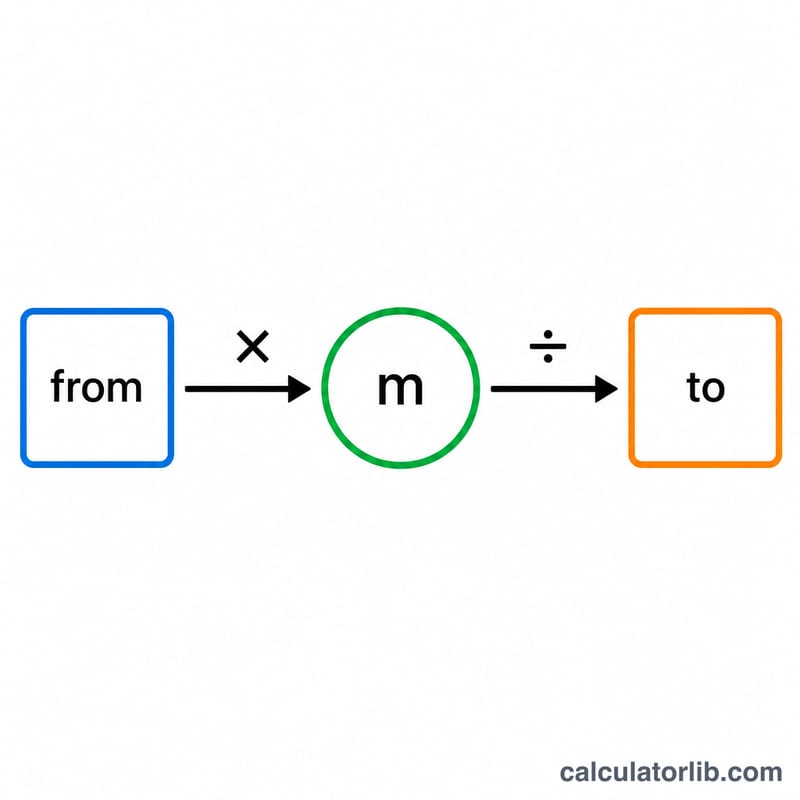
Worked example
Convert 5 kilometers to miles. First to meters: \(5 \times 1000 = 5000\,\text{m}\). Then divide by the mile factor: $$5000 \div 1609.344 \approx 3.10686 \text{ miles}.$$ So \(5\,\text{km} \approx 3.107\) miles.
More Conversion Examples
The easiest way to convert any two length units is to go through the meter. First multiply the value by the meter equivalent of the starting unit. Then divide by the meter equivalent of the target unit. The factors used below are exact by definition. The inch, foot, yard and mile values come from the 1959 international yard and pound agreement: 1 in = 0.0254 m, 1 ft = 0.3048 m, 1 yd = 0.9144 m and 1 mi = 1,609.344 m.
Example 1: 6 ft to centimeters
- Convert feet to meters: $$6 \times 0.3048 = 1.8288\ \text{m}$$
- Convert meters to centimeters (1 cm = 0.01 m): $$\frac{1.8288}{0.01} = 182.88\ \text{cm}$$
Result: 6 ft = 182.88 cm. The answer is exact, so you don't need to round it.
Example 2: 72 in to yards
- Convert inches to meters: $$72 \times 0.0254 = 1.8288\ \text{m}$$
- Convert meters to yards: $$\frac{1.8288}{0.9144} = 2\ \text{yd}$$
Result: 72 in = 2 yd. You can check this another way: 1 yd = 36 in, so 72 ÷ 36 = 2.
Example 3: 250 mm to inches
- Convert millimeters to meters (1 mm = 0.001 m): $$250 \times 0.001 = 0.25\ \text{m}$$
- Convert meters to inches: $$\frac{0.25}{0.0254} = 9.842519\ldots\ \text{in}$$
Result: 250 mm ≈ 9.8425 in. Rounded to two decimals, that is 9.84 in. This result has an endless decimal expansion, so round it to the precision your task needs.
Example 4: 3 mi to kilometers
- Convert miles to meters: $$3 \times 1609.344 = 4828.032\ \text{m}$$
- Convert meters to kilometers (1 km = 1,000 m): $$\frac{4828.032}{1000} = 4.828032\ \text{km}$$
Result: 3 mi = 4.828032 km, or about 4.83 km.
Tip: Keep the full meter value through the intermediate step and round only the final answer. Rounding early adds error, and the error grows with large values.
FAQ
How many feet are in a meter? One meter equals about 3.28084 feet \((1 \div 0.3048)\).
Is a mile exactly 1609.344 meters? Yes — the international mile is defined as exactly 1609.344 meters.
Can I convert between two imperial units? Yes. The value passes through meters internally, so any supported unit converts to any other.