
What Is the Loan-to-Value Ratio?
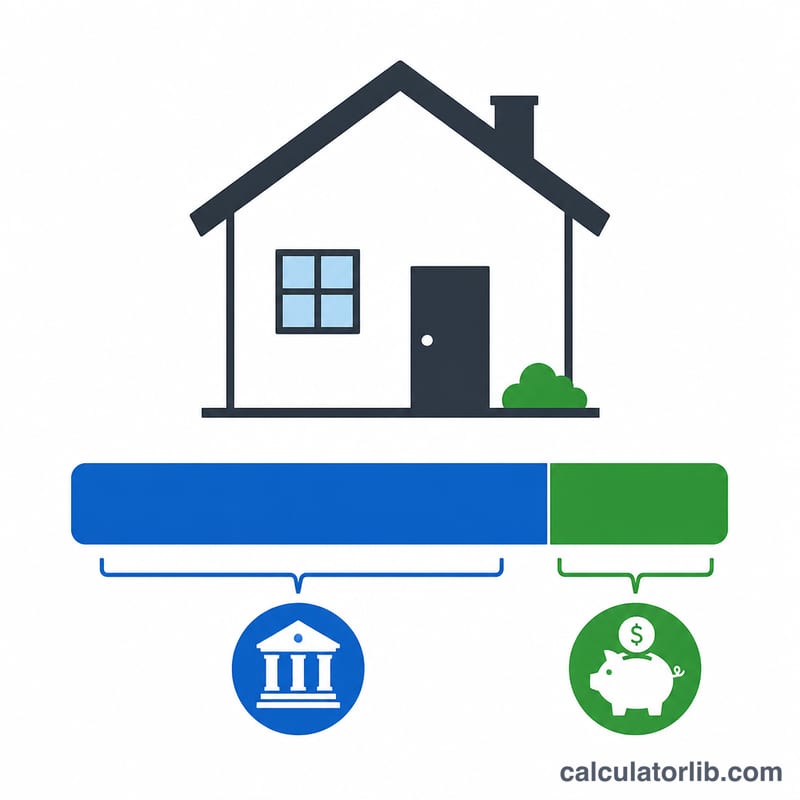
The loan-to-value (LTV) ratio is a financial measure that compares the size of a loan to the appraised value of the asset securing it — most commonly a home. Lenders use it to assess risk: a higher LTV means the borrower has less equity, which generally signals higher risk and may lead to higher interest rates or the need for private mortgage insurance (PMI).
How to Use This Calculator
Enter the total loan amount you are borrowing and the appraised value of the property. The calculator instantly returns your LTV ratio as a percentage, along with your home equity in dollars and as a percentage of the property value.
The Formula Explained
The ratio is calculated as $$\text{LTV} = \frac{\text{Loan Amount}}{\text{Appraised Property Value}} \times 100$$. The result tells you what share of the property's value is financed by debt. Your equity is simply the value minus the loan.

Worked Example
Suppose you borrow $240,000 to buy a home appraised at $300,000. The LTV is $$\frac{240{,}000}{300{,}000} \times 100 = 80\%$$ Your equity is \(\$300{,}000 - \$240{,}000 = \$60{,}000\), or 20% of the value. An 80% LTV is a common threshold — at or below it, many lenders waive PMI.
FAQ
What is a good LTV ratio? An LTV of 80% or lower is generally favorable and often avoids the need for mortgage insurance.
Why do lenders care about LTV? A lower LTV means more borrower equity and less risk to the lender if the property must be sold to recover the loan.
Does a high LTV affect my rate? Yes. Higher LTV loans often carry higher interest rates and may require PMI, increasing your monthly cost.