What is the Multiply Three Numbers Calculator?
This calculator multiplies three numbers together and returns their product. It works with whole numbers, decimals, and negative values, making it handy for quick arithmetic, scaling factors, volume estimates (length × width × height), or any situation where three quantities need to be combined by multiplication.
How to use it
Enter your three values in the fields labelled a, b and c, then submit. The calculator returns the product instantly and also echoes your three inputs so you can confirm the calculation. You can use decimals (e.g. 2.5) and negative numbers (e.g. -4).
The formula explained
The math is simple multiplication:
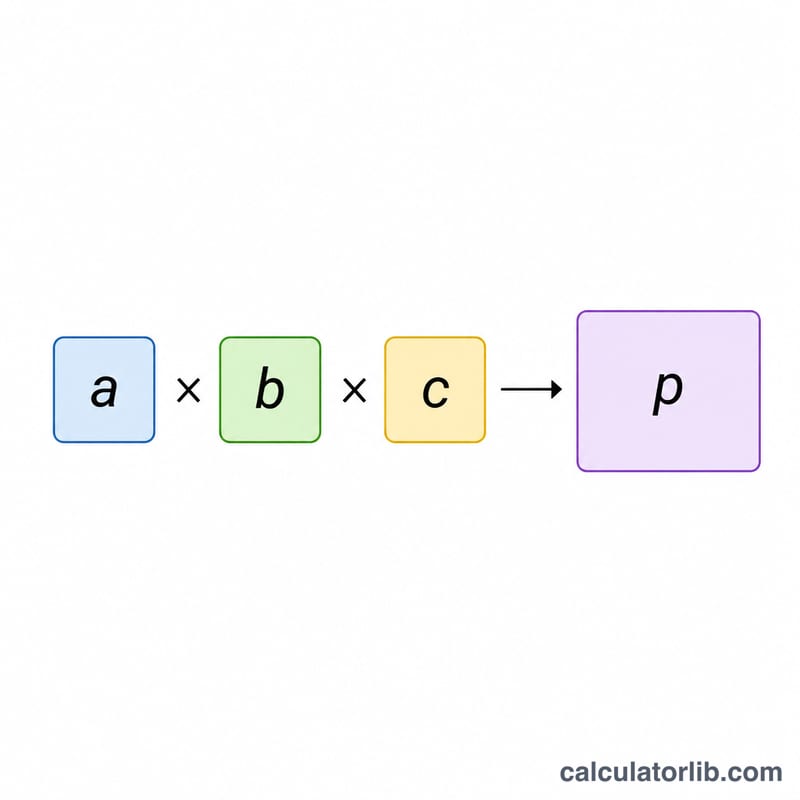
$$p = a \times b \times c$$Multiplication is commutative and associative, so the order of the numbers does not change the result — \((a \times b) \times c\) equals \(a \times (b \times c)\). If any one of the three numbers is zero, the product is always zero. An odd number of negative inputs makes the product negative; an even number makes it positive.
Worked example
Suppose \(a = 2\), \(b = 3\) and \(c = 4\). Then
$$p = 2 \times 3 \times 4 = 24$$As another example, the volume of a box that is 5 cm long, 4 cm wide and 2 cm tall is
$$5 \times 4 \times 2 = 40 \text{ cubic centimetres}$$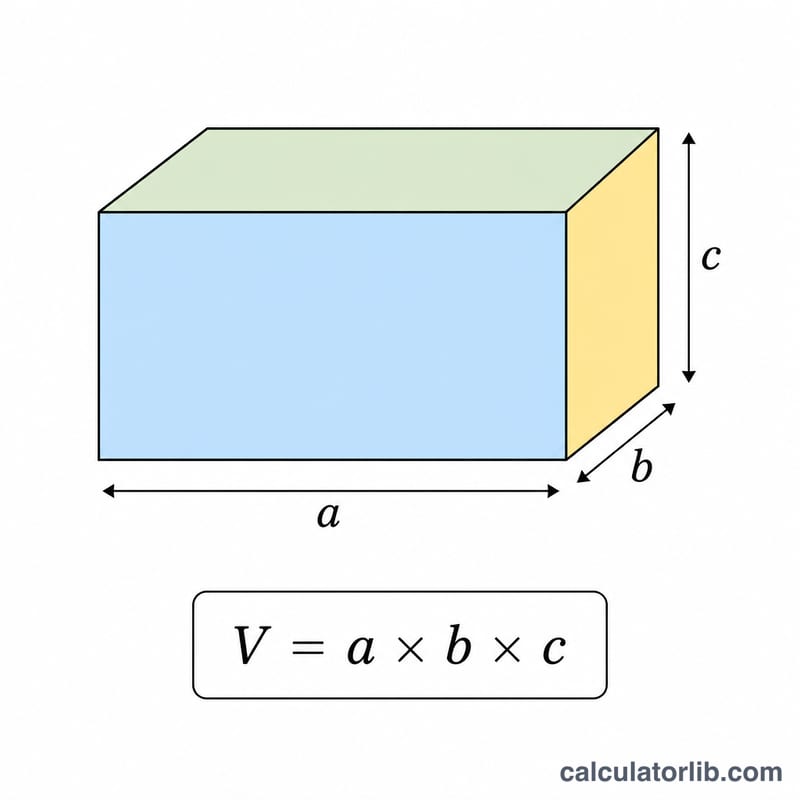
Product Across Different Input Scenarios
The table shows how the sign and size of the three factors affect the product \(a \times b \times c\).
| a | b | c | Product | Note |
|---|---|---|---|---|
| 2 | 3 | 4 | 24 | All positive, so the product is positive. |
| -2 | 3 | 4 | -24 | One negative factor gives a negative product. |
| -2 | -3 | 4 | 24 | Two negatives cancel, so the product is positive. |
| -2 | -3 | -4 | -24 | Three negatives (an odd count) give a negative product. |
| 5 | 0 | 7 | 0 | Any zero factor makes the product zero. |
| 2.5 | 4 | 0.2 | 2 | Decimals work the same way: 2.5 × 4 = 10, then 10 × 0.2 = 2. |
| 0.5 | 0.5 | 0.5 | 0.125 | Factors between 0 and 1 shrink the result. |
How to Multiply Three Numbers by Hand
- Determine the sign. Count the negative factors. An even count (0 or 2) gives a positive product; an odd count (1 or 3) gives a negative product.
- Multiply the first two numbers. Use their absolute values (ignore the signs for now). For example, with 1.5, -4 and 2: \(1.5 \times 4 = 6\).
- Multiply by the third number. Continue with the absolute value of the third factor: \(6 \times 2 = 12\).
- Handle decimals. Drop the decimal points and multiply as whole numbers, then count the decimal places in all three factors together and place the decimal point that many places from the right. For 2.5 × 4 × 0.2: \(25 \times 4 \times 2 = 200\). The factors have \(1 + 0 + 1 = 2\) decimal places in total, so the result is 2.00 = 2.
- Apply the sign and check. In the first example there is one negative, so the product is -12. To check, regroup the factors, for example \(-4 \times 2 = -8\), then \(-8 \times 1.5 = -12\). The commutative and associative properties guarantee the same answer in any order or grouping.
FAQ
Can I multiply more than three numbers? This tool is dedicated to exactly three numbers. To multiply more, take this product and multiply it by the next number.
Does it handle negative numbers? Yes. The sign follows the usual rules — two negatives multiply to a positive, three negatives give a negative.
What happens if I enter zero? If any input is zero, the product is zero, because anything multiplied by zero equals zero.