What Is the Price per Ounce Calculator?
The Price per Ounce Calculator works out the unit cost of a product based on its total price and total weight in ounces. Unit pricing is the single best way to compare products that come in different package sizes — a bigger box isn't always the better deal. By reducing every option to a cost per ounce, you can spot the true value at a glance.
How to Use It
Enter the total price you pay for the item and the total number of ounces it contains. The calculator instantly divides the price by the weight to give you the price per ounce, and also shows the equivalent price per pound (16 ounces) for convenience.
The Formula Explained
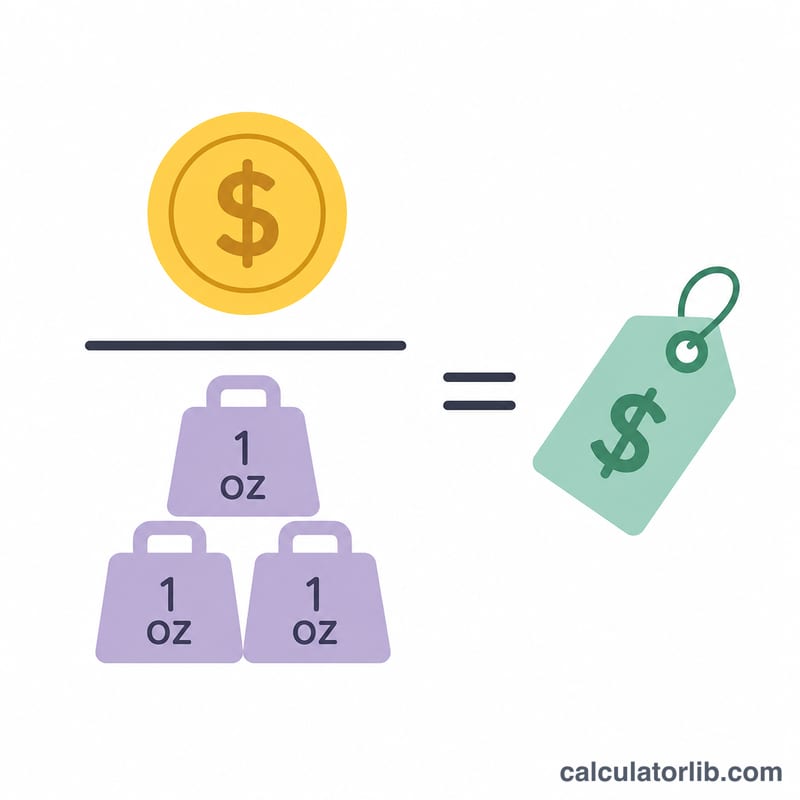
The math is simple division: $$\text{Price per Ounce} = \frac{\text{Total Price (\$)}}{\text{Total Ounces (oz)}}$$ For example, if a bag of coffee costs $12.99 and contains 32 ounces, the price per ounce is \(12.99 \div 32 = \$0.4059\). To get price per pound, multiply by 16: \(0.4059 \times 16 = \$6.49\).
Worked Example
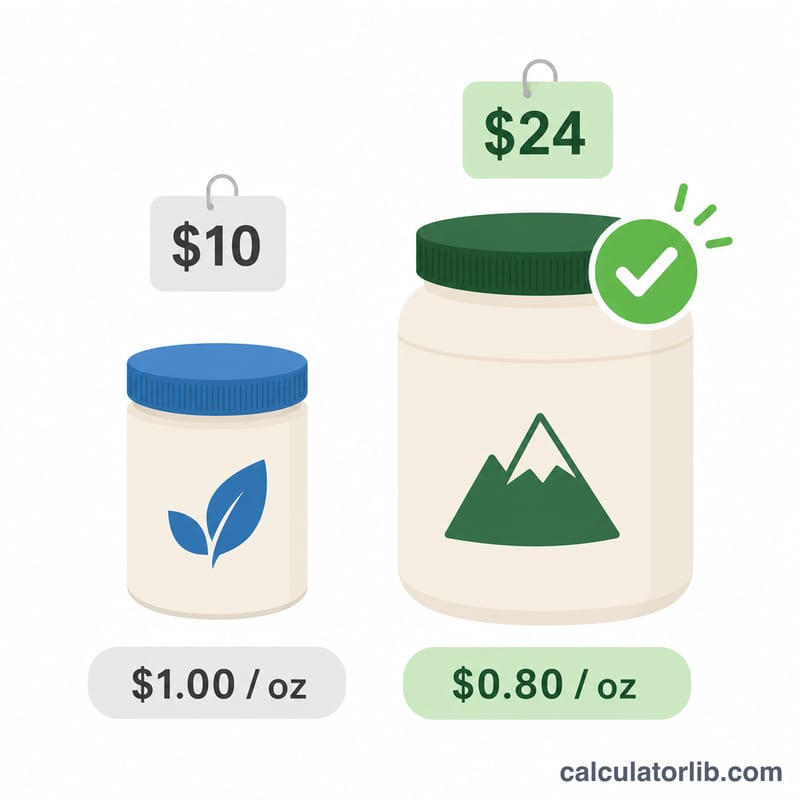
Suppose two cereal boxes: Box A is $5.99 for 16 oz, Box B is $8.49 for 24 oz. Box A \(= 5.99 \div 16 = \$0.374/\text{oz}\). Box B \(= 8.49 \div 24 = \$0.354/\text{oz}\). Box B is the better value despite the higher sticker price.
Ounce Conversion Table for Unit Pricing
Unit prices are only comparable when every product is expressed in the same unit. These standard factors help you convert package sizes to ounces before dividing the price by the quantity. Pint, quart, gallon and fluid-ounce values are US customary units; the UK imperial system uses different volumes for these.
| From | To | Factor |
|---|---|---|
| 1 pound (lb) | ounces (oz) | 16 oz |
| 1 gram (g) | ounces (oz) | 0.035274 oz |
| 100 grams | ounces (oz) | 3.5274 oz |
| 1 kilogram (kg) | ounces (oz) | 35.274 oz |
| 1 ounce (oz) | grams (g) | 28.3495 g |
| 1 US fluid ounce (fl oz) | milliliters (mL) | 29.5735 mL |
| 1 US pint | US fluid ounces | 16 fl oz |
| 1 US quart | US fluid ounces | 32 fl oz |
| 1 US gallon | US fluid ounces | 128 fl oz |
| 1 liter (L) | US fluid ounces | 33.814 fl oz |
Note: Weight ounces (oz) measure mass, while fluid ounces (fl oz) measure volume. They are different units and should not be mixed or treated as interchangeable. A fluid ounce of honey, for example, weighs more than a fluid ounce of water. Compare weight-priced items with other weight-priced items, and volume-priced items with other volume-priced items.
Example of the formula: a 24 oz package costing $4.80 gives \(\frac{\$4.80}{24\ \text{oz}} = \$0.20\) per ounce.
Interpreting Your Price per Ounce Result
The price per ounce shows how much you pay for each ounce of a product. A lower figure means a lower cost per unit of weight, but that comparison is only meaningful between the same kind of product. A cheaper price per ounce does not by itself mean better value if the products differ in what they actually contain or how you will use them.
Caveats to check
- Net vs. gross weight: Use the net weight (the contents), not the gross weight that includes packaging or, for canned goods, the liquid you may drain off. Some labels also show drained weight separately.
- Quality or concentration: A concentrated product (such as laundry detergent or juice concentrate) may require less per use, so a higher price per ounce can still cost less per serving or per use.
- Water content: Products with more water, such as fresh produce, broths or products packed in liquid, give less edible or usable material per ounce than dried or dense versions.
- Serving size: Compare cost per serving when servings differ in size or when products are used differently. Ounces alone may not reflect what you actually consume.
- Waste and spoilage: A larger bulk package has a lower price per ounce only if you use it all. Food that spoils or goes unused raises the effective price per ounce actually consumed.
Check the units on shelf labels
Store shelf labels may show unit prices per ounce, per pound, per 100 g, per liter or per count, and the unit can differ between two products on the same shelf. Make sure the units match before comparing; convert using the table above if needed (for example, 1 lb = 16 oz, so $3.20 per lb equals $0.20 per oz).
This is general information about reading unit prices, not personal financial advice.
FAQ
Why use price per ounce instead of total price? Because packages come in different sizes. Unit price lets you compare apples to apples regardless of quantity.
How do I convert price per ounce to price per pound? Multiply by 16, since one pound equals 16 ounces.
Does this work for fluid ounces too? Yes — as long as your "total ounces" measures the quantity consistently, the calculation gives a valid per-unit price for liquids as well.