
What is the SCS Curve Number Method?
The SCS Curve Number (CN) method, developed by the USDA Natural Resources Conservation Service (formerly the Soil Conservation Service), is the most widely used technique in hydrology for estimating direct surface runoff from a rainfall event. It condenses the combined effects of soil type, land use, land cover and antecedent moisture into a single dimensionless number between roughly 30 and 100. This calculator uses US customary units (inches).
How to Use This Calculator
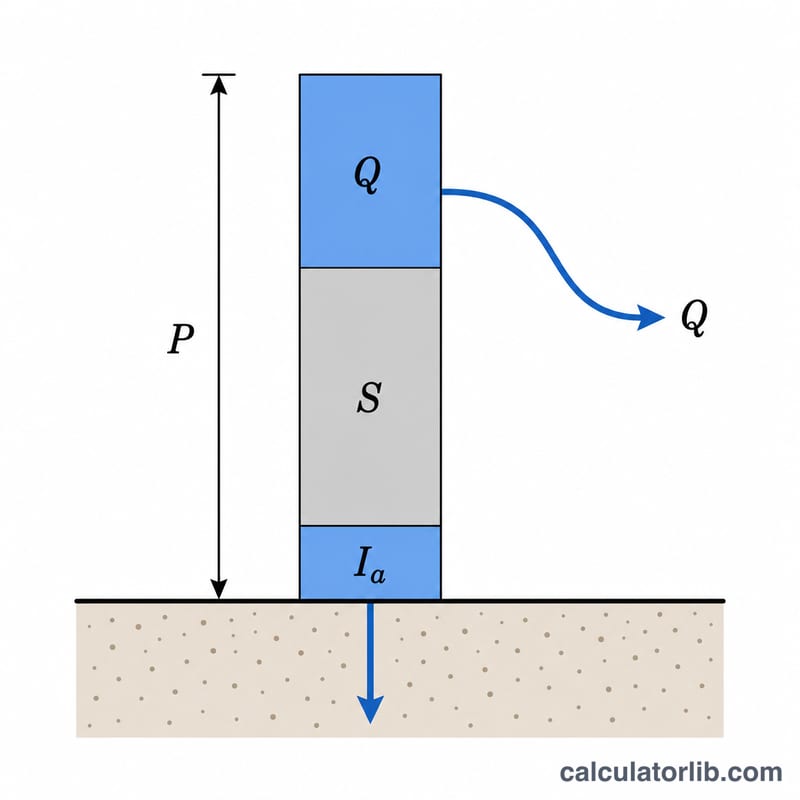
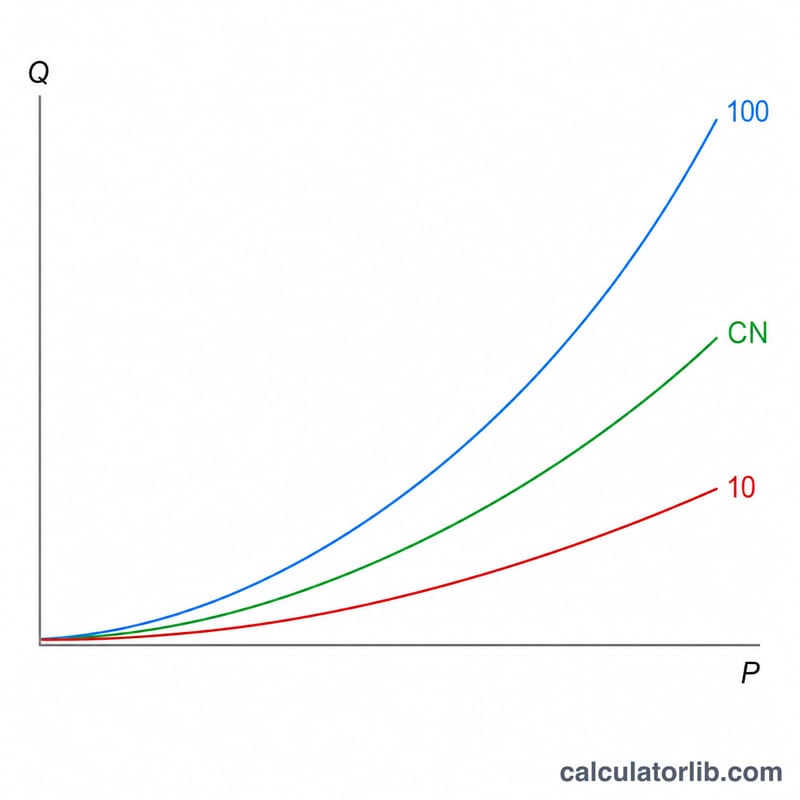
Enter the total rainfall depth P for the storm event (in inches) and the curve number CN for your watershed. Lower CN values (forest, sandy soil) produce less runoff; higher CN values (pavement, clay) produce more. The tool returns the direct runoff depth Q, the potential maximum retention S, the initial abstraction Ia, and the volume retained or infiltrated.
The Formula Explained
First compute the potential maximum retention after runoff begins: $$S = \frac{1000}{\text{CN}} - 10$$ The initial abstraction (interception, depression storage and infiltration before runoff) is assumed to be \(I_a = 0.2\,S\). Runoff is then $$Q = \frac{\left(\text{P} - 0.2\,S\right)^{2}}{\text{P} + 0.8\,S}$$ If \(\text{P} \le 0.2\,S\), no runoff occurs and \(Q = 0\).
Worked Example
For \(\text{P} = 3\) in and \(\text{CN} = 75\): \(S = \frac{1000}{75} - 10 = 3.333\) in, so \(0.2\,S = 0.667\) in. Since \(3 > 0.667\), $$Q = \frac{\left(3 - 0.667\right)^{2}}{3 + 0.8 \times 3.333} = \frac{\left(2.333\right)^{2}}{5.667} = \frac{5.444}{5.667} \approx 0.961 \text{ inches of runoff.}$$
FAQ
What if the rainfall is light? When P does not exceed the initial abstraction (0.2S), the model predicts zero runoff because all rainfall is intercepted or infiltrated.
What units does it use? This implementation uses inches, the standard for the SCS-CN method in the US. Multiply Q by the catchment area to obtain runoff volume.
How do I pick a curve number? CN tables published by the NRCS list values by hydrologic soil group and land cover for average (AMC II) moisture conditions.