What Is the Rectangular Tablecloth Size Calculator?
This tool tells you exactly what size rectangular tablecloth to buy or sew for your table. Just enter your table's length, width, and how far you want the cloth to hang over each edge (the "drop"), and it returns the finished cloth dimensions in inches. It works for any rectangular table — dining tables, banquet tables, folding tables, and craft tables.
How to Use It
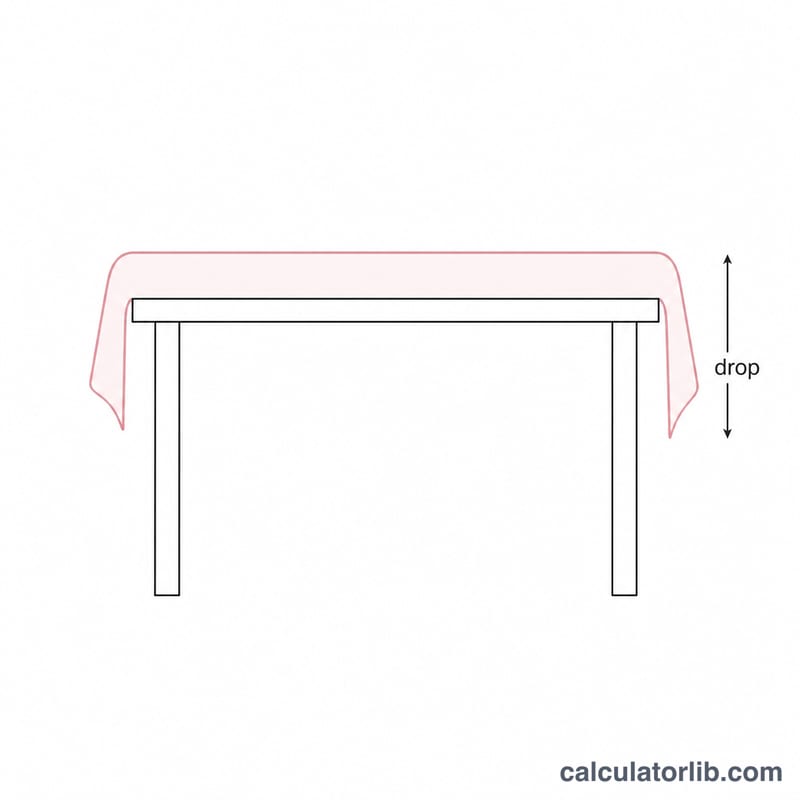
Measure the tabletop length and width in inches. Decide on a drop: a casual drop is 6–8 inches, a more formal look is 10–12 inches, and a floor-length drop for events is typically 28–30 inches (measure from tabletop to floor). Enter all three values and read off the recommended cloth length and width.
The Formula Explained
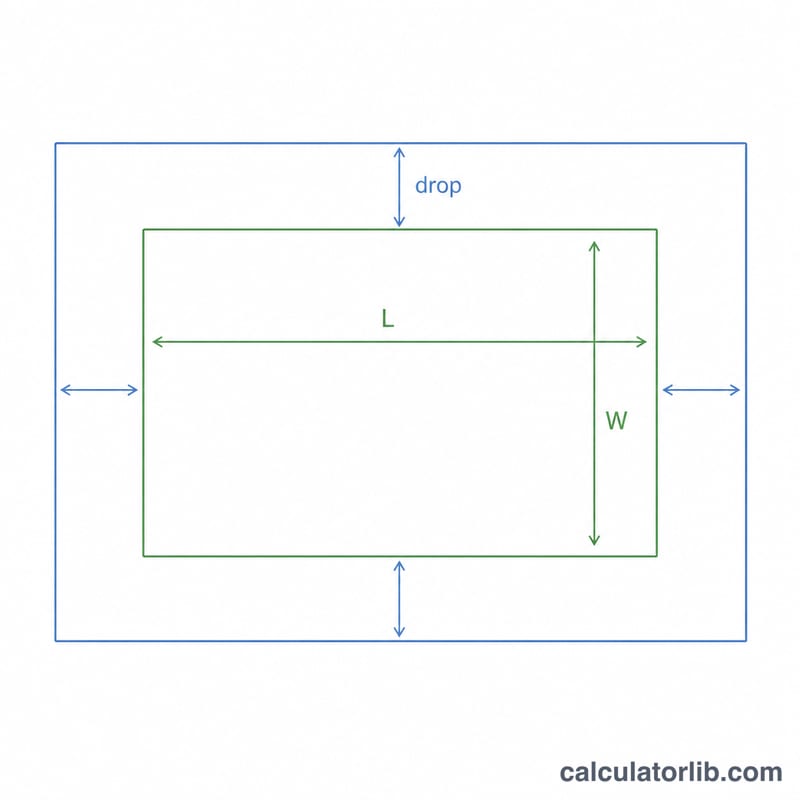
Because a tablecloth hangs over both ends and both sides, you add the drop twice to each dimension:
$$\text{Cloth Length} = \text{Table Length} + 2 \times \text{Drop}$$$$\text{Cloth Width} = \text{Table Width} + 2 \times \text{Drop}$$The factor of two accounts for the overhang on opposite edges.
Worked Example
Suppose you have a 72 × 42 inch dining table and want an 8-inch drop. Length \(= 72 + 2 \times 8 = 88\) inches. Width \(= 42 + 2 \times 8 = 58\) inches. So you need an 88 × 58 inch tablecloth.
Standard Tablecloth Sizes by Table Size
Rectangular tablecloths are sold in a handful of common sizes, in inches (width × length). The table size a cloth fits follows from the same relationship the calculator uses: \(\text{Table dimension} = \text{Cloth dimension} - 2 \times \text{Drop}\). The table sizes below are worked out from that formula.
| Cloth size (in) | Table it fits at 6" drop | Table it fits at 10" drop | Table it fits at 15" drop | Typical use |
|---|---|---|---|---|
| 52 × 70 | 40 × 58 | 32 × 50 | 22 × 40 | Small 4-6 seat tables |
| 60 × 84 | 48 × 72 | 40 × 64 | 30 × 54 | 6-8 seat tables |
| 60 × 102 | 48 × 90 | 40 × 82 | 30 × 72 | 8-10 seat tables; 6 ft banquet table (30 × 72) with a 15" drop |
| 60 × 120 | 48 × 108 | 40 × 100 | 30 × 90 | 8 ft banquet table (30 × 96): 15" side drop, 12" end drop |
| 70 × 144 | 58 × 132 | 50 × 124 | 40 × 114 | Large 8-10+ seat tables; 8 ft banquet table for a near floor-length look |
Banquet tables: a 6 ft banquet table is usually about 30 × 72 in and an 8 ft banquet table about 30 × 96 in, though some are 24 or 36 in wide. Banquet tables are about 30 in high, so a drop of 15 in or more gives a long, formal look, and a drop near 30 in reaches the floor.
Sizes vary by brand. Some makers label sizes slightly differently (for example 60 × 84 vs. 60 × 80), and sizes are nominal. Check the actual dimensions on the product page and compare them with your table before buying.
Practical Buying Tips
- Round up to the next standard size. Calculate the exact cloth size, then choose the next size up. For example, a 72 × 40 in table with a 10 in drop needs \(72 + 2 \times 10 = \)92 in of cloth length and \(40 + 2 \times 10 = 60\) in of width. A 60 × 92 cloth is rarely sold, so a 60 × 102 cloth is the practical choice. The result is a slightly longer end drop, about 15 in instead of 10 in.
- Allow for shrinkage. Untreated cotton can shrink roughly 3-5% in the first washes, depending on the fabric and wash temperature. A 102 in length could end up near 97-99 in. Buy a bit larger than your minimum, or choose pre-washed, polyester or cotton-blend cloths, which shrink much less. Check the care label.
- Measure with leaves in place. If your table has extension leaves, measure it in the configuration you will use. Measure at the widest and longest points of the tabletop, including any overhanging edges, not the base or frame.
- Consider shape and corners. Tables with rounded or oval corners, or with a pedestal base, hang differently from square-cornered tables. Rounded-corner cloths drape smoothly on rounded tables, while square-cornered cloths on sharp-cornered tables leave pointed corners that hang lower. For an oblong or oval table, check that the cloth is labeled for that shape.
- Match the drop to the occasion. Everyday use works well with a drop of about 6-10 in. Formal dining usually uses 10-15 in. Banquets often use longer drops, up to floor-length. Make sure the drop is long enough to clear chairs, or short enough that chairs do not snag it.
These are general buying suggestions. Fabric, sizing and table dimensions vary, so check the product details for your own table.
FAQ
What drop should I choose? 6–8 inches for everyday use, 10–15 inches for dinner parties, and 28–30 inches (to the floor) for weddings and formal events.
How do I measure for a floor-length cloth? Measure vertically from the tabletop edge to the floor and use that as your drop value.
Should I add anything for hems? If you are sewing your own cloth, add 1–2 inches to each dimension for hem allowance before cutting.