
What It Calculates
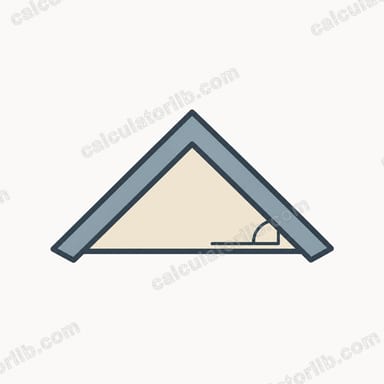
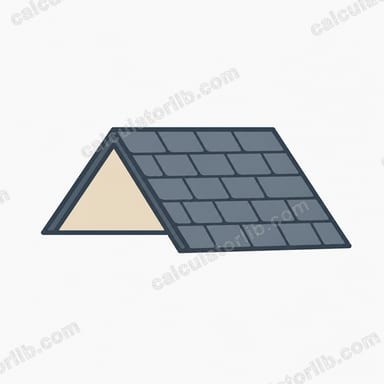
The Rectangular Roof Area Calculator finds the true sloped surface area of a simple rectangular (gable or shed) roof. Because a pitched roof rises above its footprint, its real surface is larger than the flat ground area it covers. This tool corrects the footprint area for the roof's slope so you can order the right amount of shingles, underlayment, or metal panels.
How to Use It
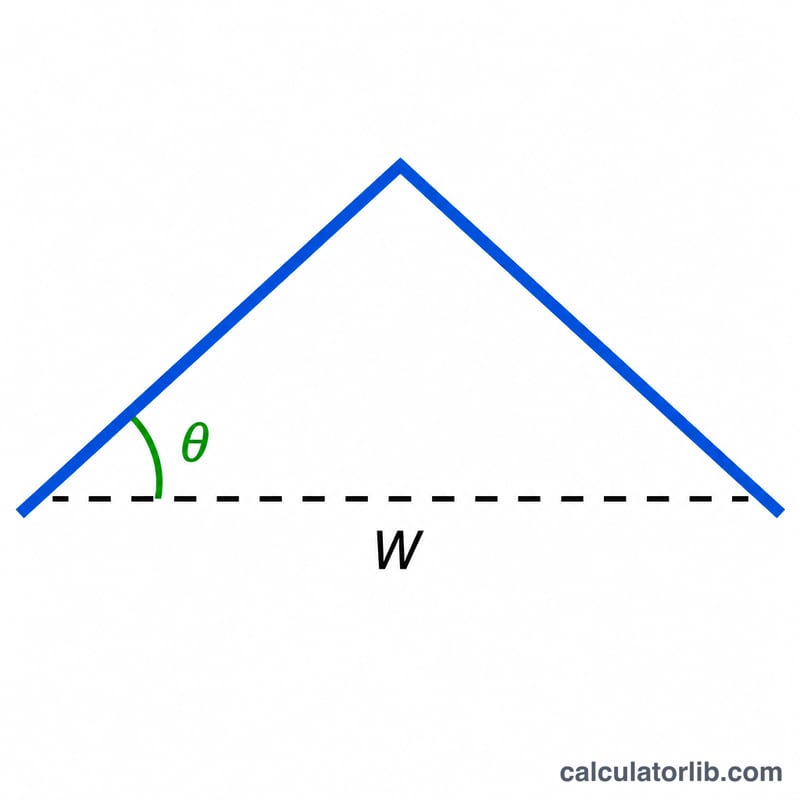
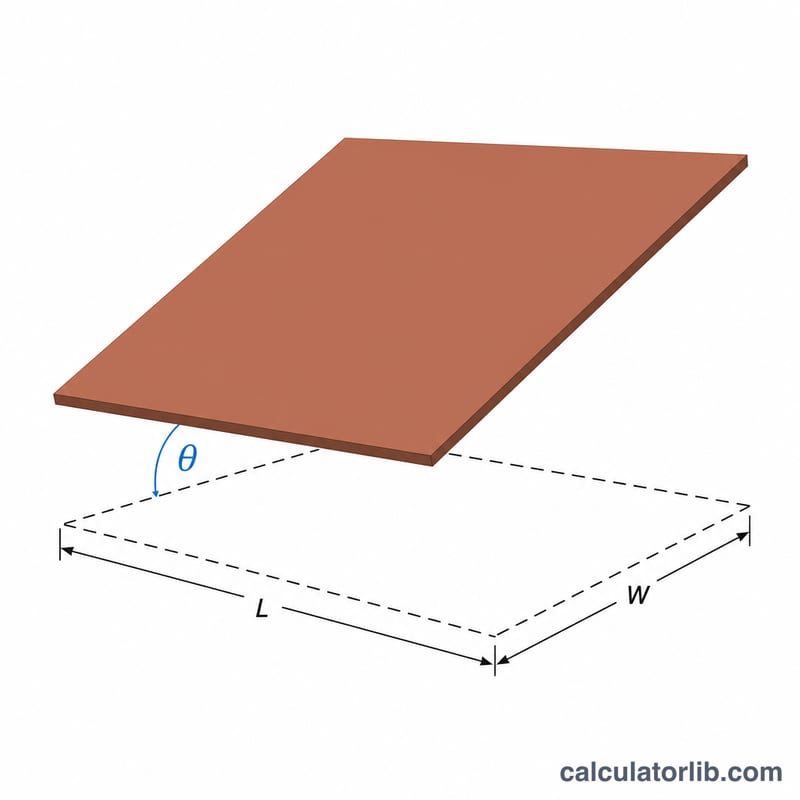
Enter the building footprint length and width (in feet) and the roof pitch angle in degrees. The calculator returns the sloped surface area in square feet, the flat footprint area for reference, and the equivalent number of roofing squares (1 square = 100 sq ft), which is how roofing materials are typically sold.
The Formula Explained
The area is computed as $$\text{A} = \frac{\text{L} \times \text{W}}{\cos\left(\theta\right)}$$ The footprint area \(L \times W\) represents the horizontal projection of the roof. Dividing by the cosine of the pitch angle \(\theta\) stretches that projection up the slope to give the actual covered surface. At 0° (flat) the roof equals the footprint; as the pitch steepens, \(\cos(\theta)\) shrinks and the area grows.
Worked Example
A house has a 40 ft × 30 ft footprint and a roof pitched at 30°. Footprint area = \(40 \times 30 = 1{,}200\) sq ft. \(\cos(30°) \approx 0.86603\), so $$A = \frac{1{,}200}{0.86603} \approx 1{,}385.64 \text{ sq ft}$$ — about 13.86 roofing squares. The slope adds roughly 15% more material than the flat footprint suggests.
FAQ
What if my pitch is given as a ratio like 6:12? Convert it to degrees first: \(\text{angle} = \arctan(\text{rise}/\text{run})\). A 6:12 pitch is \(\arctan(6/12) \approx 26.57°\).
Does this include overhangs? No — measure the full footprint including eave overhangs to capture the entire roof you intend to cover.
Why divide by cosine instead of multiply? The footprint is the horizontal shadow of the roof. The sloped length is \(\text{footprint}/\cos(\theta)\), so the area scales the same way.