
What is the AWG Wire Gauge Calculator?
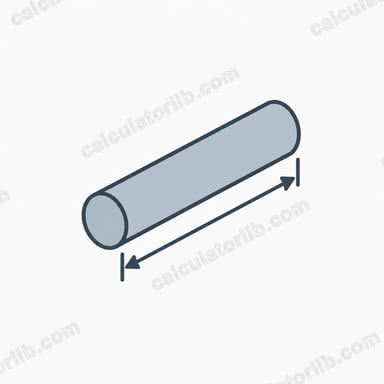
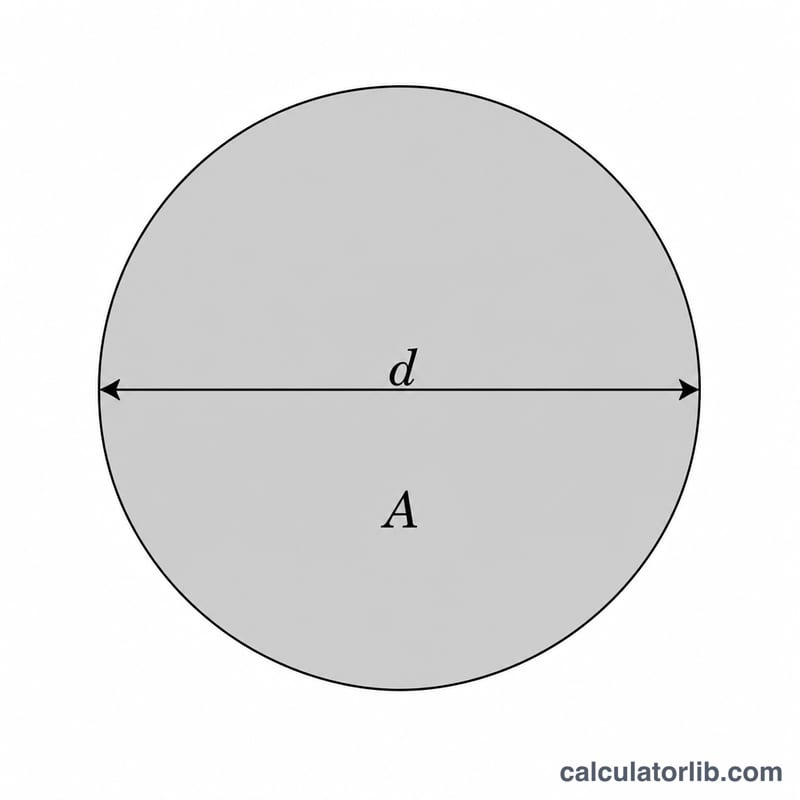
American Wire Gauge (AWG) is the standardized system used in North America to specify the diameter of round, solid, electrically conducting wire. This calculator converts an AWG number into the conductor's physical diameter (in millimeters and mils) and its cross-sectional area (in square millimeters and thousand circular mils, kcmil). It is a universal geometric conversion based on the official AWG definition.
How to use it
Enter the AWG gauge number. Smaller gauge numbers mean thicker wire — for example, 0000 (4/0) is entered as -3, 000 as -2, 00 as -1, and 0 as 0. The calculator instantly returns the diameter and the cross-sectional area, which are the values most relevant when estimating resistance and current-carrying capability.
The formula explained
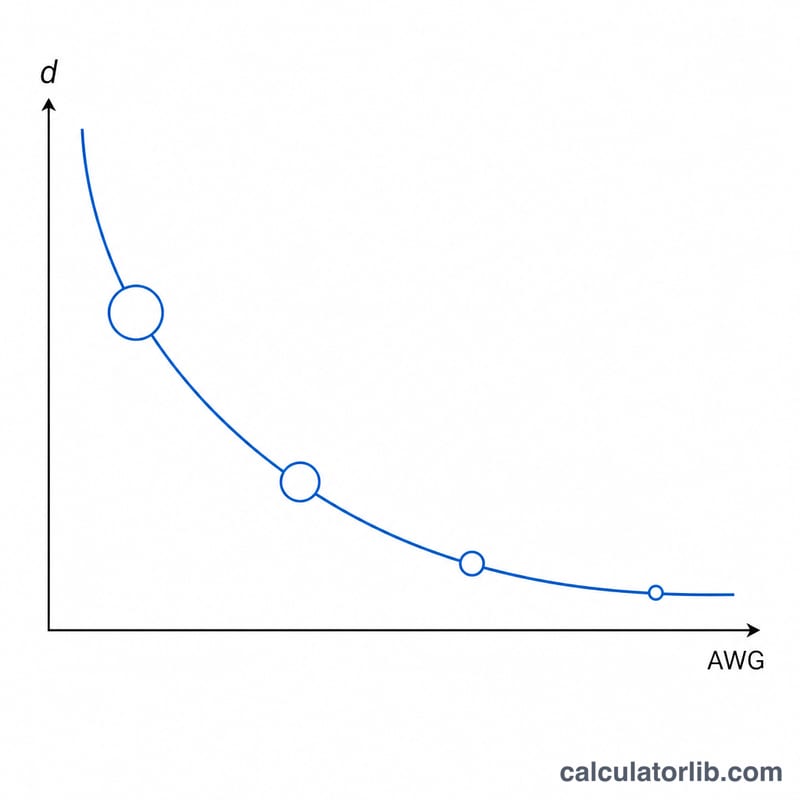
The AWG scale is geometric. Each 6-gauge decrease doubles the diameter, and each 3-gauge decrease doubles the cross-sectional area. The diameter in millimeters is given by $$d = 0.127 \times 92^{\frac{36 - \text{AWG}}{39}}\ \text{mm}$$ where 0.127 mm is the diameter of gauge 36. The area of the round conductor is then $$A = \frac{\pi}{4}\, d^{2}\ \text{mm}^{2}.$$ One square millimeter equals 0.5067075 mm² per circular-mil-thousand, so kcmil = area(mm²) ÷ 0.5067075.
Worked example
For AWG 12: $$d = 0.127 \times 92^{\frac{36 - 12}{39}} = 0.127 \times 92^{0.61538} \approx 2.05257\ \text{mm}.$$ Area $$A = \frac{\pi \times 2.05257^{2}}{4} \approx 3.3088\ \text{mm}^{2}.$$ That equals about 80.81 mils diameter and 6.53 kcmil — matching the standard published value for 12 AWG copper wire.
FAQ
Does this tell me the safe amperage? Ampacity depends on insulation, temperature, installation method and code (e.g. NEC). This tool gives the geometry (diameter/area) you need to look up or compute ampacity.
How do I enter 4/0 (0000)? Use -3. The pattern is 0=0, 00=-1, 000=-2, 0000=-3.
Is this for solid or stranded wire? The formula is for the equivalent solid conductor; stranded wire of the same AWG has nearly the same cross-section.