

What Is ARPU?
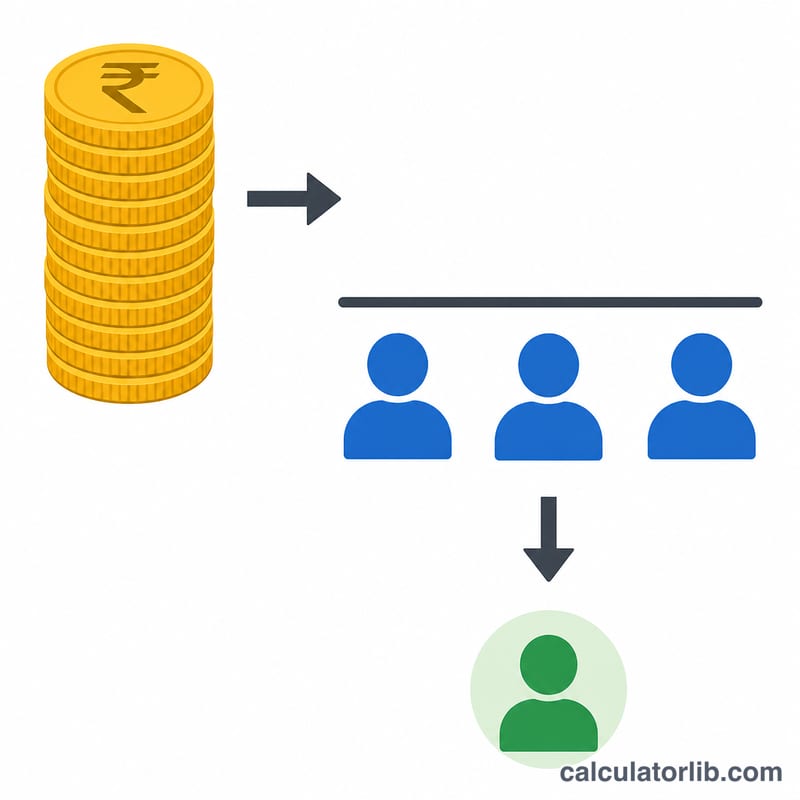
Average Revenue Per User (ARPU) measures how much revenue your business earns, on average, from each active user or customer over a given period. It is one of the most widely tracked metrics in SaaS, mobile apps, telecom, and subscription businesses because it directly reflects monetization efficiency and the value of your user base.
How to Use This Calculator
Enter your total revenue for the period (a month, quarter, or year) and the number of active users during that same period. The calculator divides revenue by users to give your ARPU. Be consistent: if revenue is monthly, count monthly active users to get monthly ARPU.
The Formula
The formula is simple:
$$\text{ARPU} = \frac{\text{Total Revenue}}{\text{Number of Active Users}}$$
The result is expressed in your revenue currency per user. Tracking ARPU over time shows whether upsells, pricing changes, and tier mixes are improving per-user monetization.
Worked Example
Suppose a SaaS company earns $50,000 in monthly revenue from 1,000 active subscribers. $$\text{ARPU} = \frac{50{,}000}{1{,}000} = \$50 \text{ per user}$$ If the next month revenue rises to $66,000 with 1,200 users, $$\text{ARPU} = \frac{66{,}000}{1{,}200} = \$55$$ — showing improved monetization even as the user count grew.
Key Terms & Definitions
- ARPU (Average Revenue Per User)
- Total revenue for a period divided by the number of active users in that period. A monetization metric expressed per user, usually monthly or annually.
- ARPPU (Average Revenue Per Paying User)
- Total revenue divided only by paying users, excluding free accounts. ARPPU is always equal to or higher than ARPU and isolates how much paying customers spend.
- MRR / ARR (Monthly / Annual Recurring Revenue)
- The predictable subscription revenue normalized to a month (MRR) or year (ARR). MRR is a common numerator for monthly ARPU; \(\text{ARR} = \text{MRR} \times 12\).
- Active User
- A user counted as engaged within the period — typically a monthly active user (MAU) or daily active user (DAU). The chosen definition forms the denominator of ARPU and must be consistent across periods.
- Paying User
- A user who generates revenue through a paid plan or purchase, as opposed to a free-tier user. The ratio of paying to active users drives the gap between ARPU and ARPPU.
- Churn Rate
- The percentage of customers (or revenue) lost over a period. It determines average customer lifespan and, combined with ARPU, the lifetime value of a customer.
- LTV (Lifetime Value)
- The total revenue or gross profit expected from a customer over their relationship. Often approximated as ARPU multiplied by average lifespan, where lifespan ≈ \(1 \div \text{churn rate}\).
- CAC (Customer Acquisition Cost)
- The total sales and marketing cost to acquire one customer. Compared with ARPU and LTV to judge whether acquisition is profitable and how quickly each user pays back its cost.
FAQ
What is the difference between ARPU and ARPPU? ARPU divides revenue by all active users, while ARPPU (Average Revenue Per Paying User) divides only by paying users, giving a higher figure when you have free users.
Is a higher ARPU always better? Generally yes, but it must be balanced against churn and acquisition cost. A high ARPU with high churn can still be unhealthy.
What period should I use? Match revenue and users to the same period. Monthly ARPU is most common for SaaS, while annual ARPU suits longer contracts.