
What Is the Ah to Wh Calculator?
Battery capacity is often rated in amp-hours (Ah), which tells you how much charge a battery can deliver but not how much energy it stores. Energy depends on both charge and voltage. This calculator converts amp-hours to watt-hours (Wh) — the true measure of stored energy — so you can compare batteries of different voltages on equal footing.
How to Use It
Enter the battery's capacity in amp-hours and its nominal voltage. For example, a typical lead-acid car battery is 12 V, a single lithium cell is about 3.7 V, and a 48 V e-bike pack uses 48 V. Click calculate to get the energy in watt-hours and kilowatt-hours.
The Formula Explained
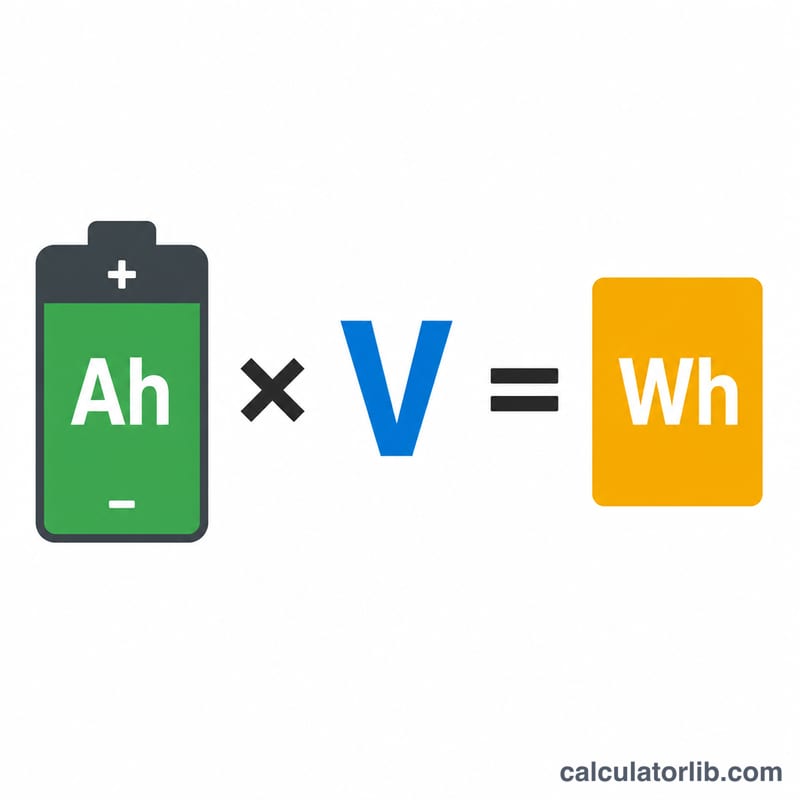
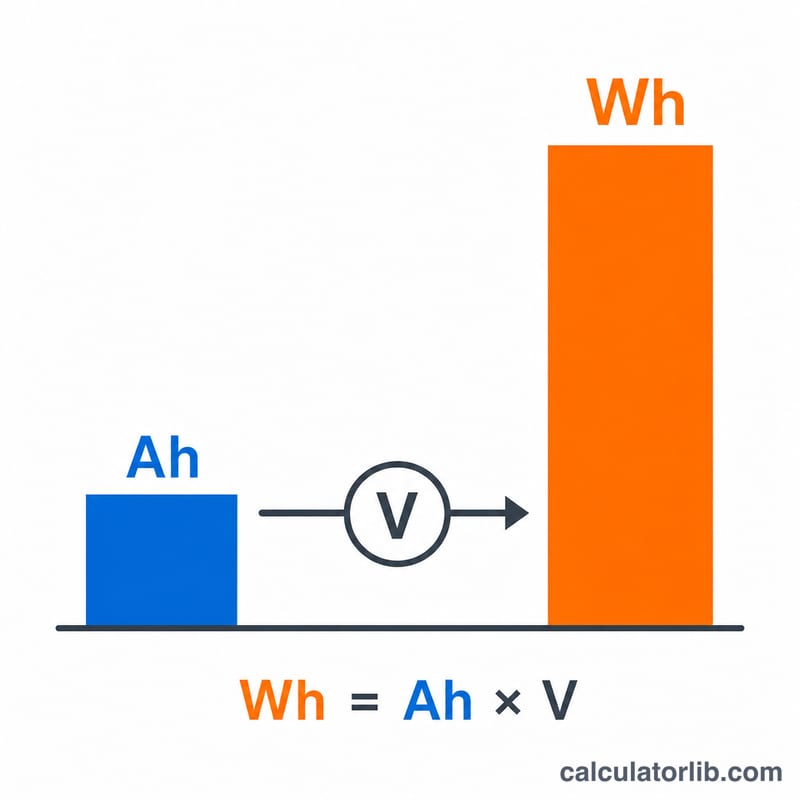
The conversion uses the simple relationship $$\text{Wh} = \text{Ah} \times \text{V}$$ Watt-hours equal the amp-hour rating multiplied by the voltage. To express the result in kilowatt-hours, divide by 1000: $$\text{kWh} = \text{Wh} \div 1000$$ This works because power (watts) is current (amps) times voltage (volts), and energy is power times time.
Worked Example
Suppose you have a 100 Ah battery at 12 V. Energy $$= 100 \times 12 = 1{,}200 \text{ Wh}$$ which is 1.2 kWh. That is enough to run a 100 W appliance for roughly 12 hours, ignoring losses.
Common Battery Voltages and Their Energy
The energy stored in a battery depends on both its charge capacity (in amp-hours) and its nominal voltage. The conversion is simply \(\text{Wh} = \text{Ah} \times \text{V}\). Because voltage varies widely between battery chemistries and configurations, the same amp-hour rating can represent very different amounts of usable energy.
The table below lists common battery types with their typical nominal voltages and a sample watt-hour value for the listed capacity. For example, a single 3.7 V lithium-ion cell rated at 3 Ah stores \(3 \times 3.7 = \) 11.1 Wh.
| Battery type | Nominal voltage | Sample capacity (Ah) | Energy (Wh) |
|---|---|---|---|
| Single Li-ion cell (18650/21700) | 3.7 V | 3 Ah | 11.1 Wh |
| Single LiFePO4 cell | 3.2 V | 100 Ah | 320 Wh |
| AA NiMH cell | 1.2 V | 2 Ah | 2.4 Wh |
| Car / lead-acid battery | 12 V | 50 Ah | 600 Wh |
| Deep-cycle / solar bank | 12 V | 100 Ah | 1200 Wh |
| 24 V battery bank | 24 V | 100 Ah | 2400 Wh |
| 36 V e-bike battery | 36 V | 10 Ah | 360 Wh |
| 48 V e-bike / golf cart | 48 V | 20 Ah | 960 Wh |
Note that nominal voltage is an average value; the actual terminal voltage rises when fully charged and falls as the battery discharges, so real-world energy delivered may differ slightly.
Ah to Wh Across Common Scenarios
To show how dramatically voltage affects stored energy, the table below holds capacity fixed at 100 Ah and varies the nominal voltage. Watt-hours scale directly with voltage, so a 48 V pack holds roughly 13 times the energy of a single 3.7 V cell at the same amp-hour rating.
| Capacity (Ah) | Voltage (V) | Energy (Wh) | Energy (kWh) |
|---|---|---|---|
| 100 Ah | 3.7 V | 370 Wh | 0.37 kWh |
| 100 Ah | 12 V | 1200 Wh | 1.2 kWh |
| 100 Ah | 24 V | 2400 Wh | 2.4 kWh |
| 100 Ah | 48 V | 4800 Wh | 4.8 kWh |
To get kilowatt-hours, divide watt-hours by 1000. For instance, the 48 V case gives \(4800 \div 1000 = 4.8\) kWh. If you instead know your target energy and need the capacity, the reverse Wh to Ah conversion divides watt-hours by voltage. A 4.8 kWh requirement at 48 V works out to 100 Ah.
Key Terms Explained
- Amp-hour (Ah)
- A measure of electric charge capacity equal to a current of one ampere flowing for one hour. It tells you how much current a battery can supply over time but, on its own, says nothing about energy unless voltage is known. Milliamp-hours (mAh) are simply thousandths of an amp-hour: 1000 mAh = 1 Ah.
- Watt-hour (Wh)
- A unit of energy equal to one watt of power delivered for one hour. For a battery it is found by multiplying capacity by voltage: \(\text{Wh} = \text{Ah} \times \text{V}\). Watt-hours allow fair comparison of batteries with different voltages.
- Kilowatt-hour (kWh)
- One thousand watt-hours (1 kWh = 1000 Wh). It is the standard unit used on electricity bills and for sizing solar systems and EV batteries.
- Nominal voltage
- The average or rated voltage of a battery during normal discharge, used for energy calculations. The actual voltage is higher when fully charged and lower when nearly empty. Typical nominal values are 3.7 V for Li-ion, 3.2 V for LiFePO4, and 2 V per lead-acid cell (12 V for a six-cell battery).
- Depth of discharge (DoD)
- The percentage of a battery's total capacity that has been used. A battery discharged to 80% DoD has 20% capacity remaining. Many battery types last longer when not fully discharged, so usable energy is often less than the rated Wh — for example, only \(80\%\) of a 1200 Wh battery, or 960 Wh, may be drawn at an 80% DoD limit.
FAQ
Why convert Ah to Wh? Two batteries with the same Ah but different voltages store different amounts of energy. Watt-hours let you compare them directly.
What voltage should I use? Use the battery's nominal voltage (e.g. 12 V, 24 V, 48 V, or 3.7 V per lithium cell).
Does this account for efficiency? No. It gives the theoretical stored energy. Usable energy is lower due to inverter losses and depth-of-discharge limits.