
What Is the Beer-Lambert Law?
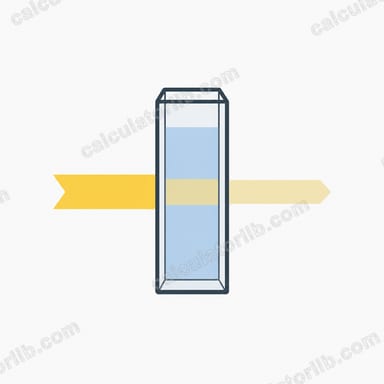
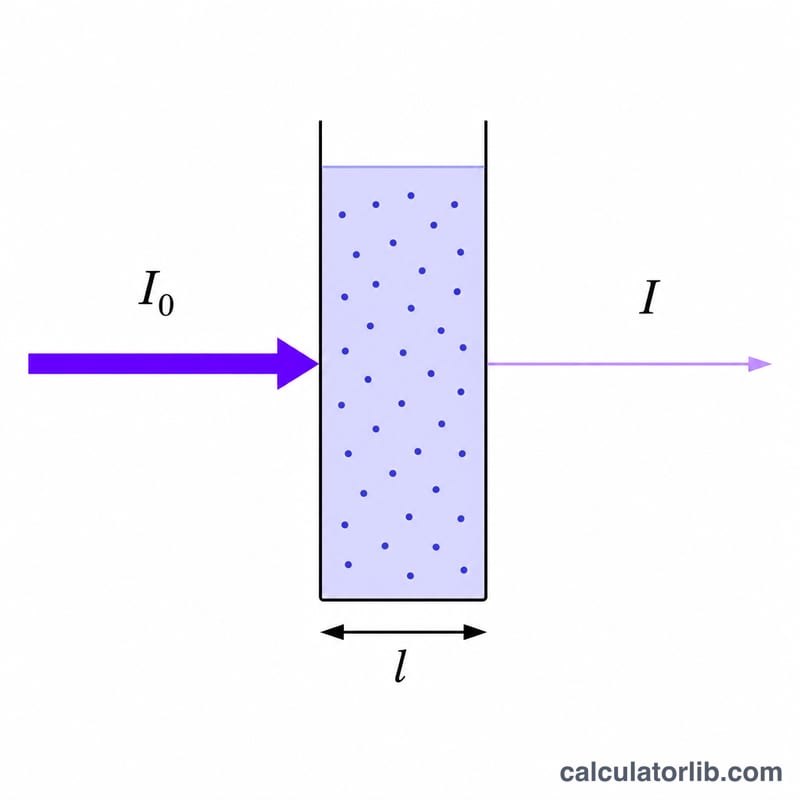
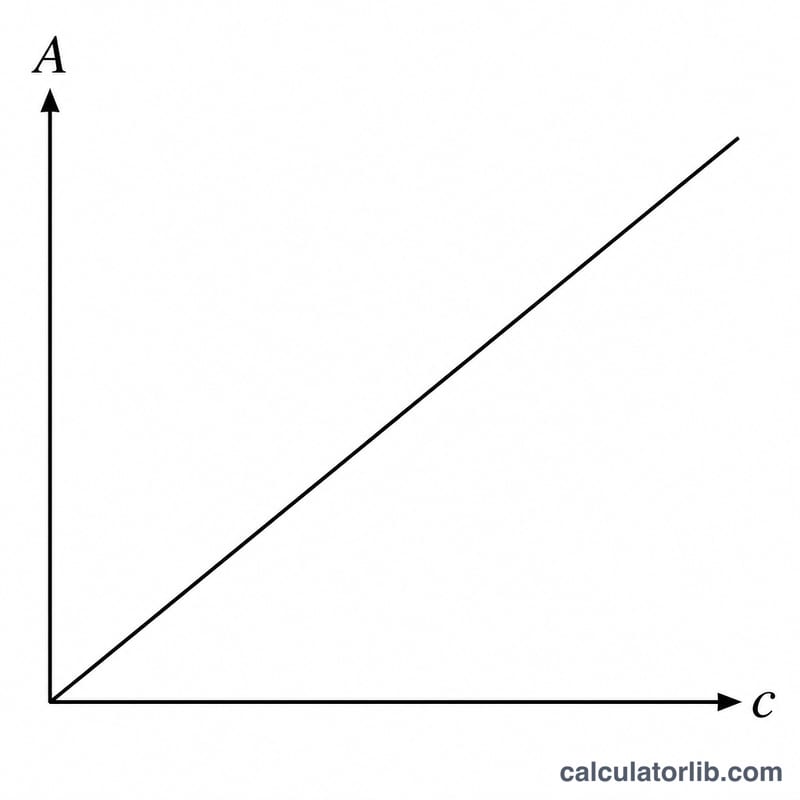
The Beer-Lambert law (also called Beer's law) relates the absorbance of light by a solution to the properties of that solution. It states that absorbance is directly proportional to the molar absorptivity of the absorbing species, the concentration of the solution, and the length of the optical path the light travels through the sample. This calculator solves $$A = \varepsilon \cdot c \cdot l$$ instantly and also reports the resulting transmittance.
How to Use This Calculator
Enter three values: the molar absorptivity \(\varepsilon\) (in L·mol⁻¹·cm⁻¹, a constant for a given substance at a given wavelength), the concentration \(c\) in mol/L, and the path length \(l\) in cm (typically 1 cm for a standard cuvette). The calculator multiplies them to give the unitless absorbance value (AU) and converts it to transmittance.
The Formula Explained
In the equation \(A = \varepsilon c l\), \(A\) is absorbance (dimensionless), \(\varepsilon\) is molar absorptivity (L·mol⁻¹·cm⁻¹), \(c\) is molar concentration (mol/L), and \(l\) is path length (cm). The units cancel to leave a pure number. Transmittance follows from \(T = 10^{-A}\), and percent transmittance is \(\%T = 100 \times 10^{-A}\). Higher absorbance means less light passes through the sample.
Worked Example
Suppose a dye has \(\varepsilon = 20{,}000\) L·mol⁻¹·cm⁻¹, a concentration of 0.0001 mol/L (\(1 \times 10^{-4}\) M), measured in a 1 cm cuvette. Then $$A = 20{,}000 \times 0.0001 \times 1 = 2.0$$ The transmittance is \(T = 10^{-2} = 0.01\), or 1% — meaning only 1% of the light passes through the sample.
Typical Molar Absorptivity Values
Molar absorptivity (also called the molar extinction coefficient, \(\varepsilon\)) is an intrinsic property of a substance at a given wavelength, expressed in L·mol⁻¹·cm⁻¹. Because \(\varepsilon\) varies strongly with wavelength, each value below is reported at the analytical (peak) wavelength where it is normally measured. Use the value for the exact buffer and wavelength of your own assay where possible, as \(\varepsilon\) can shift with solvent, pH and temperature.
| Species / dye | Wavelength (nm) | \(\varepsilon\) (L·mol⁻¹·cm⁻¹) |
|---|---|---|
| NADH (reduced) | 340 | 6,220 |
| NAD⁺ / NADH | 260 | ~18,000 |
| Potassium permanganate (KMnO₄) | 525 | ~2,400 |
| Methylene blue | 665 | ~95,000 |
| Chlorophyll a (in diethyl ether) | 662 | ~90,000 |
| Chlorophyll b (in diethyl ether) | 644 | ~56,000 |
| Bromophenol blue (basic form) | 590 | ~70,000 |
| Cytochrome c (reduced) | 550 | ~27,700 |
| FAD (oxidized) | 450 | ~11,300 |
| Double-stranded DNA (per nucleotide) | 260 | ~6,600 |
Values are representative literature figures and depend on solvent and conditions; verify against your own standards for quantitative work. For protein purity work, the related A260/A280 ratio uses these UV absorbances directly rather than \(\varepsilon\).
Interpreting Your Absorbance and Transmittance
Absorbance \(A\) and transmittance \(T\) describe the same measurement on different scales, related by \(A = -\log_{10}(T)\) where \(T\) is the fraction of light transmitted (\(\%T = 100 \times T\)). Absorbance is logarithmic, so each unit increase means ten times less light reaches the detector.
- A ≈ 0 — the sample is essentially transparent at this wavelength and transmits about 0 absorbance units (≈100 %T). Little or no analyte is detected.
- A = 1 — only 10 %T; 90% of the light is absorbed.
- A = 2 — only 1 %T; 99% of the light is absorbed. The detector now sees very little signal.
Most spectrophotometers give their most accurate, linear readings in the range of roughly A = 0.1 to 1.0. Below about 0.1 the signal is small relative to baseline noise; above about 1.0 stray light and detector limitations cause the Beer-Lambert relationship to deviate from linearity, so the apparent concentration reads low.
If your reading exceeds about 1.0, dilute the sample (for example 1:2 or 1:10), re-measure, and multiply the result by the dilution factor. This keeps the measurement within the linear region where \(A = \varepsilon c l\) holds reliably. You can plan such a dilution with a C1V1 = C2V2 solution dilution calculator.
Absorbance Across Different Inputs
The table below fixes molar absorptivity at \(\varepsilon = 10{,}000\) L·mol⁻¹·cm⁻¹ and varies concentration \(c\) and path length \(l\). Absorbance scales linearly with both, while transmittance follows \(\%T = 100 \times 10^{-A}\). Notice how a higher concentration or a longer cuvette pushes \(A\) above the reliable 0.1–1.0 window.
| \(\varepsilon\) (L·mol⁻¹·cm⁻¹) | \(c\) (M) | \(l\) (cm) | \(A = \varepsilon c l\) | %T |
|---|---|---|---|---|
| 10,000 | 1×10⁻⁵ | 1 | 0.10 | 79.4% |
| 10,000 | 5×10⁻⁵ | 1 | 0.50 | 31.6% |
| 10,000 | 1×10⁻⁴ | 1 | 1.00 | 10.0% |
| 10,000 | 1×10⁻⁴ | 0.5 | 0.50 | 31.6% |
| 10,000 | 1×10⁻⁴ | 2 | 2.00 | 1.0% |
The last two rows compare path lengths for the same solution: halving the cuvette to 0.5 cm halves \(A\) into the ideal range, while a 2 cm cell doubles it to 2.00 — outside the linear region, where dilution would be the better fix. To find the concentration that produced a measured absorbance, reverse the calculation with a concentration-from-absorbance (Beer-Lambert) calculator.
FAQ
What is a typical path length? Standard spectrophotometer cuvettes have a 1 cm path length, so the law often simplifies to \(A = \varepsilon c\).
Why does the law break down at high concentration? At high concentrations molecules interact, and stray light or instrument limitations cause deviations from linearity, so Beer's law is most accurate for dilute solutions (typically \(A < 1\)).
Can I find concentration instead? Yes — rearrange to \(c = A / (\varepsilon l)\). If you know absorbance and the constants, divide accordingly.