
What is the Bolt Circle Diameter Calculator?
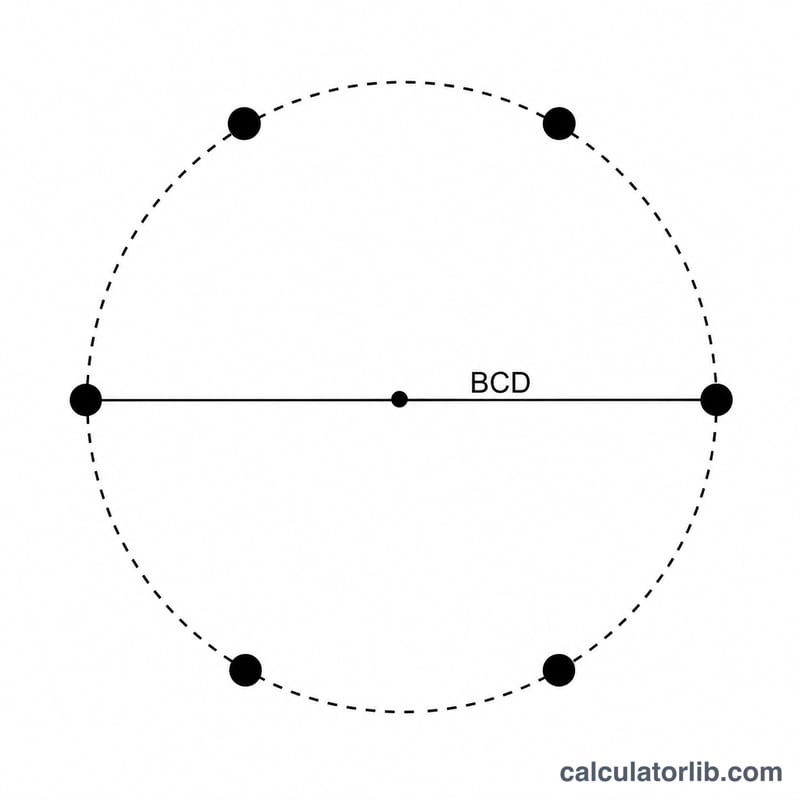
A bolt circle (or bolt-hole circle) is a set of evenly spaced holes arranged around the circumference of an imaginary circle. The bolt circle diameter (BCD) is the diameter of that circle, measured through the centers of opposing holes. This calculator converts between the BCD and the chord — the straight-line, center-to-center distance between two adjacent holes — for any number of evenly spaced holes. It is widely used in machining, flanges, wheel hubs, gears, and mechanical fastener layouts.
How to use it
Enter the bolt circle diameter in any unit (mm, inches, etc.) and the number of holes. The calculator returns the chord spacing in the same units, plus the bolt circle radius and the angular spacing between holes. To find the BCD from a known chord instead, divide the chord by \(\sin(180^{\circ}/n)\).
The formula explained
The n holes divide the full circle into n equal arcs, each subtending a central angle of \(360^{\circ}/n\). Two adjacent holes and the circle center form an isosceles triangle whose two equal sides are the radius (\(\text{BCD}/2\)). The chord opposite the central angle equals
$$\text{Chord} = 2 \cdot R \cdot \sin\!\left(\tfrac{\text{central angle}}{2}\right) = \text{BCD} \times \sin\!\left(\frac{180^{\circ}}{n}\right) = \text{BCD} \times \sin\!\left(\frac{\pi}{n}\right)$$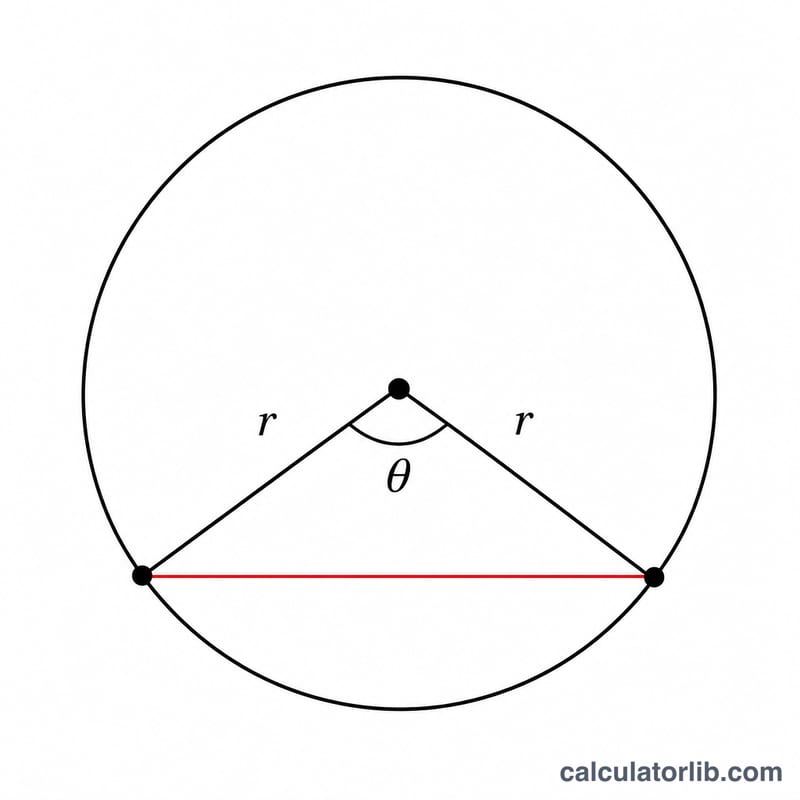
Worked example
Suppose the bolt circle diameter is 100 mm with 4 holes. The angle per hole is \(360^{\circ}/4 = 90^{\circ}\), and \(\pi/n = \pi/4\). The chord =
$$100 \times \sin(45^{\circ}) = 100 \times 0.70711 \approx 70.711 \text{ mm}$$So adjacent holes are about 70.7 mm apart, center to center.
Common Standard Bolt Patterns
Bolt patterns are usually written as n × BCD, where \(n\) is the number of holes and the BCD is given in millimeters. The adjacent-hole chord spacing below is computed with \(\text{Spacing} = \text{BCD}\times\sin(180^{\circ}/n)\) and rounded to 0.1 mm.
| Pattern | Holes \(n\) | BCD (mm) | Adjacent-hole spacing (mm) |
|---|---|---|---|
| 4 × 100 (automotive) | 4 | 100.0 | 70.7 |
| 4 × 114.3 | 4 | 114.3 | 80.8 |
| 5 × 100 | 5 | 100.0 | 58.8 |
| 5 × 114.3 (5 × 4.5") | 5 | 114.3 | 67.2 |
| 5 × 120 | 5 | 120.0 | 70.5 |
| 6 × 139.7 (6 × 5.5") | 6 | 139.7 | 69.9 |
| 8 × 165.1 (8 × 6.5") | 8 | 165.1 | 63.2 |
These spacings are the straight chord between hole centers, which is what you measure with calipers when laying out or checking a pattern. For 4- and 6-hole patterns you can also verify directly: opposite holes lie a full BCD apart, and on a 6-hole pattern the spacing exactly equals the radius (half the BCD).
FAQ
Is the chord the same as arc length? No. The chord is the straight-line distance between hole centers; the arc length follows the curve and is slightly longer (\(\pi \cdot \text{BCD}/n\)).
What units should I use? Any consistent unit. The chord comes out in whatever unit you entered the BCD in.
Can I find the BCD from the spacing? Yes — use \(\text{BCD} = \text{chord} \div \sin(\pi/n)\) with the same hole count.