
What is the Cake Serving Calculator?
The Cake Serving Calculator estimates how many slices you can cut from a round cake based on its diameter and the size of each serving. Whether you are planning a birthday party, a wedding, or a casual get-together, knowing your serving count helps you choose the right cake size and avoid running short — or over-baking.
How to use it
Enter the diameter of your round cake in inches, then pick a slice size. Party slices are generous (about 8 square inches of cake top per piece), standard slices are around 6 square inches, and small wedding-style slices are about 4 square inches. The calculator returns the number of whole servings, rounding down so every guest gets a full slice.
The formula explained
A round cake's top is a circle, so its area is \(A = \pi \times (d/2)^2\), where d is the diameter. Dividing that area by the area allotted to one slice gives the number of servings: \(\text{servings} = A \div \text{serving\_area}\). We floor the result to a whole number because partial slices are not full servings. This area-based method scales naturally with cake size and is the same logic professional bakers use for tiered cakes.
$$\text{Servings} = \left\lfloor \frac{\pi \left(\frac{\text{Diameter (in)}}{2}\right)^2}{\text{Slice Size (sq in)}} \right\rfloor$$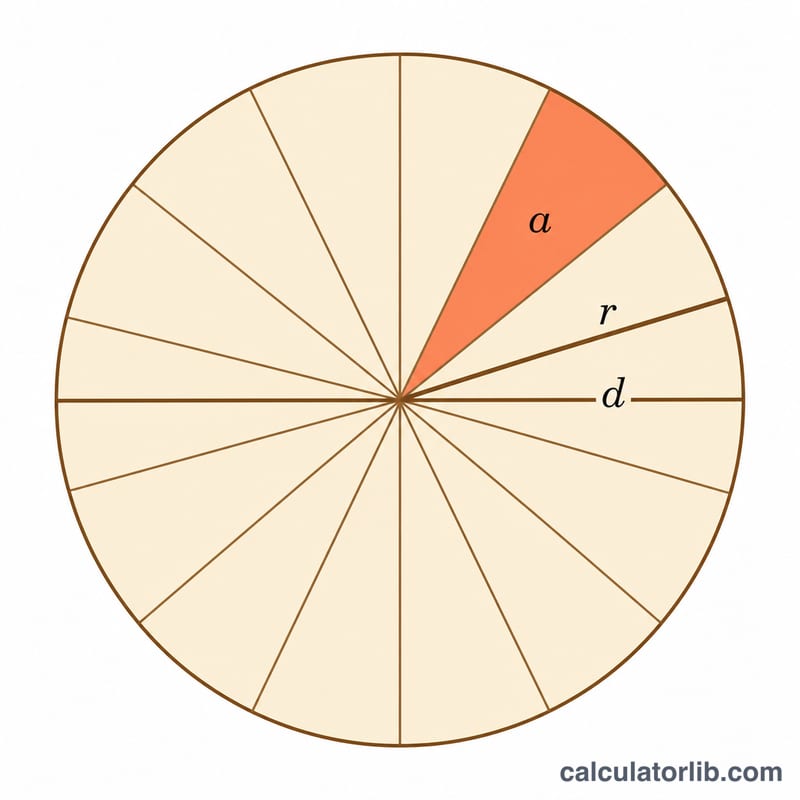
Worked example
For a 9-inch round cake with party slices (8 sq in): radius = 4.5 in, area = \(\pi \times 4.5^2 = 63.62\) sq in. Servings:
$$\text{Servings} = 63.62 \div 8 = 7.95$$which floors to 7 party slices. Choosing standard 6 sq in slices instead gives \(63.62 \div 6 = 10.6\), or 10 servings.
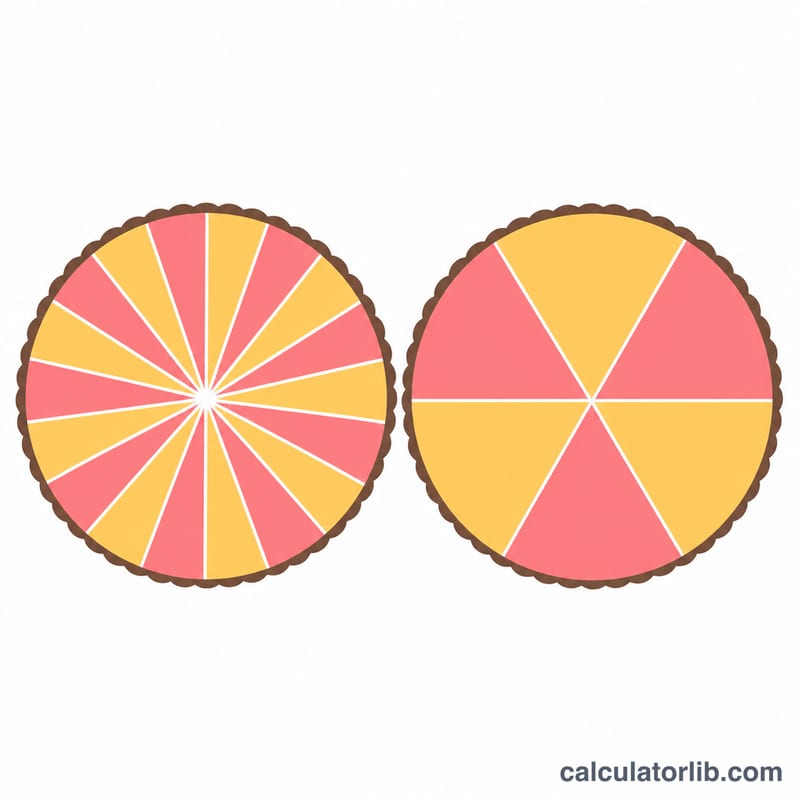
Round Cake Serving Chart by Diameter
Servings are estimated from the cake's top surface area divided by the slice size, using the formula \(\text{Servings} = \left\lfloor \dfrac{\pi (d/2)^2}{A} \right\rfloor\), where \(d\) is the diameter in inches and \(A\) is the slice area in square inches. Party slices are 8 sq in (generous), standard slices are 6 sq in, and wedding slices are a slim 4 sq in.
| Diameter (in) | Top Area (sq in) | Party (8 sq in) | Standard (6 sq in) | Wedding (4 sq in) |
|---|---|---|---|---|
| 6 | 28.3 | 3 | 4 | 7 |
| 7 | 38.5 | 4 | 6 | 9 |
| 8 | 50.3 | 6 | 8 | 12 |
| 9 | 63.6 | 7 | 10 | 15 |
| 10 | 78.5 | 9 | 13 | 19 |
| 12 | 113.1 | 14 | 18 | 28 |
| 14 | 153.9 | 19 | 25 | 38 |
Values are rounded down to whole slices, since you cannot serve a partial slice.
How Much Cake to Order
- Add about 10% extra servings. Some guests take seconds, slices break, and a few pieces never get cut cleanly. For 50 guests, plan for roughly 55 servings so you do not run short.
- Round up to the next cake size. If your guest count lands between two diameters, choose the larger one. Leftover cake is far better than empty plates.
- Use wedding-size slices for large events. A 4 sq in slice stretches a cake almost twice as far as an 8 sq in party slice — ideal when cake is one of several desserts or follows a full meal.
- Combine tiers or multiple cakes for big counts. A single round cake tops out fast; for 80+ guests, stack tiers (e.g. 12-in + 9-in + 6-in) or set out two or three same-size rounds and sum their servings.
- Match slice size to appetite. Children's parties and dessert-heavy buffets do well with smaller slices; a cake that is the main event deserves generous party slices.
This is general planning guidance — adjust for your guests, the time of day, and whether other desserts are served.
Serving Scenarios Compared
Three realistic setups show how diameter and slice size together drive the serving count.
| Scenario | Diameter | Slice Size | Servings | Typical Use Case |
|---|---|---|---|---|
| Birthday party slices | 8 in | 8 sq in | 6 | Small home celebration with generous, casual slices for close family. |
| Standard event slices | 10 in | 6 sq in | 13 | Office party or shower where everyone gets a moderate piece. |
| Wedding slices | 12 in | 4 sq in | 28 | Formal reception tier cut into slim, elegant portions after a meal. |
Notice the 12-in wedding setup serves more than four times the 8-in party setup — both the larger diameter and the smaller slice multiply the count.
FAQ
Does this work for tiered cakes? Calculate each tier separately by its diameter and add the servings together.
Why does it round down? Rounding down guarantees every serving is a complete slice, so you never promise more than the cake delivers.
What about square cakes? This tool assumes a round cake. For a square cake, multiply side length by itself and divide by your slice area instead.