What Is the Chicken Feed Calculator?
The Chicken Feed Calculator helps backyard keepers and small farmers estimate how much feed their flock will consume each day, week and month. Knowing your feed requirement makes it easy to budget, buy the right size bags, and avoid running out or over-stocking feed that can spoil. The default of 120 grams per bird per day reflects the typical appetite of a standard laying hen, though you can adjust it for your own breed and conditions.
How to Use It
Enter the number of hens in your flock and the average feed each hen eats per day in grams. Lighter breeds and bantams may eat less (90–110 g), while heavy breeds or birds in cold weather may eat more (130–150 g). The calculator instantly returns the total feed needed per day in grams and kilograms, plus weekly and monthly totals so you can plan purchases.
The Formula Explained
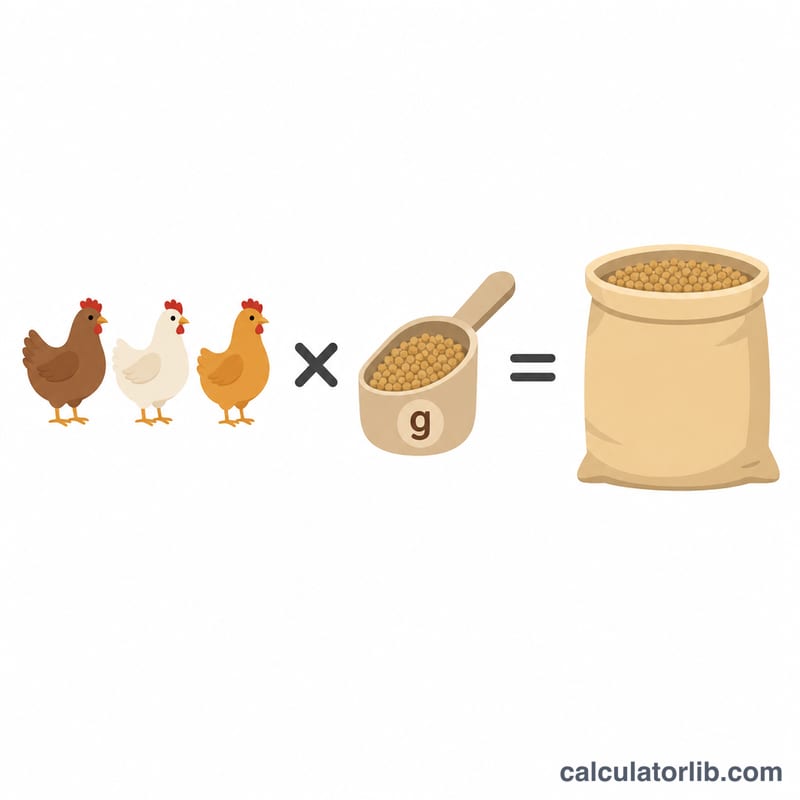
The core calculation is simple multiplication:
$$\text{Daily feed (g)} = \text{Number of hens} \times \text{Feed per hen (g/day)}$$To get larger time spans, the daily figure is multiplied by 7 for a week and 30 for a month, then divided by 1,000 to convert grams to kilograms.
Worked Example
Suppose you keep 10 laying hens that each eat 120 g per day.
$$\text{Daily feed} = 10 \times 120 = 1{,}200 \text{ g} = 1.2 \text{ kg}$$Over a week that is
$$1.2 \times 7 = 8.4 \text{ kg}$$and over a 30-day month it is
$$1.2 \times 30 = 36 \text{ kg}$$So a 20 kg bag of layer feed would last roughly 16–17 days for this flock.
Feed Needs by Flock Size and Breed Type
Daily feed for a flock is simply the number of hens multiplied by the average intake per hen:
$$\text{Daily feed (g)} = \text{Hens} \times \text{Feed per hen (g/day)}$$To turn that into planning figures, divide grams by 1000 for kilograms, multiply by 7 for a week and by 30 for a nominal month. The scenarios below use intake figures typical of well-managed backyard and small commercial flocks; your own birds may sit slightly above or below these values depending on weather, feed energy density and how much they forage.
| Scenario | Birds | g / hen / day | Daily feed | Weekly (kg) | Monthly, 30 days (kg) | 20 kg bags / month |
|---|---|---|---|---|---|---|
| Bantams (small breeds) | 4 | 90 | 360 g (0.36 kg) | 2.52 | 10.8 | 0.54 → 1 bag |
| Light-breed layers | 6 | 110 | 660 g (0.66 kg) | 4.62 | 19.8 | 0.99 → 1 bag |
| Standard brown layers | 10 | 120 | 1200 g (1.2 kg) | 8.4 | 36.0 | 1.80 → 2 bags |
| Heavy breeds in winter | 12 | 145 | 1740 g (1.74 kg) | 12.18 | 52.2 | 2.61 → 3 bags |
| Small flock / hobby farm | 25 | 120 | 3000 g (3.0 kg) | 21.0 | 90.0 | 4.50 → 5 bags |
Worked example for the 10-hen row:
$$10 \times 120\ \text{g} = 1200\ \text{g/day} = 1.2\ \text{kg/day}$$$$1.2 \times 7 = 8.4\ \text{kg/week}, \qquad 1.2 \times 30 = 36\ \text{kg/month}$$$$\frac{36\ \text{kg}}{20\ \text{kg per bag}} = 1.8 \Rightarrow 2\ \text{bags}$$Bag counts are always rounded up, since you cannot buy 0.8 of a bag. Note that a 31-day month adds roughly one extra day of feed (1.2 kg in this example), and a 28-day February needs about two days less.
Typical Daily Feed Intake by Bird Type
The figures below are consolidated from commercial layer management guides (breeds such as ISA Brown, Lohmann and Hy-Line publish official feed intake curves) and general breed feeding charts. They assume a complete, balanced compound ration of roughly 2700–2800 kcal ME/kg fed ad libitum, with free access to clean water. Values are averages per bird per day, not a strict ration to weigh out — layers are normally fed to appetite.
| Bird type / stage | Typical intake (g/day) | Feed type | Notes |
|---|---|---|---|
| Bantams (all light bantam breeds) | 60–90 | Layer (bantam or crumble form) | Roughly half to two-thirds of a standard hen |
| Light layer, e.g. Leghorn, Ancona | 100–115 | Layer mash/pellet, 16–17% protein | Efficient converters; high egg output on modest intake |
| Standard brown layer, e.g. ISA Brown, Rhode Island Red | 110–125 | Layer pellet, 16–17% protein | The default assumption for most backyard flocks |
| Heavy / dual-purpose, e.g. Orpington, Sussex, Brahma | 130–150 | Layer pellet, 16% protein | Larger body mass to maintain; upper end in cold weather |
| Chick, 0–8 weeks | 15–50 (rising with age) | Starter crumble, 18–20% protein | Intake climbs steeply week by week |
| Pullet grower, 8–18 weeks | 55–90 (rising with age) | Grower, 15–16% protein | Switch to layer feed at point of lay or ~18 weeks |
| Cockerel / rooster (standard breed) | 120–150 | Layer or maintenance ration | Roosters should not rely on high-calcium layer feed long term; offer calcium separately where practical |
| Meat birds (broilers), grow-out | 50–200+ (highly age-dependent) | Broiler starter → grower → finisher | Fast-growing strains eat far more than layers; follow the strain's own feeding program rather than this calculator |
Adjusting the per-hen figure
- Cold weather: add about 10–15%. Birds burn more energy maintaining body temperature, so a 120 g hen may eat 132–138 g in a hard winter.
- Free-range or large pasture: subtract about 10–20%, because forage, insects and greens replace part of the ration. In deep winter or on bare ground this saving largely disappears.
- Hot weather: intake typically falls; watch body condition and egg size rather than forcing intake.
- Feeder waste: spillage from open trough feeders can add 5–15% to what you actually buy — that is covered in the buying tips below, not in the intake figure.
These are planning ranges, not veterinary guidance. Sudden changes in intake — a drop of more than about 10% over a few days, or a flock that empties feeders far faster than expected — are worth investigating for illness, parasites, rodents or feed spoilage.
Practical Feed Buying and Storage Tips
The calculated monthly figure is what the birds eat. What you need to buy is a little more, because some feed is spilled, blown away, eaten by wild birds or lost to damp. A practical purchase figure is:
$$\text{Feed to buy (kg)} = \text{Monthly feed (kg)} \times 1.10$$$$\text{Bags} = \left\lceil \frac{\text{Feed to buy (kg)}}{\text{Bag weight (kg)}} \right\rceil$$For the 10-hen example (36 kg/month): \(36 \times 1.10 = 39.6\) kg, and \(39.6 \div 20 = 1.98\), so buy 2 × 20 kg bags per month.
Choosing a bag size
Common retail bag sizes differ by region: 20 kg and 25 kg sacks are standard across Europe, Australia and much of Asia, while 40 lb (≈18.14 kg) and 50 lb (≈22.68 kg) bags are typical in the United States. Divide your monthly kilograms by the bag weight and round up:
| Bag size | Weight in kg | Days of feed for 10 hens @ 120 g/day |
|---|---|---|
| 20 kg | 20.00 | ≈ 16–17 days |
| 25 kg | 25.00 | ≈ 20–21 days |
| 40 lb | 18.14 | ≈ 15 days |
| 50 lb | 22.68 | ≈ 18–19 days |
Buying and storage checklist
- Add ~10% to the calculated amount for waste, then round up to whole bags. Covered or port-hole feeders reduce this margin; open trays in a windy run may need more.
- Keep no more than about 4–8 weeks of feed on hand. Added vitamins in compound feed degrade over time, and most manufacturers recommend using feed within roughly three months of its milling date. Check the date on the bag and use the oldest stock first.
- Store in sealed, rodent-proof containers — metal bins or heavy-duty lidded drums — in a cool, dry, shaded place. Never store bags directly on a damp concrete floor; use a pallet or shelf.
- Discard any feed that smells musty, is clumped or shows mould. Mouldy feed can carry mycotoxins and is not worth the risk.
- Reorder when about one week of feed remains. That leaves a buffer for delivery delays or a shop being out of your usual brand, and avoids an abrupt feed change.
- Change feeds gradually where possible — mix increasing proportions of the new feed over several days.
- Count grit and oyster shell separately. Insoluble grit (for the gizzard) and soluble calcium (oyster shell or limestone chips) should be offered free-choice in their own containers, not included in the calculated ration, so each hen takes what she needs.
- Keep treats, scratch grain and kitchen scraps under about 10% of total intake. For a hen eating 120 g/day that is roughly 12 g — a small handful. More than that dilutes the balanced ration and can reduce shell quality and lay rate.
- Provide enough feeder space so timid birds are not crowded out, and check water daily — water intake drives feed intake, and a frozen or empty drinker will cut feed consumption immediately.
This is general flock-management information, not veterinary advice. For sick birds, sharp changes in appetite, or decisions about medicated feed and withdrawal periods, consult a veterinarian or your local poultry extension service, and follow the feeding directions printed on your specific feed label.
FAQ
How much should a chicken eat per day? A typical adult laying hen eats around 120 grams (about 1/4 lb) of complete feed daily, plus any treats and forage.
Does the season change feed needs? Yes. Hens eat more in cold weather to stay warm and slightly less in hot weather, so adjust the grams-per-hen value accordingly.
Does this include treats and scraps? No. The figure is for complete formulated feed. Treats should stay under about 10% of the diet to keep nutrition balanced.