
What Is Cost Per View (CPV)?
Cost Per View (CPV) is a key video advertising metric that tells you how much you pay, on average, for each view of your ad. It is widely used on platforms like YouTube, TikTok, and other video ad networks where advertisers are billed when a viewer watches or engages with their video. A lower CPV generally means your campaign is reaching viewers more efficiently.
How to Use This Calculator
Enter your total ad spend (the full amount you paid for the campaign) and the total views your video received. The calculator divides spend by views to give your CPV, and also shows the equivalent Cost Per 1,000 Views (CPM) so you can benchmark against other campaigns.
The Formula Explained
The formula is simple:
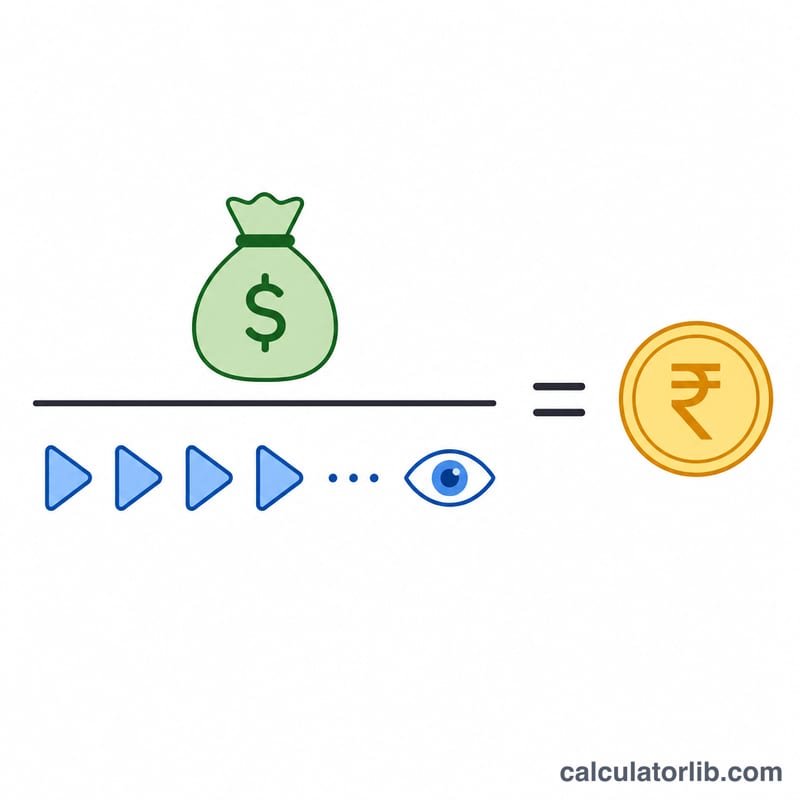
$$\text{CPV} = \frac{\text{Total Ad Spend (\$)}}{\text{Total Views}}$$For example, if you spent $500 and earned 20,000 views, your CPV is \(\$500 \div 20{,}000 = \$0.025\) per view. Multiply by 1,000 to express it as a CPM of $25 per thousand views.
Worked Example
Suppose a campaign cost $1,200 and generated 48,000 views.
$$\text{CPV} = 1{,}200 \div 48{,}000 = \$0.025 \text{ per view}$$The CPM would be \(\$0.025 \times 1{,}000 = \$25\). This means each view costs two and a half cents, and reaching a thousand viewers costs $25.
CPV Across Different Campaign Scenarios
CPV is total ad spend divided by total views, and the equivalent CPM is \(\text{CPM} = \text{CPV} \times 1000\). The table shows five illustrative spend and view combinations. They are examples, not benchmarks.
| Total Ad Spend | Total Views | CPV | Equivalent CPM |
|---|---|---|---|
| $250 | 25,000 | $0.01 | $10.00 |
| $500 | 20,000 | $0.025 | $25.00 |
| $750 | 50,000 | $0.015 | $15.00 |
| $1,000 | 10,000 | $0.10 | $100.00 |
| $2,500 | 100,000 | $0.025 | $25.00 |
Example of the formula: \(\text{CPV} = \frac{ \$1000}{10000} = \$0.10\), so \(\text{CPM} = 0.10 \times 1000 = \$100\). Two campaigns with very different budgets (the $500 and $2,500 rows) can have the same CPV, because CPV depends on the ratio of spend to views, not on the size of the budget.
Interpreting Your CPV Result
CPV tells you how much you pay, on average, for each counted view. Lower is not automatically better, because the quality of the views matters as much as their price.
- Low CPV: you are buying views efficiently. This can reflect broad targeting, an engaging creative, or low competition. It can also mean the views are low-intent, for example from broad audiences or accidental plays, so check downstream results such as clicks, conversions or brand lift.
- Moderate CPV: usually a balance between reach and audience precision, and typical of campaigns with reasonably defined targeting.
- High CPV: often caused by narrow or in-demand audiences, strong competition in auctions, weak creative that viewers skip, or strict view definitions. A high CPV can still be worthwhile if the viewers are highly valuable to you.
Factors that influence CPV:
- Platform: each platform has its own auction, formats and audience behavior.
- Targeting: narrower or more valuable audiences generally cost more.
- Creative: a strong hook in the first seconds can improve view rate and lower CPV.
- View definition: a view counted after a longer watch time or an interaction typically costs more than one counted after a few seconds.
- Bidding: bid strategy and bid levels affect how much you pay per view.
- Audience competition: seasonality and other advertisers raise or lower prices.
CPV benchmarks vary widely by platform, industry, region and time of year, so compare your result with your own past campaigns and with the platform's reporting rather than a single universal number. This is general information, not financial or professional advice.
Key Terms: CPV, CPM, Views and Ad Spend
- CPV (cost per view)
- Total ad spend divided by the number of counted views: \(\text{CPV} = \frac{\text{spend}}{\text{views}}\).
- CPM (cost per mille)
- The cost per 1,000 impressions. In this calculator, the equivalent CPM is CPV × 1000, meaning what you would pay per 1,000 views.
- View vs. impression
- An impression is any time an ad is shown. A view is counted only when a viewer meets the platform's watch or interaction threshold, so views are always at most equal to impressions.
- Total ad spend
- The total amount charged for the campaign in the period you are measuring, in your currency.
- View rate
- The share of impressions that result in a view: \(\text{view rate} = \frac{\text{views}}{\text{impressions}} \times 100\%\).
- CPC (cost per click)
- For contrast, spend divided by clicks. CPV measures video viewing, while CPC measures click-through traffic.
Note on definitions: platforms count a view differently. For example, YouTube has counted a view on some video ad formats when a viewer watches about 30 seconds (or the full ad if shorter) or interacts with it, while other platforms use shorter thresholds. Always use the view definition and the spend and view figures reported by your platform so the CPV you calculate matches the platform's billing.
FAQ
What is a good CPV? It varies by platform and audience, but many YouTube campaigns see CPVs between $0.01 and $0.30. Lower is better for efficiency.
What counts as a "view"? Platforms define this differently — often a view is counted after a few seconds of watch time or a click. Use your platform's reported view count for accuracy.
How is CPV different from CPM? CPV is the cost of a single view; CPM is the cost per 1,000 views. CPM is handy for comparing reach-based campaigns.