What is the Diamond Painting Drill Count Calculator?
Diamond painting uses tiny resin "drills" placed onto a sticky, color-coded canvas to build a sparkling mosaic image. This calculator estimates how many drills your project needs based on the canvas size and how much of it is actually covered with drills. It's perfect for planning supply orders, comparing kit sizes, or checking whether you have enough beads to finish a piece.
How to use it
Enter your canvas width and height in centimeters, then enter the drill coverage as a percentage. Use 100% for a "full drill" painting that covers the entire canvas, or a lower value (for example 40%) for a "partial drill" design where only part of the image is beaded. The calculator returns the estimated drill count, the total number of grid cells, and a rough number of bags assuming 200 drills per bag.
The formula explained
Standard square and round drills measure about 2.5 mm, or 0.25 cm. Dividing each canvas dimension by 0.25 cm gives the number of drill positions across and down. Multiplying those together gives the total grid cells. Multiplying by the coverage fraction (coverage \(\div\) 100) yields the number of drills you'll actually place:
$$\text{drills} = \frac{W}{0.25} \times \frac{H}{0.25} \times \frac{\text{coverage}}{100}$$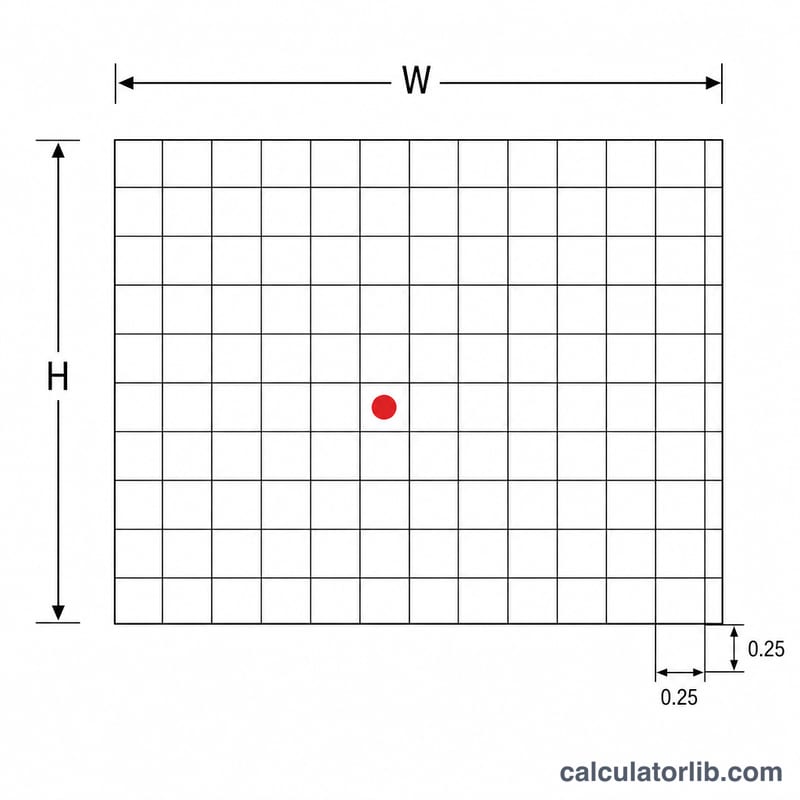
Worked example
For a 30 cm \(\times\) 40 cm full-coverage canvas: drills across = \(30 / 0.25 = 120\), drills down = \(40 / 0.25 = 160\), total cells = \(120 \times 160 = 19{,}200\). At 100% coverage you need 19,200 drills, or about 96 bags of 200.
$$\text{drills} = \frac{30}{0.25} \times \frac{40}{0.25} \times \frac{100}{100} = 19{,}200$$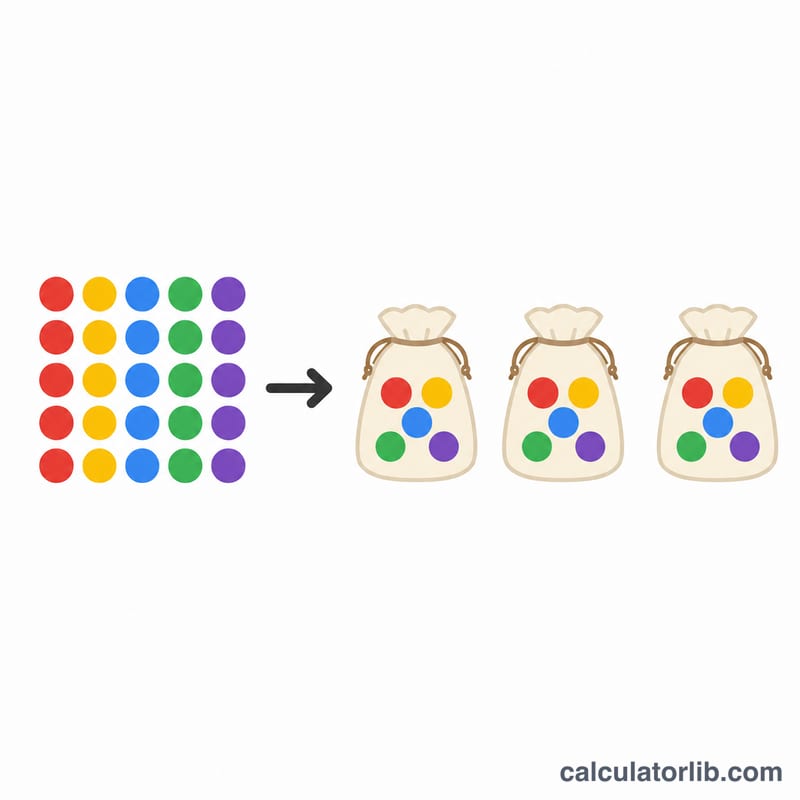
Canvas Size Conversion Table (Inches to Centimeters)
Diamond painting kits are labelled in inches in some markets (commonly the US) and in centimetres in others, but the drill grid itself is always metric: the standard drill is 2.5 mm wide, so the calculator divides each side by 0.25 cm. The conversion factor is exact by international definition: 1 in = 2.54 cm, so \(\text{cm} = \text{in} \times 2.54\) and \(\text{in} = \text{cm} \div 2.54\).
| Canvas (in) | Canvas (cm) | Grid columns (W ÷ 0.25) | Grid rows (H ÷ 0.25) | Grid cells (≈ drills at 100% coverage) |
|---|---|---|---|---|
| 8 × 10 | 20.3 × 25.4 | 81 | 102 | ≈ 8,262 |
| 12 × 16 | 30.5 × 40.6 | 122 | 162 | ≈ 19,764 |
| 16 × 20 | 40.6 × 50.8 | 162 | 203 | ≈ 32,886 |
| 20 × 24 | 50.8 × 61.0 | 203 | 244 | ≈ 49,532 |
| 24 × 32 | 61.0 × 81.3 | 244 | 325 | ≈ 79,300 |
| 30 × 40 | 76.2 × 101.6 | 305 | 406 | ≈ 123,830 |
Drill size note. A standard drill measures 2.5 mm = 0.25 cm ≈ 0.098 in. Because 0.098 in is just under a tenth of an inch, a 2.5 mm grid gives roughly 10 drills per linear inch — and therefore about 100 drills per square inch. That rule of thumb is handy for sanity-checking any estimate: a 16 × 20 in canvas is 320 square inches, so ≈ 32,000 drills at full coverage, which matches the table.
The column and row counts above are rounded to whole drills, since a canvas cannot hold a partial cell. The calculator works with the unrounded division, so its total for a size such as 40.6 × 50.8 cm (about 33,000) can differ from the rounded product here by a few tenths of a percent. Kit makers also round their printed inch labels (a 30 × 40 cm canvas is often sold as "12 × 16 in" even though 12 in is 30.48 cm), so always measure the canvas you actually have.
Drill Counts for Common Canvas Sizes and Coverage Levels
Every figure below comes from the same formula the calculator uses, with a 2.5 mm (0.25 cm) drill:
$$\text{Drills} = \frac{W}{0.25} \times \frac{H}{0.25} \times \frac{C}{100}$$Full-coverage kits place a drill in every cell (\(C = 100\)). Partial-coverage designs leave the background printed, so only part of the grid is filled — 60% and 40% are typical for a portrait or a single motif on an open background.
| Canvas size | Grid cells (W ÷ 0.25 × H ÷ 0.25) | 100% full coverage | 60% partial | 40% partial | Bags at 200 drills (full coverage) |
|---|---|---|---|---|---|
| 20 × 25 cm (≈ 7.9 × 9.8 in) | 80 × 100 = 8,000 | 8,000 | 4,800 | 3,200 | 40 |
| 30 × 40 cm (≈ 11.8 × 15.7 in) | 120 × 160 = 19,200 | 19,200 | 11,520 | 7,680 | 96 |
| 40 × 50 cm (≈ 15.7 × 19.7 in) | 160 × 200 = 32,000 | 32,000 | 19,200 | 12,800 | 160 |
| 50 × 60 cm (≈ 19.7 × 23.6 in) | 200 × 240 = 48,000 | 48,000 | 28,800 | 19,200 | 240 |
| 60 × 80 cm (≈ 23.6 × 31.5 in) | 240 × 320 = 76,800 | 76,800 | 46,080 | 30,720 | 384 |
Worked check — 40 × 50 cm at full coverage:
$$\frac{40}{0.25} \times \frac{50}{0.25} \times \frac{100}{100} = 160 \times 200 \times 1 = 32{,}000 \text{ drills}$$At 200 drills per bag that is \(32{,}000 \div 200 = 160\) bags, spread across however many colours the design uses. The same canvas at 60% coverage needs \(32{,}000 \times 0.60 = 19{,}200\) drills — note that this equals the full-coverage count of the smaller 30 × 40 cm canvas, which is a useful way to picture what "partial coverage" really costs.
Two assumptions to adjust. First, bag size: 200 drills per bag is the figure used here, but there is no industry standard — suppliers sell drills by weight or by packet and counts commonly range from well under 200 to several hundred, so divide by your own supplier's count. Second, waste: counts above are the exact grid requirement, so add a margin (many stitchers allow 10–20%) for drills that are lost, flipped, miscoloured or discarded, and remember that each colour must be rounded up to a whole bag individually.
FAQ
Are these square or round drills? The 0.25 cm size applies to both standard square and round drills, so the count works for either.
Why order extra? Always buy 15–20% more per color than calculated, because drills get lost, damaged, or run short by color.
Does this account for color counts? No—it gives the total drill count across all colors. Your kit's color chart breaks that total down by shade.