What is a division calculator?
A division calculator splits one number, the dividend, into equal parts defined by a second number, the divisor. It returns three useful values: the exact decimal quotient, the whole-number (integer) quotient, and the remainder left over. Division is one of the four basic arithmetic operations and answers the question “how many times does the divisor fit into the dividend, and what is left?”
The formula
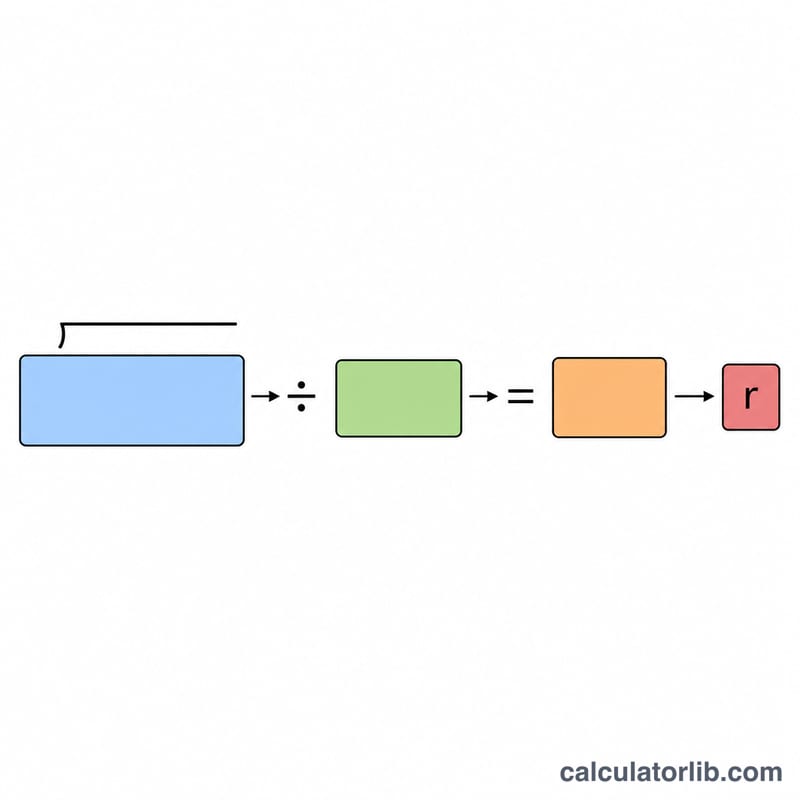
The exact quotient is simply the ratio of the two numbers:
$$\text{quotient} = \frac{\text{dividend}}{\text{divisor}}$$where \(\text{dividend}\) is the number being divided and \(\text{divisor}\) is the number you divide by. The integer quotient uses the floor function, and the remainder is what stays behind:
$$\text{remainder} = \text{dividend} - \left\lfloor \frac{\text{dividend}}{\text{divisor}} \right\rfloor \times \text{divisor}$$The divisor must not be zero, since division by zero is undefined.
How to use it
Enter the dividend and the divisor, then read the results. The large value is the exact decimal quotient; the table shows the integer quotient and the remainder for whole-number division.
Worked example
Divide \(10\) by \(3\). The exact quotient is:
$$\frac{10}{3} = 3.3333\ldots$$The largest whole multiple of \(3\) that fits into \(10\) is \(3\times 3 = 9\), so the integer quotient is \(3\) and the remainder is:
$$10 - 3 \times 3 = 1$$More Division Examples
Example 1: An even division (20 ÷ 4)
- Exact quotient: \(q = \frac{20}{4} = 5\).
- Integer quotient: \(q_{int} = \lfloor 5 \rfloor = 5\).
- Remainder: \(r = 20 - 5 \cdot 4 = 0\).
The remainder is 0, so 20 is divisible by 4 (it is a multiple of 4).
Example 2: A larger case (47 ÷ 6)
- Exact quotient: \(q = \frac{47}{6} = 7.8333\ldots\) (the digit 3 repeats forever).
- Integer quotient: \(q_{int} = \lfloor 7.8333\ldots \rfloor = 7\).
- Remainder: \(r = 47 - 7 \cdot 6 = 47 - 42 = \) 5.
Check: \(6 \times 7 + 5 = 47\).
Example 3: A negative dividend (−7 ÷ 3)
- Exact quotient: \(q = \frac{-7}{3} = -2.3333\ldots\)
- Floor-based integer quotient: \(q_{int} = \lfloor -2.3333\ldots \rfloor = -3\), because the floor rounds toward negative infinity.
- Remainder: \(r = -7 - (-3)\cdot 3 = -7 + 9 = 2\).
Check: \(3 \times (-3) + 2 = -7\).
Some programming languages and textbooks use truncation toward zero instead. That gives an integer quotient of −2 and a remainder of \(-7 - (-2)\cdot 3 = -1\). Both results satisfy dividend = divisor × quotient + remainder, but they differ in convention. The formula on this page uses the floor convention, so for a positive divisor the remainder is never negative.
Division Terms and Glossary
- Dividend: the number being divided (the 47 in 47 ÷ 6).
- Divisor: the number you divide by (the 6 in 47 ÷ 6). It cannot be zero.
- Quotient: the result of division. The exact quotient is the full value, including any decimal part (7.8333…). The integer quotient is the number of whole times the divisor fits into the dividend (7).
- Remainder: what is left over after taking out the whole multiples of the divisor (5 in 47 ÷ 6).
- Floor function \(\lfloor x \rfloor\): the greatest integer less than or equal to \(x\). For example, \(\lfloor 7.83 \rfloor = 7\) and \(\lfloor -2.33 \rfloor = -3\).
- Divisible / multiple: a number is divisible by the divisor when the remainder is 0. The dividend is then a multiple of the divisor.
- Modulo: the operation that returns the remainder, often written \(a \bmod b\). With floor division it matches the remainder used here. Programming languages differ for negative numbers.
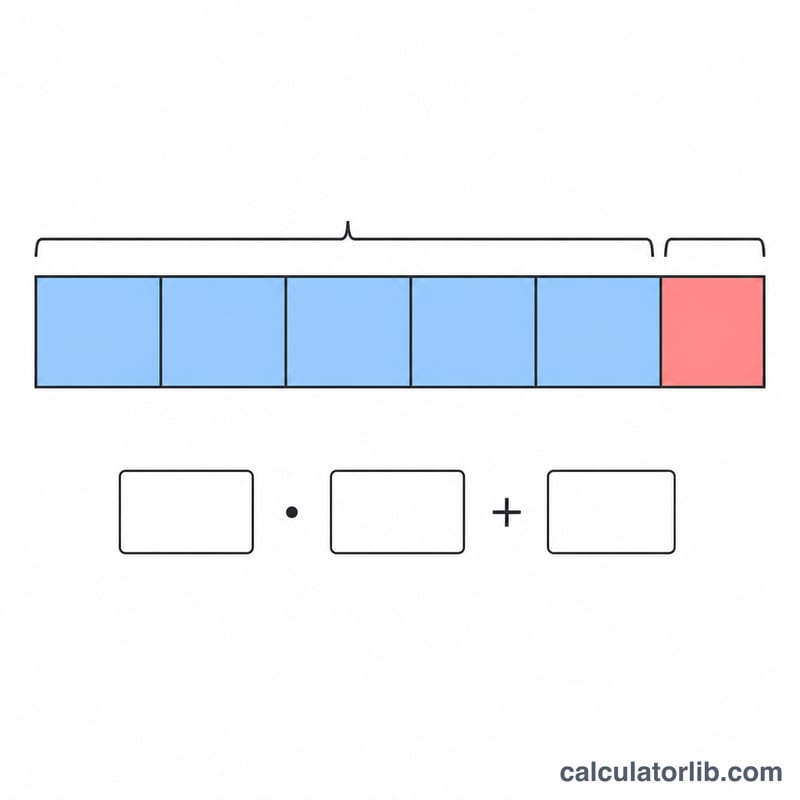
The core relationship is:
$$\text{dividend} = \text{divisor} \times q_{int} + r$$
For a positive divisor, the remainder satisfies \(0 \le r < |\text{divisor}|\).
Division Results for Different Inputs
| Dividend | Divisor | Exact quotient | Integer quotient | Remainder |
|---|---|---|---|---|
| 20 | 4 | 5 | 5 | 0 |
| 10 | 3 | 3.3333… | 3 | 1 |
| 7 | 2 | 3.5 | 3 | 1 |
| 100 | 7 | 14.2857… | 14 | 2 |
| 5 | 8 | 0.625 | 0 | 5 |
| 1 | 3 | 0.3333… | 0 | 1 |
When the dividend is smaller than the divisor (5 ÷ 8, 1 ÷ 3), the integer quotient is 0 and the remainder equals the dividend. Each row satisfies dividend = divisor × integer quotient + remainder; for example, \(7 \times 14 + 2 = 100\).
FAQ
What if the numbers divide evenly? When the dividend is a multiple of the divisor, the remainder is \(0\) and the quotient is a whole number, for example \(20 \div 4 = 5\).
Can I divide decimals? Yes. The exact quotient works for any real numbers; the integer quotient and remainder are most meaningful for whole numbers.
Why can I not divide by zero? There is no number that, multiplied by zero, gives a nonzero dividend, so division by zero has no defined result.