
What Is Heart Rate Reserve?
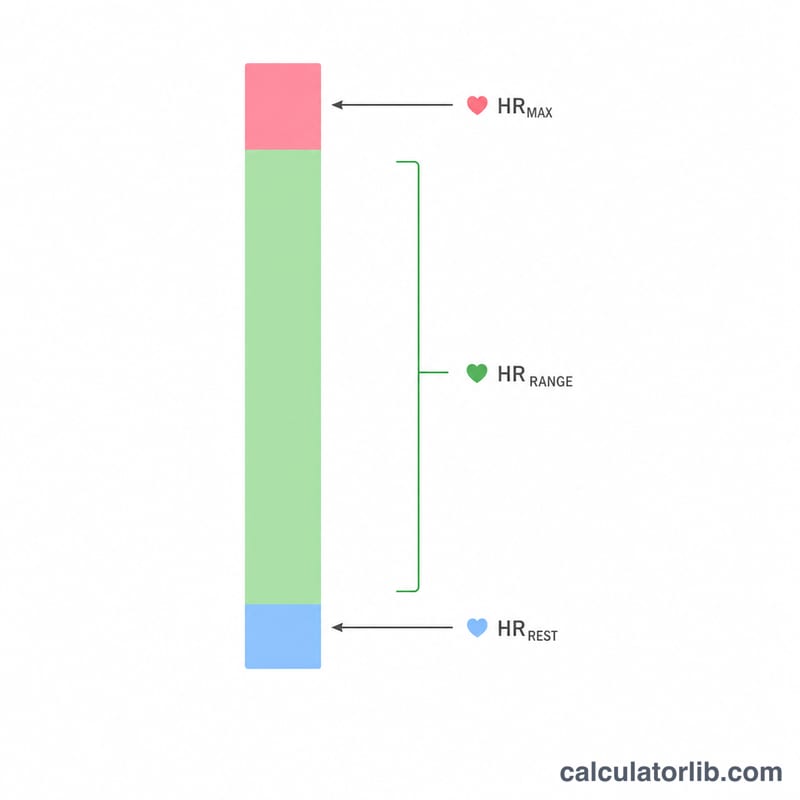
Heart Rate Reserve (HRR) is the difference between your maximum heart rate and your resting heart rate. It represents the usable range your heart has between complete rest and all-out effort. HRR is the foundation of the Karvonen method, a widely used and more individualized way to set training heart-rate zones because it accounts for your fitness level via resting pulse.
How to Use This Calculator
Enter your age and your resting heart rate (measured first thing in the morning before getting up, in beats per minute). The calculator estimates your maximum heart rate as 220 minus your age, then subtracts your resting rate to give your HRR. Optionally enter a target intensity percentage to get your recommended training heart rate using the Karvonen formula.
The Formula Explained
The core equation is simple: \(\text{HRR} = \text{Max HR} - \text{Resting HR}\), where \(\text{Max HR} \approx 220 - \text{age}\). To find a training target you take a percentage of that reserve and add it back to your resting rate:
$$\text{Target HR} = \text{Resting HR} + \text{HRR} \times \frac{\text{Intensity (\%)}}{100}$$This keeps the lower end of your zone realistic relative to your own resting heart rate rather than a flat percentage of max.
Worked Example
Suppose you are 30 years old with a resting heart rate of 60 bpm.
$$\text{Max HR} = 220 - 30 = 190$$$$\text{HRR} = 190 - 60 = 130 \text{ bpm}$$For moderate training at 70% intensity:
$$\text{Target HR} = 60 + 130 \times 0.70 = 60 + 91 = 151 \text{ bpm}$$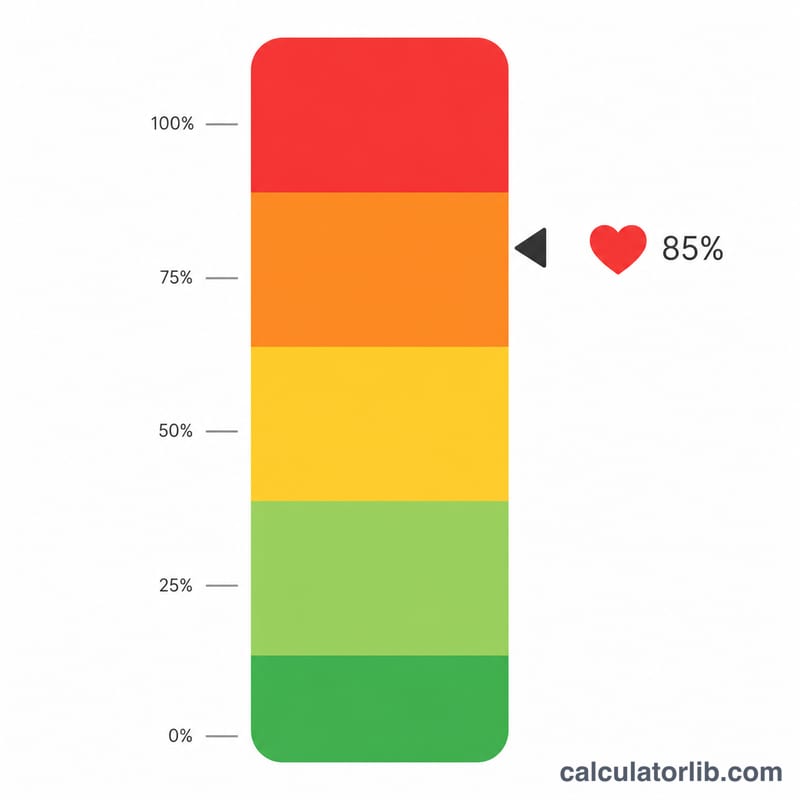
FAQ
Is 220 − age accurate? It is a population estimate and can be off by ±10–12 bpm for any individual. For precise zones, use a measured max heart rate from a stress test or field test.
Why use HRR instead of percentage of max? The Karvonen (HRR) method factors in your resting heart rate, so it better reflects individual cardiovascular fitness.
What intensity should I train at? 50–70% HRR is light to moderate, 70–85% is vigorous. Consult a professional before high-intensity training if you have health concerns.