
What Is the Grams to Moles Calculator?
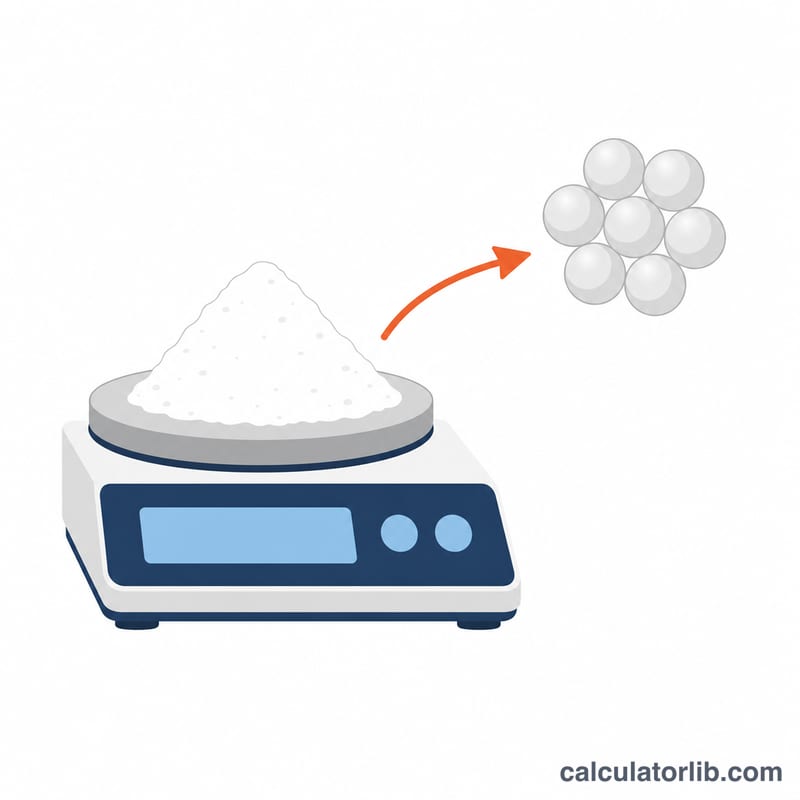
This calculator converts a measured mass (in grams) into an amount of substance (in moles). The mole is the SI unit chemists use to count particles such as atoms, molecules, or ions. Because weighing a substance on a balance gives you grams, you need its molar mass to bridge between what you can measure and the number of particles you actually have.
How to Use It
Enter the mass of your sample in grams and the molar mass of the substance in grams per mole (g/mol). The molar mass is obtained by adding the atomic masses of every atom in the chemical formula. Press calculate and the tool returns the number of moles.
The Formula Explained
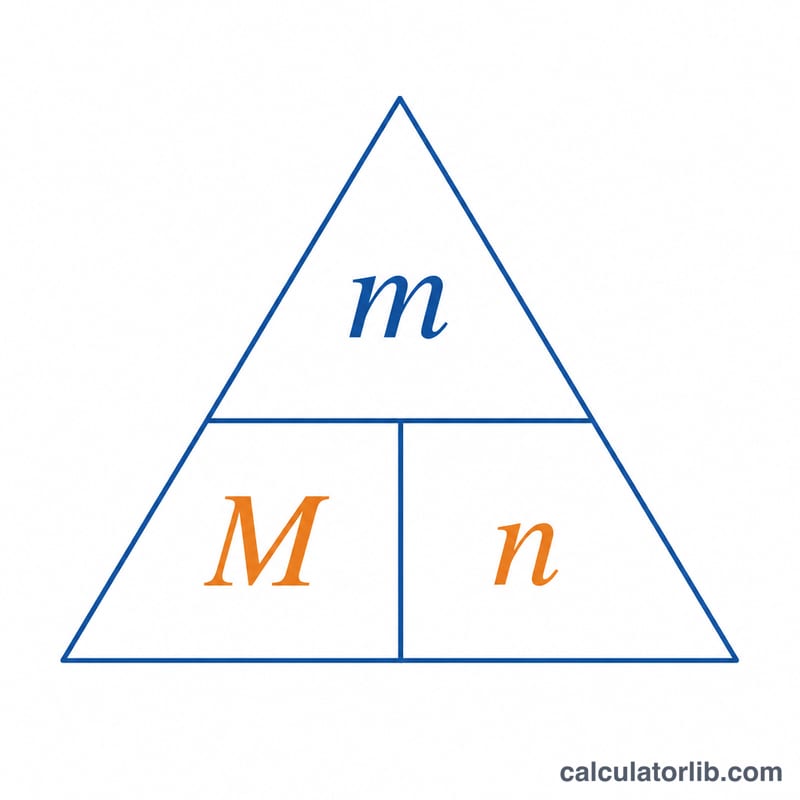
The relationship is simply $$n = \frac{m}{M}$$ where n is the amount in moles, m is the mass in grams, and M is the molar mass in grams per mole. The grams cancel, leaving units of moles. Dividing by a larger molar mass yields fewer moles for the same mass, which makes intuitive sense because heavier molecules mean fewer of them per gram.
Worked Example
Suppose you have 36 g of water (H₂O). The molar mass of water is about 18.015 g/mol. Then $$n = \frac{36}{18.015} = 1.998 \text{ mol}$$ roughly 2 moles of water. That corresponds to about \(2 \times 6.022 \times 10^{23} = 1.204 \times 10^{24}\) molecules.
FAQ
Where do I find the molar mass? Sum the atomic masses (from the periodic table) of each atom in the formula. For NaCl: \(22.99 + 35.45 = 58.44\) g/mol.
Can I go from moles back to grams? Yes — rearrange to \(m = n \times M\), multiplying moles by molar mass.
Does it work for elements? Yes. Use the element atomic mass as the molar mass; for example carbon is 12.011 g/mol.