What Is a Linear Feet Calculator?
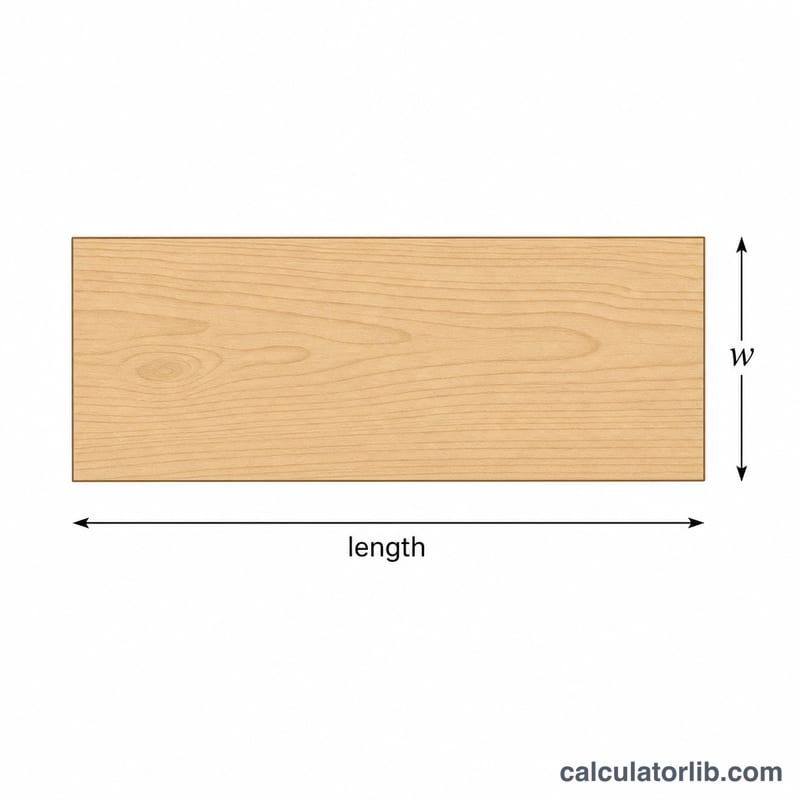
A linear foot is simply a measurement of length equal to 12 inches, regardless of width or thickness. When you buy flooring, decking, trim, fencing, or lumber that comes in fixed-width boards, you need to know how many linear feet to purchase to cover a given area. This calculator converts a total square-foot area into the linear feet of board you need, then optionally estimates the material cost.
How to Use It
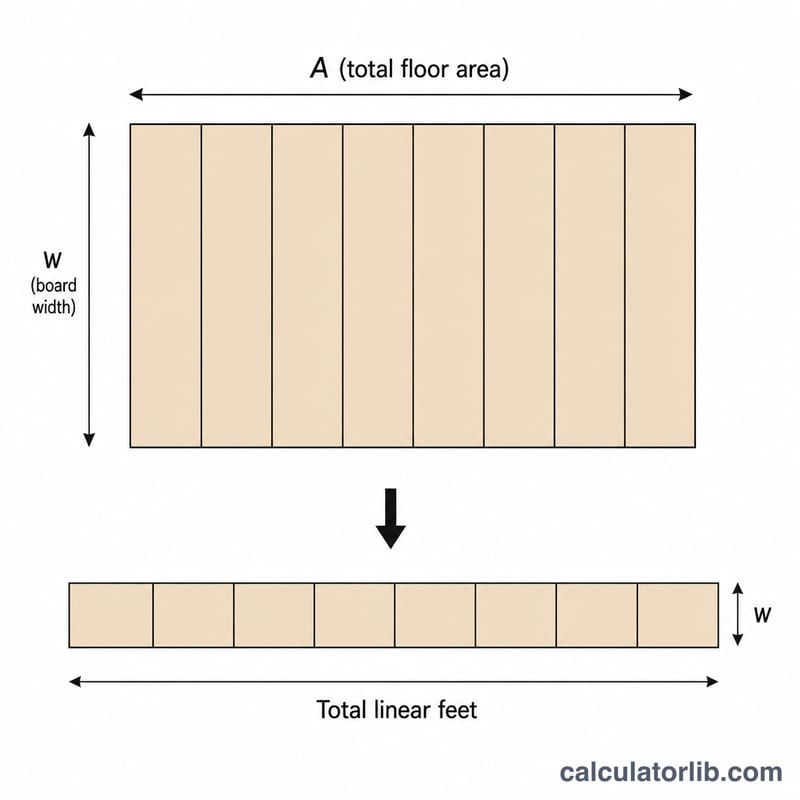
Enter the total area you want to cover in square feet, the board width in inches, and (optionally) the price per linear foot. The tool converts the board width to feet, divides the area by that width to get linear feet, and multiplies by the price to estimate total cost. Add 5–10% extra for cuts and waste.
The Formula Explained
Because area equals length times width, the length (linear feet) needed equals area divided by width: $$\text{Linear Feet} = \frac{\text{Area (ft}^2\text{)}}{\dfrac{\text{Width (in)}}{12}}$$ Width is divided by 12 to convert inches to feet so the units match. Cost is then $$\text{Cost} = \frac{\text{Area (ft}^2\text{)}}{\dfrac{\text{Width (in)}}{12}} \times \text{Price (\$/ft)}$$
Worked Example
Suppose you are installing flooring over a 320 ft² room using boards that are 5.5 inches wide. The board width in feet is \(5.5 \div 12 = 0.4583\) ft. Linear feet \(= 320 \div 0.4583 \approx\) 698.18 linear feet. At $2.50 per linear foot, the material cost is \(698.18 \times 2.50 \approx\) $1,745.45.
Common Board Widths and Linear Feet per 100 Sq Ft
Linear feet are the total board length laid end to end. For a given area, the narrower the board, the more linear feet you need. The formula is \(\text{Linear Feet} = \frac{\text{Area}}{\text{Width (in)}/12}\), so for 100 ft² it becomes \(\frac{100}{\text{Width}/12} = \frac{1200}{\text{Width}}\).
| Board type (typical use) | Face width (in) | Linear feet per 100 ft² |
|---|---|---|
| Narrow strip hardwood flooring | 2.25 | 533.33 |
| Hardwood / laminate plank | 3.25 | 369.23 |
| 2x4 laid on its wide face; 1x4 boards; 3.5 in tongue-and-groove | 3.5 | 342.86 |
| Wide hardwood / laminate plank | 5 | 240.00 |
| 2x6 and 5/4x6 deck boards | 5.5 | 218.18 |
| Wide plank flooring | 7.5 | 160.00 |
Nominal vs. actual size: In North American softwood lumber, the nominal name is larger than the real size. A 2x4 measures about 1.5 × 3.5 in, and a 2x6 measures about 1.5 × 5.5 in. Likewise, 1x4 and 1x6 boards are about 3.5 in and 5.5 in wide. Always use the actual measured width, not the name on the label. Other countries and product lines may use different sizes.
Tongue-and-groove: Enter the exposed face width (the "coverage" width after the boards interlock), not the full width including the tongue. Using the full board width underestimates the linear feet you need.
Practical Ordering Tips
- Add a waste allowance based on layout. A common rule of thumb is about 5% for a straight lay, about 10% for diagonal or patterned layouts, and about 15% for herringbone. Complex rooms with many cuts may need more.
- Round up to whole boards or standard lengths. Lumber commonly comes in 8, 10, 12 and 16 ft lengths. Example: 100 ft² of 5.5 in decking is 218.18 linear ft; with 5% waste, 218.18 × 1.05 ≈ 229.09 linear ft. With 12 ft boards, 229.09 ÷ 12 ≈ 19.09, so order 20 boards. Check the lengths that suit your layout to reduce offcuts.
- Use the exposed face width. For tongue-and-groove, shiplap or other interlocking boards, use the visible coverage width, not the full width of the board.
- Keep extra for future repairs. Set aside a few spare boards from the same batch. Color and profile can vary between production runs, so a later match may be difficult.
- Check the pricing unit. Prices may be quoted per linear foot, per board, per square foot or per box. Convert everything to the same unit before comparing, and enter a price per linear foot in the calculator for a correct cost estimate.
These are general guidelines. Always confirm quantities and waste factors with your supplier or the manufacturer's installation instructions.
FAQ
What is the difference between linear feet and square feet? Linear feet measure straight length only; square feet measure area (length \(\times\) width). This tool bridges the two using the board's width.
Should I add waste? Yes — most installers add 5–10% extra to cover cutting, mistakes, and pattern matching.
Can I use this for fencing or trim? Yes, anything sold by the linear foot. For trim, you can also just total the lengths of each run directly.