What is the Loot Drop Probability Calculator?
The Loot Drop Probability Calculator tells you the real chance of obtaining a rare item after a set number of attempts. Many games advertise a small per-attempt drop rate, but your odds build up the more you try. This tool converts a single-attempt chance into the cumulative probability across all of your runs.
How to use it
Enter the drop rate per attempt as a percentage (for example, 2 for a 2% chance) and the number of attempts you plan to make. The calculator returns your chance of at least one drop, the chance of walking away empty-handed, and the expected number of drops.
The formula explained
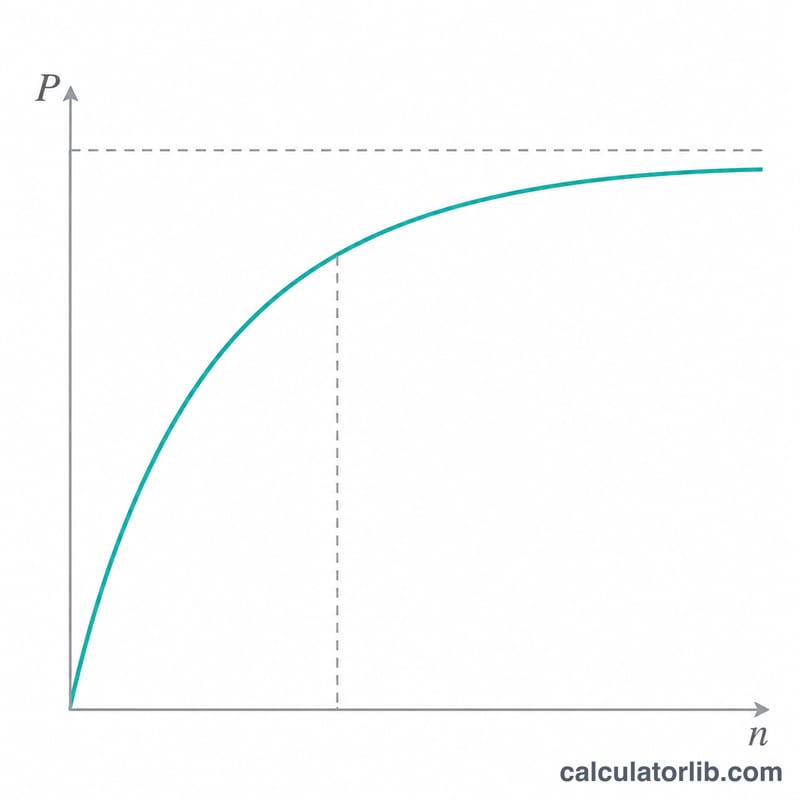
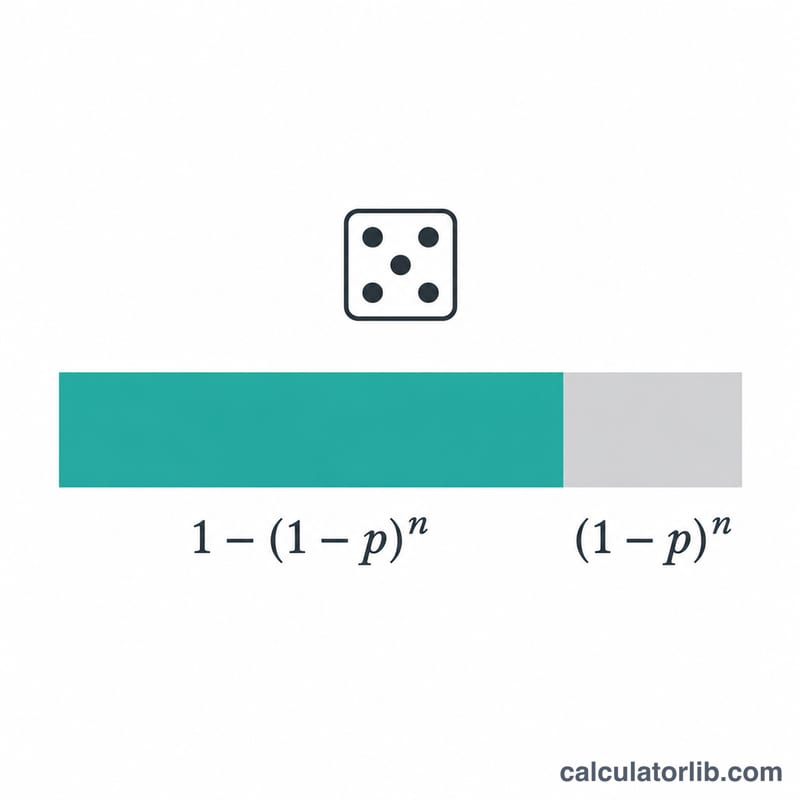
Each attempt is treated as independent. If \(p\) is the per-attempt drop probability and \(N\) is the number of attempts, the chance of at least one success uses the complement rule:
$$P = 1 - (1-p)^{N}$$Here \(1-p\) is the chance of a single failure, and \((1-p)^{N}\) is the chance that every attempt fails.
Worked example
Suppose the drop rate is 10% per attempt and you make 7 attempts. Then \(p = 0.10\) and \(N = 7\):
$$P = 1 - (1-0.10)^{7} = 1 - 0.9^{7} = 1 - 0.4783 = 0.5217$$So you have about a 52.17% chance of at least one rare drop over 7 attempts.
Drop Odds Across Common Scenarios
The table shows the chance of getting at least one drop, \(P = 1-(1-p)^{N}\), for common per-attempt drop rates. Each attempt is treated as independent, with the same fixed rate. Values are rounded to two decimal places. The last column is the expected number of drops in 100 attempts, \(E = N \cdot p\).
| Drop rate (p) | 10 tries | 25 tries | 50 tries | 100 tries | Expected drops in 100 tries |
|---|---|---|---|---|---|
| 0.5% | 4.89% | 11.78% | 22.17% | 39.42% | 0.5 |
| 1% | 9.56% | 22.22% | 39.50% | 63.40% | 1 |
| 2% | 18.29% | 39.65% | 63.58% | 86.74% | 2 |
| 5% | 40.13% | 72.26% | 92.31% | 99.41% | 5 |
| 10% | 65.13% | 92.82% | 99.48% | >99.99% | 10 |
Notice that running exactly \(1/p\) attempts (100 tries at 1%, 50 at 2%, 10 at 10%) gives you about 63–65%, not 100%. On average you get one drop in that many tries, but a good share of players still get nothing. The chance of a drop never reaches exactly 100%, however many attempts you make.
More Worked Examples
Example 1: A 0.5% drop over 200 attempts
- Convert the rate to a fraction: \(p = 0.5/100 = 0.005\), and \(N = 200\).
- Find the chance of missing on every attempt: \((1-0.005)^{200} = 0.995^{200} \approx 0.36696\).
- Take that away from 1: \(P = 100 \times (1 - 0.36696) \approx\) 63.30%.
- Expected drops: \(E = 200 \times 0.005 = 1\).
You expect one drop on average, but there is still about a 36.7% chance of getting none after 200 attempts.
Example 2: How many attempts for a 90% chance at a 1% drop?
Solve \(1-(1-p)^{N} = 0.90\) for \(N\):
$$N = \frac{\ln(1-0.90)}{\ln(1-p)} = \frac{\ln(0.10)}{\ln(0.99)} = \frac{-2.302585}{-0.010050} \approx 229.1$$- Round up to the next whole attempt: \(N = 230\).
- Check: \(0.99^{230} \approx 0.09910\), so \(P = 100 \times (1 - 0.09910) \approx\) 90.09%.
- At 229 attempts the chance is about 89.99%, just under the target. So 230 is the smallest number of attempts that reaches 90%.
Example 3: A 25% drop over 5 attempts
- \(p = 25/100 = 0.25\), \(N = 5\).
- Chance of missing every time: \((1-0.25)^{5} = 0.75^{5} = 0.2373046875\).
- \(P = 100 \times (1 - 0.2373046875) \approx\) 76.27%.
- Expected drops: \(E = 5 \times 0.25 = 1.25\).
Even with a generous 1-in-4 rate, about 1 player in 4 (23.7%) still gets nothing after 5 attempts.
These results assume each attempt is independent with a fixed rate. Games that use pity timers, bad-luck protection or rising drop rates give different odds, usually better than this formula shows.
FAQ
Does a 2% drop rate guarantee a drop in 50 tries? No. Over 50 tries at 2% your chance is \(1-(0.98)^{50}\approx 63.6\%\), not 100%.
What are expected drops? It is the average count of drops, \(N \times p\), which can exceed 1 over many attempts.
Are attempts assumed independent? Yes, each attempt is independent with the same drop rate, which matches most loot systems.