What Is the Miles to Empty Calculator?
The Miles to Empty Calculator estimates how far you can still drive before running out of fuel. It uses two simple inputs — the number of gallons left in your tank and your vehicle's fuel economy in miles per gallon (MPG) — to project your remaining driving range. Many modern dashboards show a "distance to empty" reading, but this tool lets you verify it, plan a long trip, or calculate range when your gauge is unreliable.
How to Use It
Enter the gallons of fuel remaining in your tank. If you only know your tank percentage, multiply your tank capacity by that fraction (for example, a 14-gallon tank at 1/4 full holds about 3.5 gallons). Then enter your average MPG — use your trip computer's reading, or divide miles driven by gallons used on a recent fill-up. The calculator multiplies the two values and displays your estimated miles to empty.
The Formula Explained
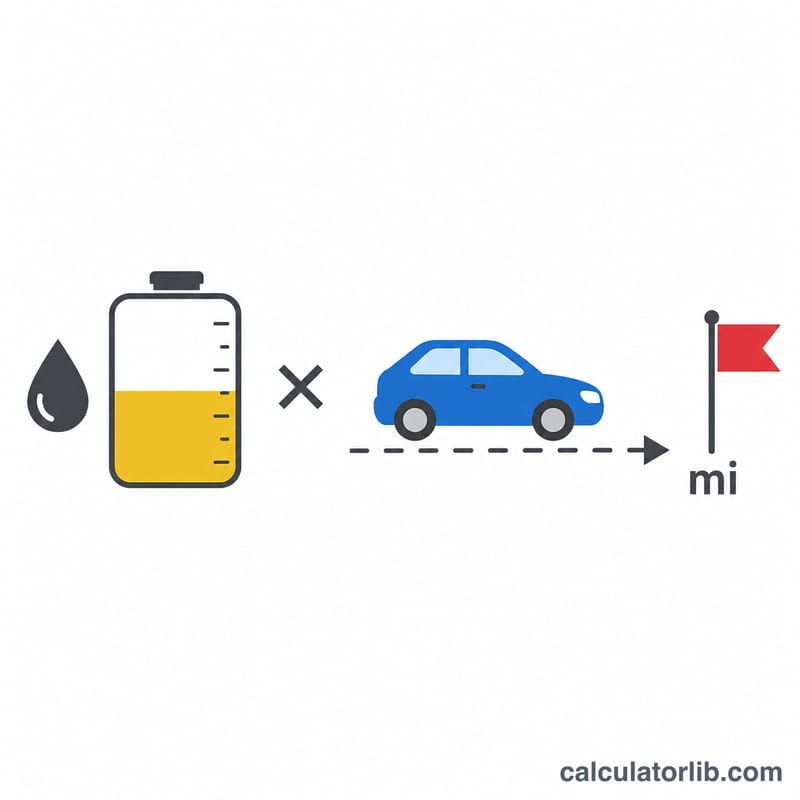
The math is straightforward: $$\text{Miles Left} = \text{Fuel Remaining (gallons)} \times \text{MPG}$$ Each gallon carries you a number of miles equal to your fuel economy, so multiplying gallons by MPG gives total distance. Keep in mind real-world MPG drops at high speeds, with heavy loads, in cold weather, and in stop-and-go traffic, so treat the result as an upper-bound estimate.
Worked Example
Suppose you have 5 gallons of gas remaining and your car averages 25 MPG. Then $$\text{Miles Left} = 5 \times 25 = 125 \text{ miles}$$ of range. If your economy on the highway is higher — say 30 MPG — the same 5 gallons would take you \(5 \times 30 = 150\) miles.
Typical MPG and Tank Sizes by Vehicle Type
The table below gives general, approximate ranges for combined (city and highway) fuel economy and fuel tank capacity for typical gasoline vehicles sold in the United States (miles per US gallon). Individual models vary, so treat these as ballpark figures. For exact values for your vehicle, check the owner's manual or the U.S. EPA's fueleconomy.gov.
| Vehicle class | Typical combined MPG | Typical tank size (gal) |
|---|---|---|
| Compact car | 30–38 | 12–14 |
| Midsize sedan | 28–35 | 14–18 |
| Crossover / small SUV | 24–30 | 14–19 |
| Minivan | 20–25 | 17–21 |
| Half-ton pickup | 17–22 | 23–36 |
| Full-size SUV | 15–20 | 24–33 |
| Hybrid (car or small crossover) | 40–55 | 11–14 |
Example: with 10 gallons left and a vehicle averaging 25 MPG, \(10 \times 25 = \)250 miles to empty.
Real-world MPG changes with speed, temperature, load, terrain and driving style, so use your own recent average where possible and leave a safety margin rather than driving to zero.
Fuel Gauge Fraction to Gallons Conversion
If you know your tank capacity, you can estimate the fuel remaining as \(\text{capacity} \times \text{fraction}\). For example, a 16-gallon tank at 3/4 holds about \(16 \times 0.75 = 12\) gallons. Enter that figure as the fuel amount in the calculator.
| Gauge reading | 12 gal tank | 14 gal tank | 16 gal tank | 20 gal tank | 26 gal tank |
|---|---|---|---|---|---|
| Full | 12 | 14 | 16 | 20 | 26 |
| 3/4 | 9 | 10.5 | 12 | 15 | 19.5 |
| 1/2 | 6 | 7 | 8 | 10 | 13 |
| 1/4 | 3 | 3.5 | 4 | 5 | 6.5 |
| 1/8 | 1.5 | 1.75 | 2 | 2.5 | 3.25 |
| Empty (needle at E) | 0 (nominal) | 0 (nominal) | 0 (nominal) | 0 (nominal) | 0 (nominal) |
Keep in mind: fuel gauges are not perfectly linear. Many read slowly near the top and drop faster near the bottom, and the needle is often damped, so it may lag. Manufacturers also build in a reserve, which differs by vehicle, so a gauge showing empty usually still has some fuel left. The exact reserve is not something you should rely on. Fill up well before the low-fuel warning, and treat these gallon values as estimates.
FAQ
Is the estimate exact? No. It assumes your stated MPG holds steady. Actual range varies with terrain, speed, and driving style.
Should I drive my tank to empty? No. Always keep a buffer — running on fumes can damage the fuel pump and leave you stranded. Refuel with at least a gallon to spare.
How do I find my MPG? Fill the tank, reset your trip odometer, drive normally, then refill and divide the miles driven by the gallons it took to top off.