
What Is the Money per Hour Calculator?
The Money per Hour Calculator converts a lump-sum payment into an effective hourly rate. Whether you're paid a flat project fee, a weekly salary, or a one-off bonus, dividing the total amount by the hours you actually worked tells you what your time is really worth. This is a universal financial tool — the math works with any currency.
How to Use It
Enter your total earnings (the full amount you were paid) and the hours worked to produce that income. The calculator instantly returns your hourly rate, along with equivalent earnings for a standard 8-hour day and a 40-hour week so you can compare offers easily.
The Formula Explained
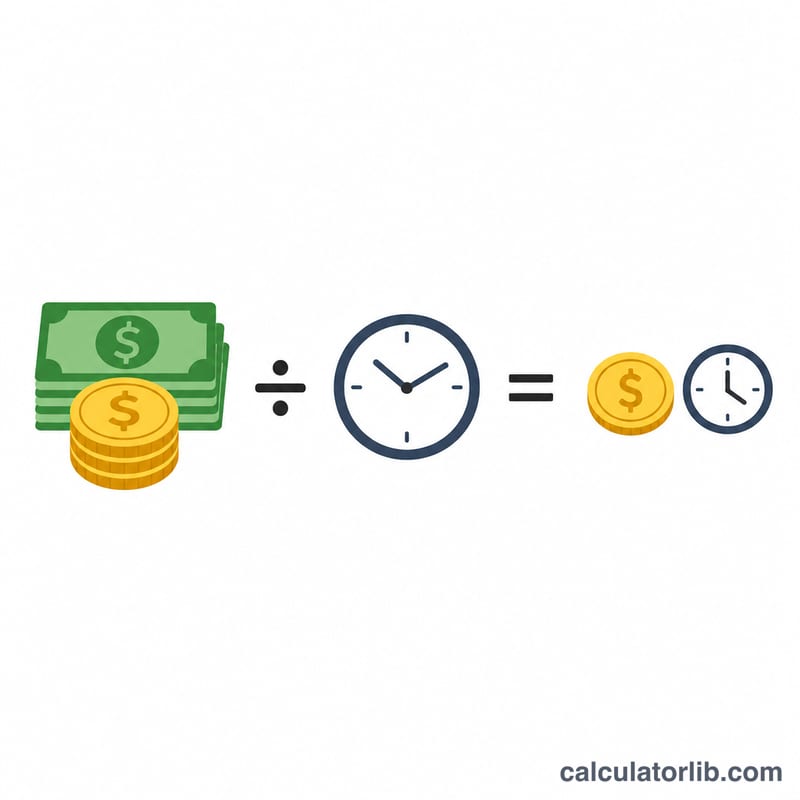
The calculation is simple division:
$$\text{Hourly Rate} = \dfrac{\text{Total Earnings}}{\text{Hours Worked}}$$
The daily equivalent multiplies the hourly rate by 8, and the weekly equivalent multiplies it by 40. If hours worked is zero, the rate cannot be computed (you can't divide by zero), so the result is shown as 0.
Worked Example
Suppose you earned $1,000 for a project that took 40 hours. Your hourly rate is \(\$1{,}000 \div 40 = \$25\) per hour. Over an 8-hour day that's $200, and over a 40-hour week it's $1,000.
Interpreting Your Hourly Rate
The number the calculator returns is a gross effective rate — gross unless you deliberately entered net (after-tax, after-deduction) earnings. The tool cannot tell which you typed, so whichever basis you enter is the basis of the answer.
- The daily and weekly figures are arithmetic equivalents, not forecasts. They are simply the rate multiplied by 8 and by 40. They tell you what the rate would be worth over a standard day or week; they do not predict what you will actually be paid, because your real schedule, overtime rules and paid hours may differ.
- Annualising assumes a complete year of work. The common full-time-equivalent basis is \(40\ \text{h/week}\times 52\ \text{weeks}=2{,}080\ \text{h/year}\). Multiplying your rate by 2,080 therefore assumes no unpaid leave, no unpaid gaps between contracts and no reduced weeks. Freelancers in particular rarely bill 2,080 hours in a year.
- A freelance rate is not comparable to an employee rate at the same number. A self-employed $50/h is not equivalent to an employed $50/h, because the calculator does not capture self-employment or payroll taxes borne by the worker, unpaid admin hours (quoting, invoicing, chasing payment, bookkeeping), equipment, software and insurance, or the absence of paid leave, sick pay, pension contributions and other employer benefits. The specific taxes and benefit entitlements involved depend entirely on your country and status.
- Compare two offers on the same basis. Use gross against gross or net against net, and paid hours against paid hours (or worked hours against worked hours) on both sides. Mixing a gross salary over contracted hours with a net freelance fee over actually-worked hours produces a meaningless comparison.
- Decide what counts as an hour before you enter it. Travel, preparation, revisions and unbilled research are real time; including them gives a truthful effective rate, excluding them gives a billing rate. Both are useful, but only if you know which one you computed.
This section is general information for personal budgeting and rate comparison, not financial, tax or employment advice. For decisions about taxes, contracts or compensation, consult a qualified professional in your own jurisdiction.
Key Terms Defined
| Term | Definition and units |
|---|---|
| Total Earnings (gross) | Money earned before any deductions, in currency units (e.g. $). The invoice total, fee or gross salary for the period being measured. |
| Net (take-home) Earnings | Earnings after taxes and deductions, in currency units. Entering net earnings yields a net hourly rate; the tool does not convert between the two. |
| Hours Worked | Time spent earning that money, in hours (decimal — 2 h 30 min is entered as 2.5). May be contracted hours or actually-worked hours; the choice changes the meaning of the result. |
| Billable hours | Hours a client is charged for, in hours. Directly generate revenue. |
| Non-billable hours | Hours worked but not charged — admin, marketing, quoting, training, unpaid revisions — in hours. Including them lowers the effective rate. |
| Effective Hourly Rate | Earnings divided by all hours genuinely spent, in currency per hour: \(\text{Rate}=\dfrac{\text{Earnings}}{\text{Hours}}\). The headline output of this calculator. |
| Daily Equivalent | Rate × 8 h, in currency per day. An arithmetic restatement at a nominal 8-hour day. |
| Weekly Equivalent | Rate × 40 h, in currency per week. An arithmetic restatement at a nominal 40-hour week. |
| Full-time-equivalent (FTE) year | 2,080 hours, from 40 h/week × 52 weeks. A widely used convention for annualising an hourly rate; it is a convention, not a legal standard, and standard full-time weeks are shorter than 40 h in some countries. |
| Overtime | Hours beyond the standard schedule, in hours. May be paid at a premium, paid at the base rate, or unpaid — entitlement rules vary by country and contract. Unpaid overtime raises Hours Worked without raising earnings, so it reduces the effective rate. |
| Flat / Project Fee | A single agreed price for a defined deliverable, in currency units, independent of hours spent. The fee is the numerator; your actual hours determine the realised rate. |
| Retainer | A recurring fixed payment (currency per month or other period) for ongoing availability or a capped block of work. Divide the payment by the hours actually used in the period to get the effective rate. |
| Gross-to-net deductions | Amounts subtracted from gross earnings, in currency units or as a percentage: income tax, employee payroll/social-contribution withholding, or — for the self-employed — self-employment/social contributions paid directly. Rates, thresholds and names differ entirely by country. |
Income and jobs: United States
Average income and unemployment in United States compared with the world, from the World Bank: a benchmark for the figures you enter above.
- GNI per capita 2025
- 88,810 USD
- GDP per capita, PPP 2025
- 90,027 intl. $
- World: 25,704
- Unemployment 2025
- 4.2%
- World: 4.8%
Latest change Up +7.1% 2025: 88,810 USD, against 82,910 USD in 2024. CalculatorLib computes this change from the two published figures.
In 2025, gross national income per person in United States was 88,810 US dollars a year, about 7,401 US dollars a month. World: 14,244 USD
| Year | GNI per capita (USD) | GDP per capita, PPP (intl. $) | Unemployment |
|---|---|---|---|
| 2025 | 88,810 | 90,027 | 4.2% |
| 2024 | 82,910 | 86,170 | 4.0% |
| 2023 | 79,950 | 82,587 | 3.6% |
| 2022 | 77,230 | 78,009 | 3.7% |
| 2021 | 71,510 | 71,441 | 5.3% |
| 2020 | 64,630 | 64,465 | 8.1% |
| 2019 | 65,840 | 65,228 | 3.7% |
| 2018 | 63,040 | 62,876 | 3.9% |
| 2017 | 58,860 | 60,048 | 4.4% |
| 2016 | 56,830 | 57,977 | 4.9% |
GNI per capita (Atlas method) is the average of all income in the economy, not a typical salary; PPP dollars adjust for local prices.
Income tax and social security: United States
- Top income tax rate 2025
- 43.65%
- from 8.7 × the average wage
- Employee social security 2025
- 7.65% · 1.45%
In 2025, the top statutory personal income tax rate in United States (central and local government combined) was 43.65%. It applies from 8.7 times the average wage of 73,520 USD, that is from about 642,101 USD a year.
Employee social security contribution rates for successive earnings bands, lowest band first; the band limits are not shown.
Top income tax rates in OECD countries
| Country | Top rate | Applies from (× average wage) | Year |
|---|---|---|---|
| Japan | 55.95% | 7.7 | 2025 |
| France | 55.37% | 12.9 | 2025 |
| South Korea | 49.5% | 19.0 | 2025 |
| Germany | 47.48% | 4.4 | 2025 |
| United Kingdom | 45% | 2.2 | 2025 |
| United States | 43.65% | 8.7 | 2025 |
| Türkiye | 40.76% | 5.6 | 2025 |
| Mexico | 35% | 20.6 | 2025 |
The top rate is the statutory rate on the highest earnings, not the rate most workers pay. OECD figures cover OECD member countries only.
United States and other countries
GNI per capita in current US dollars (Atlas method) — each country’s latest published year.
- United States 88,810 USD (2025)
- France 48,630 USD (2025)
- Japan 38,340 USD (2025)
- South Korea 37,880 USD (2025)
- Saudi Arabia 36,070 USD (2025)
- Türkiye 16,300 USD (2025)
- Russia 15,960 USD (2025)
- World 14,244 USD (2025)
- China 14,230 USD (2025)
- Mexico 13,730 USD (2025)
- Vietnam 4,970 USD (2025)
- India 2,760 USD (2025)
No published figure yet for Taiwan.
Years can differ between rows: each figure is shown with its own year. The same World Bank indicator for every country.
Latest figure: 2025 Data last updated 2026-10-18 · current
Source: The World Bank Group CC BY 4.0; OECD, Tax Database CC BY 4.0
Monthly figures are computed by CalculatorLib from these data. The top-rate threshold in national currency (multiple × average wage) is computed by CalculatorLib from these data.
Source details and methodology
- The World Bank Group — World Development Indicators (NY.GNP.PCAP.CD, NY.GDP.PCAP.PP.CD, SL.UEM.TOTL.ZS)
- OECD, Tax Database — Top statutory personal income tax rate; employee social security contribution rates
FAQ
Should I include unpaid breaks? For a true picture of your effective rate, include only the hours you were actually working, or include break time if you were paid for it — be consistent with how you define your earnings.
Does this account for taxes? No. It uses gross earnings. To find your after-tax hourly rate, enter your net (take-home) earnings instead.
Can I use it for freelance project pricing? Yes. Estimate the hours a project will take and divide your quoted fee by that figure to check your effective hourly rate before accepting.