

What this calculator does
This tool estimates your gross weekly pay under Illinois (US) overtime rules. Under the Illinois Minimum Wage Law and the federal Fair Labor Standards Act (FLSA), most non-exempt employees must be paid 1.5× their regular hourly rate for every hour worked beyond 40 in a single workweek. Illinois does not require daily overtime — overtime is calculated on a weekly basis. Figures are gross (before tax, Social Security, and other deductions).
How to use it
Enter your hourly rate and the total hours you worked this week. The calculator automatically splits your hours into the first 40 (paid at the regular rate) and any hours above 40 (paid at time-and-a-half), then adds them together for your total gross weekly pay.
The formula explained
If hours ≤ 40, all hours are regular and overtime is zero. If hours > 40, then regular hours = 40 and overtime hours = hours − 40. Overtime pay and total pay are:
$$\text{OT pay} = \text{rate} \times 1.5 \times \text{OT hrs}$$$$\text{Total} = (\text{rate} \times \text{reg hrs}) + \text{OT pay}$$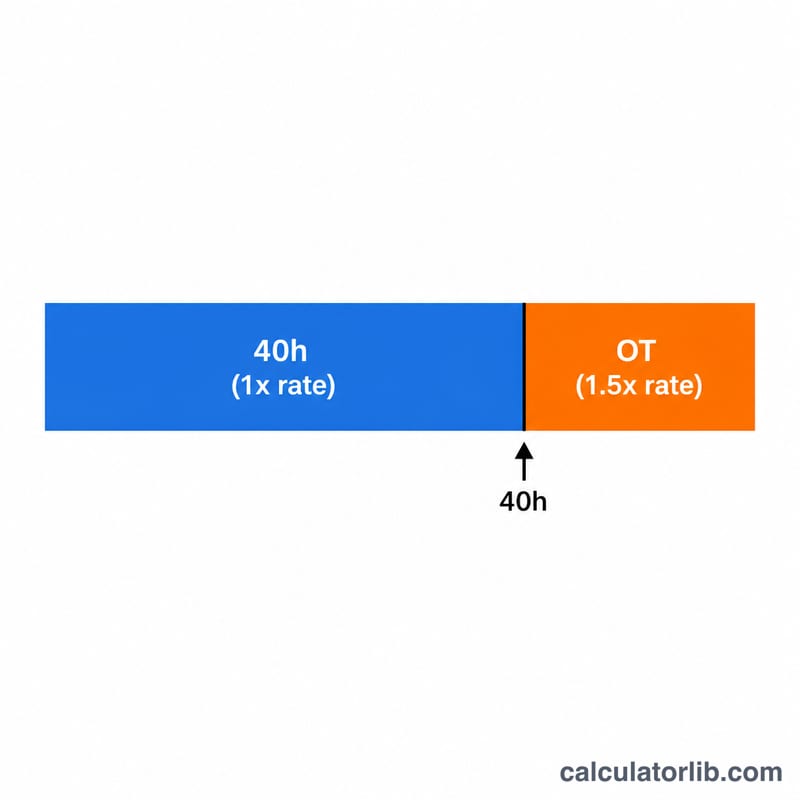
Worked example
Suppose you earn $20.00/hour and work 45 hours in a week. Your first 40 hours are regular: \(40 \times \$20 = \$800\). The 5 extra hours are overtime at $30/hour (\(20 \times 1.5\)): \(5 \times \$30 = \$150\). Total gross pay = \(\$800 + \$150 =\) $950.

FAQ
Does Illinois have daily overtime? No. Unlike some states, Illinois bases overtime only on hours worked over 40 in a workweek, not on hours over 8 in a day.
Who is exempt? Many salaried executive, administrative, and professional employees are exempt from overtime, as are certain other categories. This calculator assumes you are a non-exempt, hourly employee.
Is this my take-home pay? No. The result is gross pay before federal and Illinois income tax, Social Security, Medicare, and any benefit deductions.