What This Calculator Does
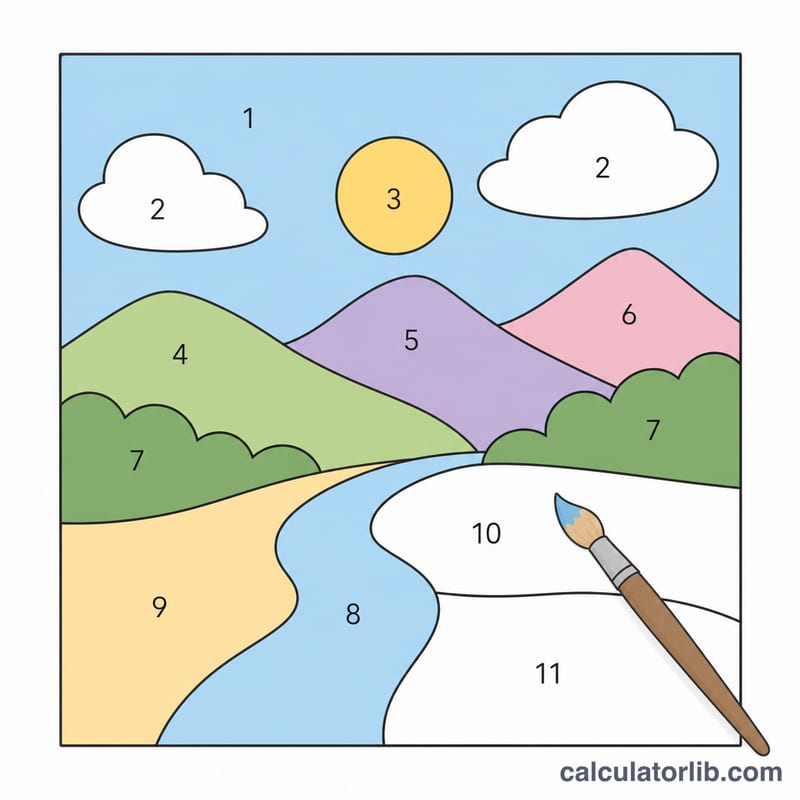
The Acrylic Paint Coverage Calculator estimates how much surface area you can cover with a given amount of paint. It is handy for paint-by-numbers kits, miniatures, canvases, models, and DIY craft projects where you want to know whether a tube or bottle of acrylic will be enough — and how the answer changes when you apply several coats for opaque, even color.
How to Use It
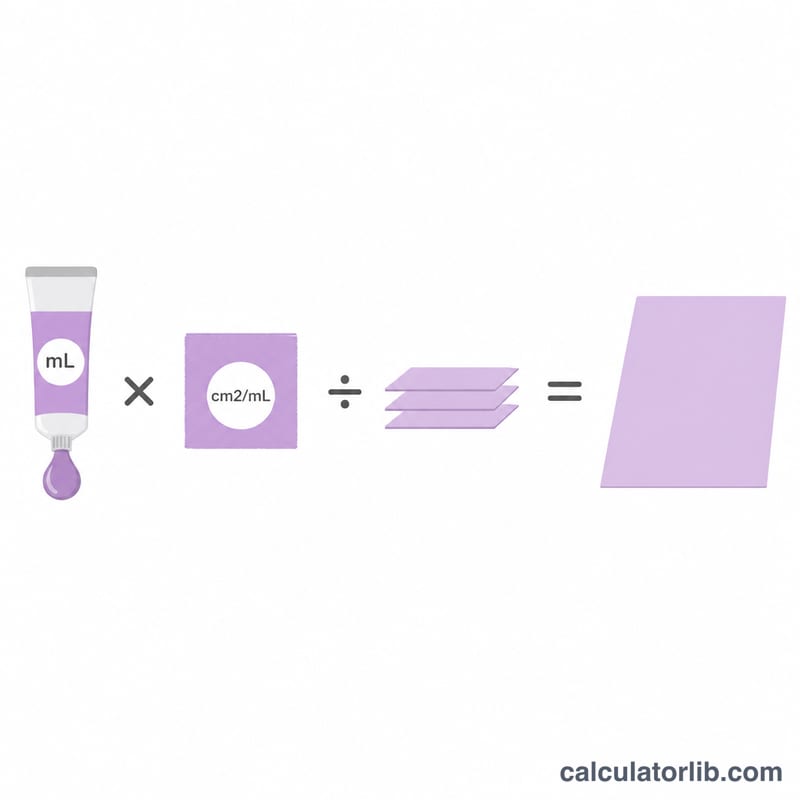
Enter three values: the amount of paint you have in milliliters (mL), the coverage rate in square centimeters per milliliter (cm²/mL), and the number of coats you plan to apply. The calculator multiplies paint by coverage rate to get the single-coat area, then divides by the number of coats to show the realistic area you can finish. It also converts the result to square meters for larger projects.
The Formula Explained
The core relationship is \(\text{Area} = \text{Paint (mL)} \times \text{Coverage (cm}^2\text{/mL)}\). Coverage rate depends on the paint's body and how thickly you apply it; thin, fluid acrylics spread further than heavy-body paints. Because each extra coat consumes more paint, the effective finished area is the single-coat area divided by the number of coats: \(A = \dfrac{V \times c}{n}\).
Worked Example
Suppose you have 50 mL of acrylic with a coverage rate of 100 cm²/mL and you want two coats. Single-coat area $$= 50 \times 100 = 5{,}000 \text{ cm}^2.$$ With two coats, $$A = \frac{5{,}000}{2} = 2{,}500 \text{ cm}^2,$$ which is 0.25 m². So that bottle finishes a quarter of a square meter with full two-coat coverage.
Typical Acrylic Coverage Rates by Paint Type
Coverage per mL depends mostly on how thick the wet paint film is. Because 1 mL = 1 cm³, the area covered by one coat is roughly \(\text{Area (cm}^2\text{)} = \frac{10{,}000}{\text{film thickness (µm)}}\) per mL. A 50 µm wet film therefore covers about 200 cm²/mL. The ranges below are rough estimates for a single coat, not guaranteed values.
| Paint type | Approx. coverage per coat (cm²/mL) | Notes |
|---|---|---|
| Fluid / soft-body acrylic | 150–400 | Thin, self-leveling; spreads far but may need extra coats for opacity |
| Heavy-body acrylic | 60–200 | Thick paste; coverage drops quickly when applied with a palette knife or impasto |
| Craft / student acrylic | 80–200 | Often lower pigment load, so more coats may be needed |
| Paint-by-numbers kit paints | 100–250 | Usually applied thinly in small areas; waste in the pot is common |
These figures vary with brand, pigment, surface texture, dilution and how thickly you paint. If the manufacturer gives a spread rate, or you measure one with a small test patch, use that instead of the table.
Worked example: 20 mL of paint at 150 cm²/mL over 2 coats gives \(\frac{20 \times 150}{2} = \) 1500 cm² of finished coverage.
Area and Coverage Unit Conversions
| Quantity | Equivalent |
|---|---|
| 1 m² | 10,000 cm² |
| 1 in² | 6.4516 cm² |
| 1 ft² | 929.03 cm² |
| 1 mL | 1 cm³ |
| 1 US fl oz | ≈ 29.57 mL |
| 1 m²/L | 10 cm²/mL (10,000 cm² ÷ 1,000 mL) |
| 1 cm²/mL | 0.1 m²/L |
Sample coverage conversions:
| Spread rate (m²/L) | Coverage (cm²/mL) |
|---|---|
| 5 m²/L | 50 cm²/mL |
| 10 m²/L | 100 cm²/mL |
| 12 m²/L | 120 cm²/mL |
| 20 m²/L | 200 cm²/mL |
To convert a canvas size to cm², multiply inches by 2.54 for each side, or multiply the area in in² by 6.4516. For example, a 16 in × 20 in canvas is 320 in², about 2,064.5 cm².
Practical Tips for Estimating Paint Needs
- Add a buffer: set aside about 10–20% extra paint for waste, residue left on the palette or brush, and color mixing.
- Test a patch: paint a known area (for example 10 cm × 10 cm = 100 cm²) with a measured amount, then divide area by mL used to find your real cm²/mL.
- Plan for dark-over-light and light-over-dark: pale or translucent colors over dark areas, and some bright pigments, often need more coats than the label suggests.
- Consider the surface: absorbent canvas, wood, or paper soaks up paint, so unprimed surfaces lower your coverage; a coat of gesso or primer helps, but the primer is its own material to budget for.
- Remember the coats divide the result: doubling the number of coats halves the area one volume of paint will finish.
- Round up: buy the next whole tube, pot or bottle size above your calculated need, since leftover paint is cheaper than a mismatched second batch.
These are general estimating guidelines; results depend on your materials and technique.
FAQ
What coverage rate should I use? A common starting estimate for acrylics is 80–120 cm²/mL for a thin opaque coat. Check the manufacturer's spread rate when available, or test a small patch.
Why divide by the number of coats? Each coat repaints the same area, so two coats use roughly twice the paint for the same finished surface, halving the area a fixed amount of paint can cover.
Can I use this for wall paint? The math is the same, but wall paints are usually rated in m² per liter — convert units first, since 1 m²/L equals 0.1 cm²/mL... actually larger; this tool is tuned for small craft volumes in mL.