
What This Calculator Does
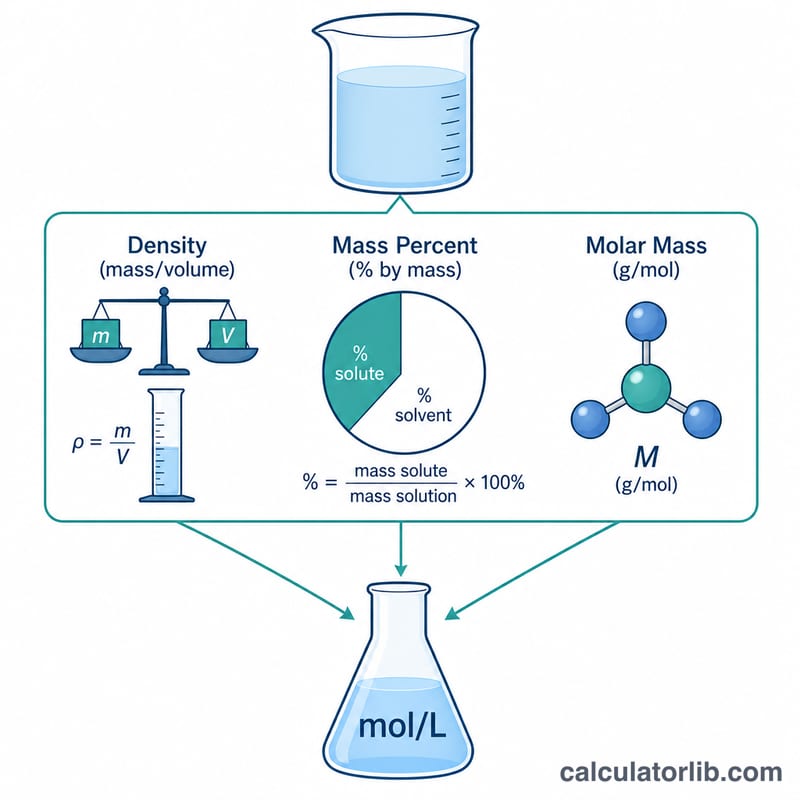
This calculator converts a solution described by its density and mass percent (weight %) concentration into its molarity — the number of moles of solute per liter of solution. This conversion is extremely common when preparing diluted solutions from concentrated stock reagents such as hydrochloric acid, sulfuric acid, ammonia, or nitric acid, where bottle labels list density and percent purity but lab protocols call for molar concentrations.
How to Use It
Enter three values: the solution density in grams per milliliter (g/mL), the mass percent concentration as a number (e.g. enter 36 for 36%), and the molar mass of the solute in grams per mole (g/mol). The calculator returns the molarity in mol/L (M).
The Formula Explained
The relationship is:
$$M = \frac{10 \times \text{density} \times \text{mass\%}}{\text{molar mass}}$$
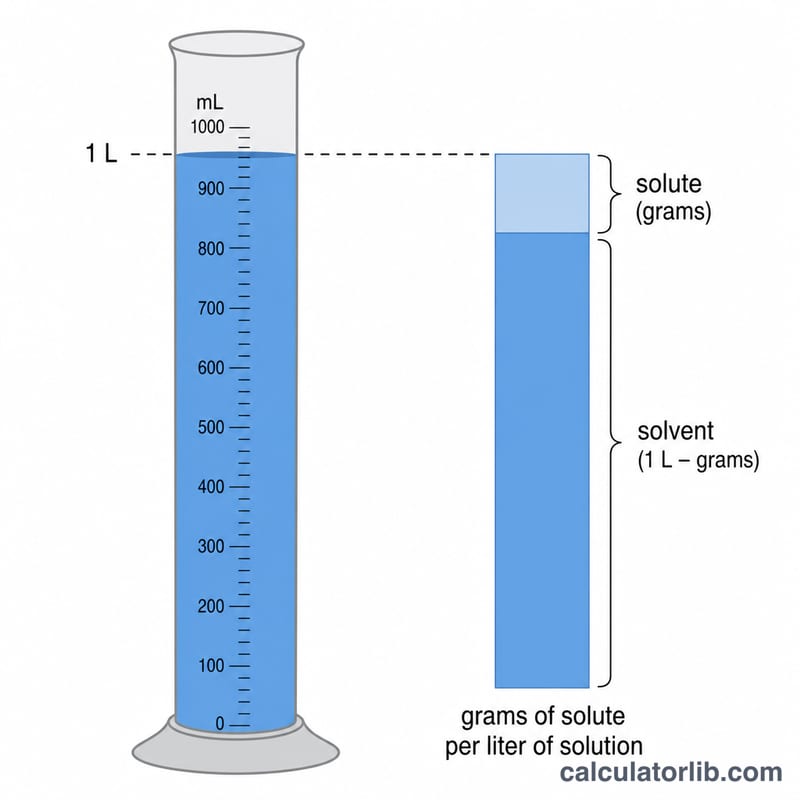
The factor of 10 arises from the unit bookkeeping: density in g/mL multiplied by 1000 mL/L gives grams of solution per liter; multiplying by the mass fraction (mass% / 100) gives grams of solute per liter; dividing by molar mass converts grams to moles. The combined constants \(1000 / 100 = 10\).
Worked Example
Concentrated hydrochloric acid has a density of about 1.18 g/mL and is 36% HCl by mass. The molar mass of HCl is 36.46 g/mol. Then $$M = \frac{10 \times 1.18 \times 36}{36.46} = \frac{424.8}{36.46} \approx 11.65 \text{ mol/L},$$ which matches the familiar ~11.6 M concentration of stock HCl.
FAQ
Do I enter mass percent as 36 or 0.36? Enter it as 36. The formula's factor of 10 already accounts for converting the percentage to a fraction.
What units does density use? Grams per milliliter (g/mL), which equals grams per cubic centimeter. This equals the solution's specific gravity when water is the reference.
Can I use this for any solute? Yes — it works for any single solute as long as you supply that solute's correct molar mass and the overall solution density and weight percent.