
What Is a Pre-Money Valuation?
Pre-money valuation is the agreed value of your company before a new round of funding is added. It is one of the most important numbers in any startup financing negotiation because it directly determines how much of the company an investor receives for their money. This calculator works backwards from the two figures that are usually settled first in a term sheet — the investment amount and the investor's equity percentage — to reveal the implied pre-money valuation, post-money valuation, and remaining founder ownership.
How to Use the Calculator
You only need two inputs:
- Investment Amount — the cash the investor is putting in (in your local currency).
- Investor's Equity (%) — the share of the company the investor will own after the round. This must be between 0 and 100.
The tool returns the pre-money valuation, the post-money valuation, and the founder/existing-shareholder equity (simply 100% minus the investor's stake).
The Formula Explained
First the calculator finds the post-money valuation, then subtracts the new money to get the pre-money figure:
- Post-Money = Investment Amount ÷ (Investor Equity % ÷ 100)
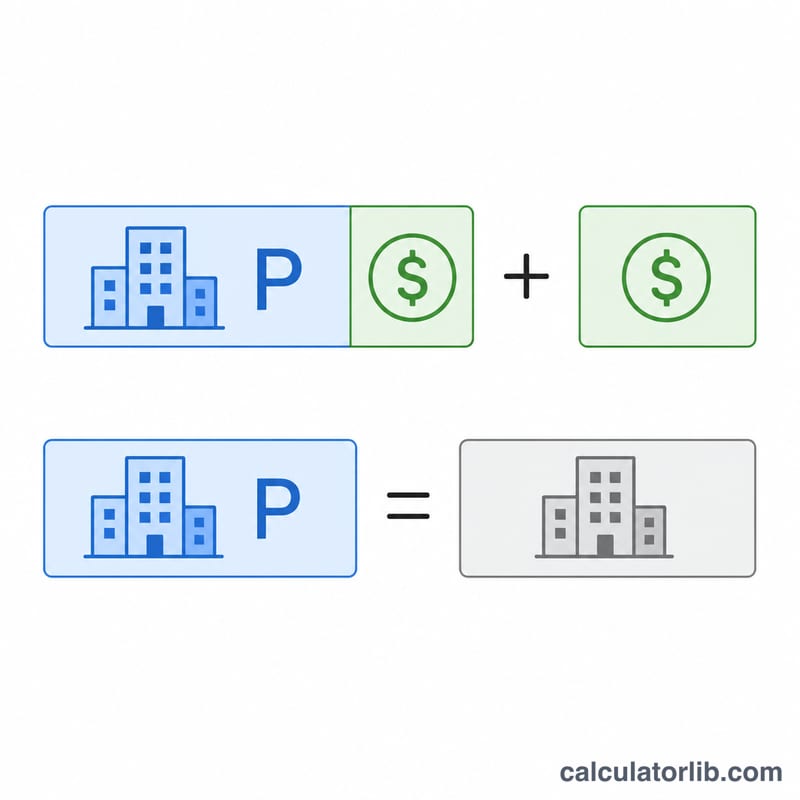
- Pre-Money = Post-Money − Investment Amount
The logic is that the investor's percentage equals their cash divided by the value of the company after their cash is added. Rearranging that relationship gives the post-money value, and removing the investment isolates the pre-money value.
Worked Example
Suppose an investor offers $500,000 for a 20% stake.
- Post-Money = $500,000 ÷ (20 ÷ 100) = $500,000 ÷ 0.20 = $2,500,000
- Pre-Money = $2,500,000 − $500,000 = $2,000,000
- Founder/Existing Equity = 100 − 20 = 80%
So the company is valued at $2 million before the investment and $2.5 million afterwards.
Frequently Asked Questions
What is the difference between pre-money and post-money valuation? Pre-money is the value before the new investment; post-money equals pre-money plus the investment amount. Investors care about post-money because it sets their ownership percentage.
Why does a higher equity percentage lower the pre-money valuation? For a fixed investment, giving away more equity means each percentage point is "cheaper," which implies a smaller overall company value. Less equity for the same cash implies a higher valuation.
Does this account for option pools or convertible notes? No. This is a clean, single-round calculation. Option pool top-ups, SAFEs, and convertible notes can dilute founders further and should be modelled separately.