What Is the Price per Quantity Calculator?
This calculator finds the unit price — the cost of a single item or unit — by dividing a total price by the quantity it covers. It is the simplest way to compare two products that come in different pack sizes, weights, or volumes so you can see which one is truly the better deal.
How to Use It
Enter the Total Price you pay and the Quantity you receive (number of items, grams, ounces, litres, etc.). The calculator instantly returns the price per single unit. Compare that figure across products measured in the same unit to spot the cheapest option.
The Formula Explained
The math is a single division:
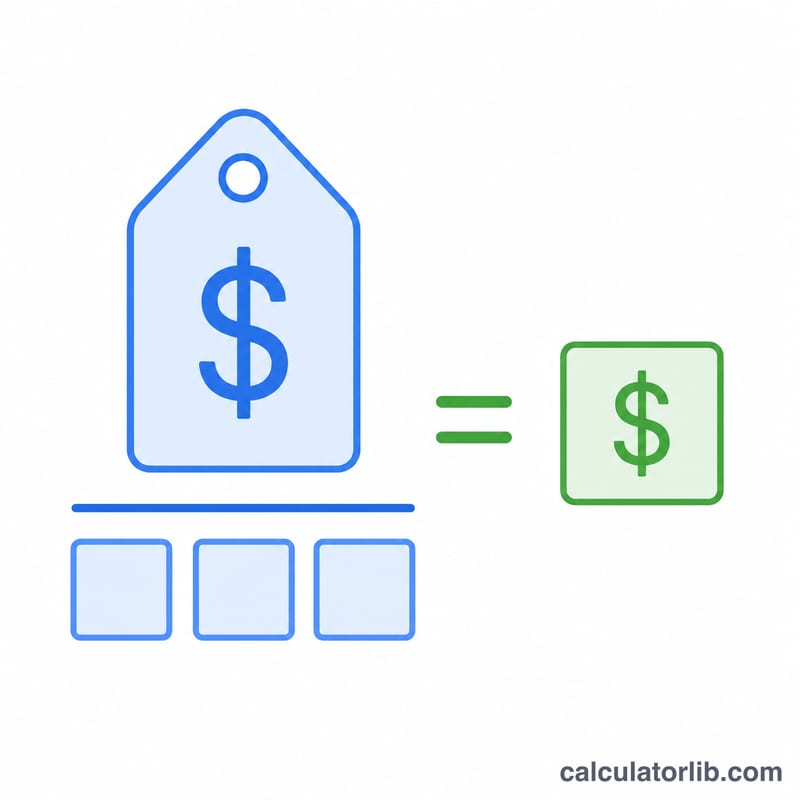
$$\text{Unit Price} = \frac{\text{Total Price}}{\text{Quantity}}$$
Total Price is the full amount you pay. Quantity is how many units that price buys. The result is what one unit costs. Keep your units consistent between products — comparing price per 100 g to price per ounce will mislead you.
Worked Example
Suppose a 6-pack of drinks costs $12. The unit price is $$12 \div 6 = \$2.00 \text{ per can}$$ A competing 4-pack costs $9, giving \(9 \div 4 = \$2.25\) per can. The 6-pack is the better value at $0.25 less per can.
Unit Conversion Table for Fair Comparisons
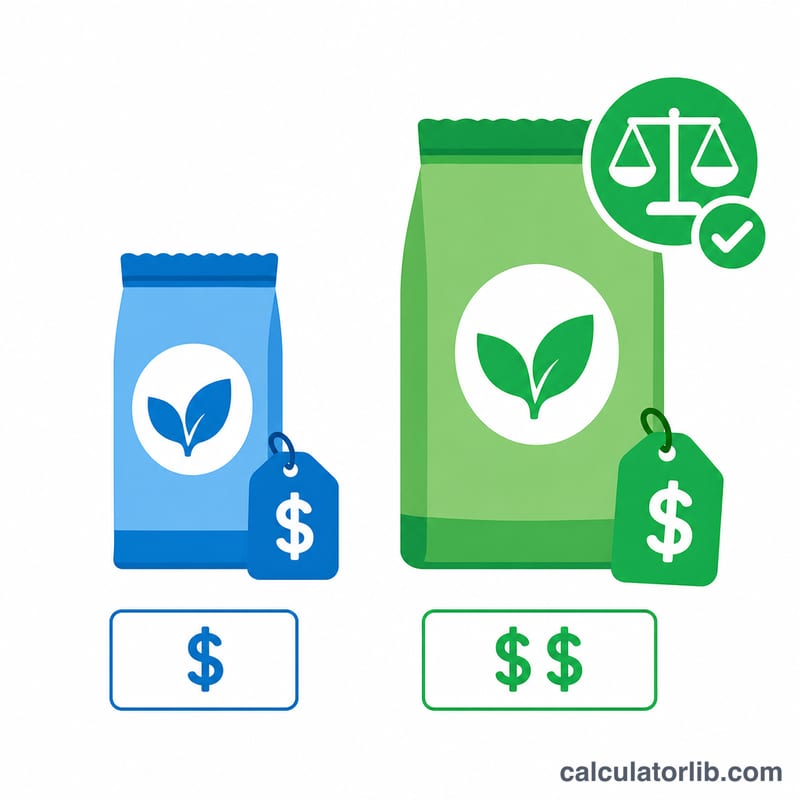
Unit prices only compare fairly when both products are measured in the same unit. Use these standard conversions to translate between units. Fluid ounces and gallons here are US customary units; UK imperial fluid ounces and gallons are different sizes.
| Type | Conversion |
|---|---|
| Weight | 1 oz = 28.3495 g |
| Weight | 1 lb = 16 oz = 453.592 g |
| Weight | 1 kg = 1000 g = 2.20462 lb |
| Volume | 1 US fl oz = 29.5735 mL |
| Volume | 1 L = 1000 mL = 33.814 US fl oz |
| Volume | 1 US gallon = 3.78541 L |
| Area | 1 sq ft = 0.092903 m² |
| Length | 1 in = 2.54 cm; 1 ft = 0.3048 m |
Tip: Convert everything to one common base unit before comparing, such as price per 100 g for solid foods or price per litre for liquids. Then apply \(\text{Unit price} = \frac{\text{total price}}{\text{quantity}}\) using the same unit for every product. For example, a price per ounce becomes a price per 100 g by dividing by 28.3495 and multiplying by 100.
Scenario Comparison: Pack Sizes and Unit Prices
Example 1: the same product sold by weight, compared as price per 100 g.
| Option | Total price | Quantity | Unit price | Cheapest? |
|---|---|---|---|---|
| A | $4.00 | 500 g | $0.80 per 100 g | No |
| B | $7.20 | 1 kg (1000 g) | $0.72 per 100 g | Yes |
| C | $2.50 | 250 g | $1.00 per 100 g | No |
Example 2: the same item sold in multipacks, compared per item.
| Option | Total price | Quantity | Unit price | Cheapest? |
|---|---|---|---|---|
| 12-pack | $9.00 | 12 items | $0.75 each | No |
| 24-pack | $16.80 | 24 items | $0.70 each | Yes |
Check: \(\frac{9.00}{12} = 0.75\) and \(\frac{16.80}{24} = 0.70\).
Note: The lowest unit price is not always the best choice. If the larger pack means you throw food away, it spoils before you use it, or it takes up space you lack, the real cost per item you actually use can be higher than the smaller pack's price. Buy the larger size only when you will use all of it.
FAQ
What units can I use? Any — items, grams, kilograms, ounces, litres, square feet. Just make sure both products use the same unit when comparing.
What if the quantity is zero? Division by zero is undefined, so the calculator returns 0. Enter a quantity greater than zero for a meaningful result.
Does the currency matter? No. The calculator is currency-agnostic; the unit price comes out in whatever currency you entered the total price.