What Is the Rain to Snow Calculator?
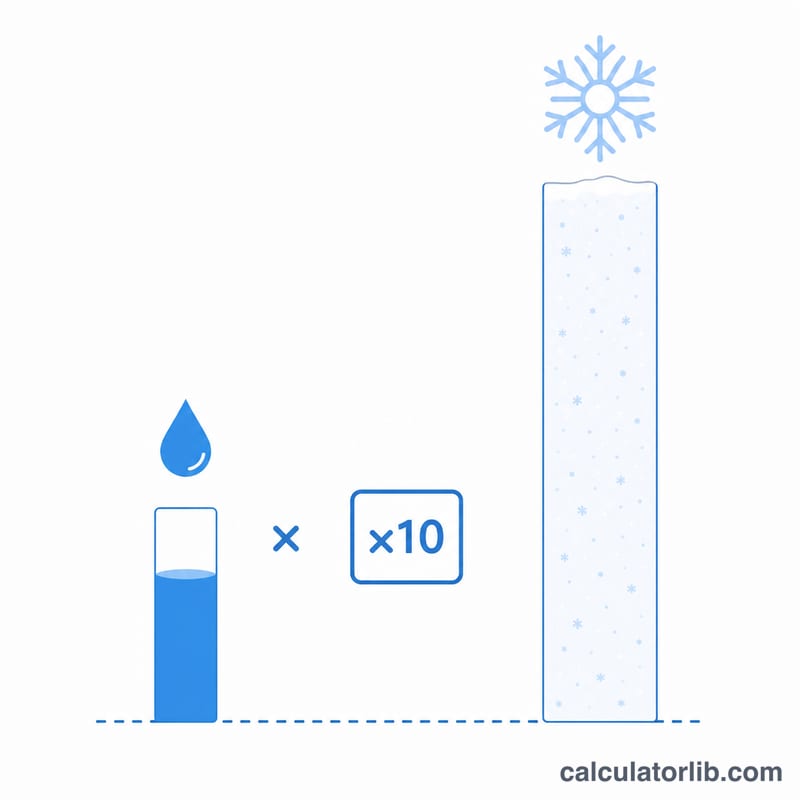
This tool converts a given amount of rainfall — or the liquid-equivalent of precipitation — into an estimated depth of snow. It uses the snow-to-rain ratio, which tells you how many inches of snow form from one inch of liquid water. The most commonly quoted average is 10:1, but the real ratio swings widely with air temperature, from roughly 5:1 for wet, heavy snow near freezing to 20:1 or more for dry powder in very cold air.
How to Use It
Enter the rainfall (or melted precipitation) in inches, then pick the snow-to-rain ratio that best matches the conditions. If you are unsure, the default 10:1 is a solid all-purpose estimate. The calculator multiplies the two values and returns the expected snow depth.
The Formula Explained
The equation is simply $$\text{Snowfall} = \text{Rainfall} \times \text{Ratio}$$ The ratio captures how "fluffy" the snow is: colder air produces lighter, more voluminous flakes (higher ratio), while temperatures near 32°F yield dense, slushy snow (lower ratio). Because the calculation is linear, doubling the ratio doubles the predicted snow depth.
Worked Example
Suppose a storm drops 0.5 inches of liquid precipitation and the air is cold and dry, supporting a 15:1 ratio. The snowfall estimate is $$0.5 \times 15 = 7.5 \text{ inches}$$ of snow. Had the storm been warmer at a 10:1 ratio, you'd expect only 5 inches.
Snow-to-Rain Ratio by Temperature
The snow-to-liquid ratio says how many inches of snow form from 1 inch of liquid water. Colder air usually produces lighter, fluffier snow and a higher ratio. Warmer, near-freezing air produces wetter, denser snow and a lower ratio. The values below are approximate averages. Real ratios vary with the storm, the moisture and wind, and the temperature through the whole atmosphere, not just at the surface.
| Surface/air temperature | Typical snow-to-liquid ratio | Snow type |
|---|---|---|
| 27–32°F (−3 to 0°C) | about 5–10:1 | Wet, heavy snow |
| 20–27°F (−7 to −3°C) | about 10:1 | Average snow |
| 15–20°F (−9 to −7°C) | about 12–15:1 | Light, drier snow |
| 10–15°F (−12 to −9°C) | about 15–20:1 | Dry, fluffy snow |
| Below 10°F (below −12°C) | about 20–30+:1 | Very dry powder |
The 10:1 ratio is a common rule of thumb, but it is only an average. Use this table to pick a ratio closer to your expected conditions.
Snowfall Comparison for Different Ratios
Snowfall is liquid precipitation multiplied by the ratio: \(\text{Snowfall} = \text{Rainfall (in)} \times \text{Ratio}\). For example, 0.5 in of liquid at 15:1 gives \(0.5 \times 15 = \)7.5 inches of snow. The table shows the same liquid amounts at different ratios.
| Liquid amount | Ratio | Snow depth | Snow type |
|---|---|---|---|
| 0.5 in | 5:1 | 2.5 in | Wet, heavy |
| 0.5 in | 10:1 | 5 in | Average |
| 0.5 in | 15:1 | 7.5 in | Light, dry |
| 0.5 in | 20:1 | 10 in | Dry powder |
| 1.0 in | 5:1 | 5 in | Wet, heavy |
| 1.0 in | 10:1 | 10 in | Average |
| 1.0 in | 15:1 | 15 in | Light, dry |
| 1.0 in | 20:1 | 20 in | Dry powder |
The same amount of liquid can produce four times as much snow depth in very cold, dry conditions as in wet, near-freezing conditions.
Inches to Millimeters and Centimeters Conversion
Exact conversion: 1 inch = 25.4 mm = 2.54 cm. Metric weather reports often give liquid precipitation in millimeters and snow depth in centimeters. At a 10:1 ratio, 1 mm of liquid water gives 1 cm of snow.
| Liquid precipitation (in) | Liquid (mm) | Snow depth at 10:1 (in) | Snow depth at 10:1 (cm) |
|---|---|---|---|
| 0.1 | 2.54 | 1 | 2.54 |
| 0.25 | 6.35 | 2.5 | 6.35 |
| 0.5 | 12.7 | 5 | 12.7 |
| 1 | 25.4 | 10 | 25.4 |
For other ratios, multiply the millimeters of liquid by the ratio ÷ 10 to get centimeters of snow. For example, 10 mm of liquid at 15:1 gives \(10 \times 1.5 = 15\) cm of snow.
FAQ
Is 10:1 always accurate? No — it is an average. Cold, dry storms can exceed 20:1, while warm, wet storms may be 5:1 or even less.
What rainfall value should I enter? Use the liquid-water equivalent of the precipitation. If a forecast gives expected rain that would otherwise fall as snow, use that number.
Can I reverse the calculation? Yes — to find liquid equivalent from snow depth, divide the snowfall by the ratio.