
What Is the Geometric Mean?
The geometric mean is a type of average that multiplies all the values in a data set together and then takes the nth root of the product, where n is the count of values. Unlike the arithmetic mean (which adds and divides), the geometric mean is ideal for data that grows multiplicatively — such as investment returns, population growth rates, ratios, and rates of change. It is always less than or equal to the arithmetic mean and requires every value to be positive.
How to Use This Calculator
Enter your numbers separated by commas or spaces (for example 4, 9, 16) and the calculator returns the geometric mean instantly along with the count of values used. All values must be greater than zero, since multiplying by zero or a negative number makes the geometric mean undefined or imaginary.
The Formula Explained
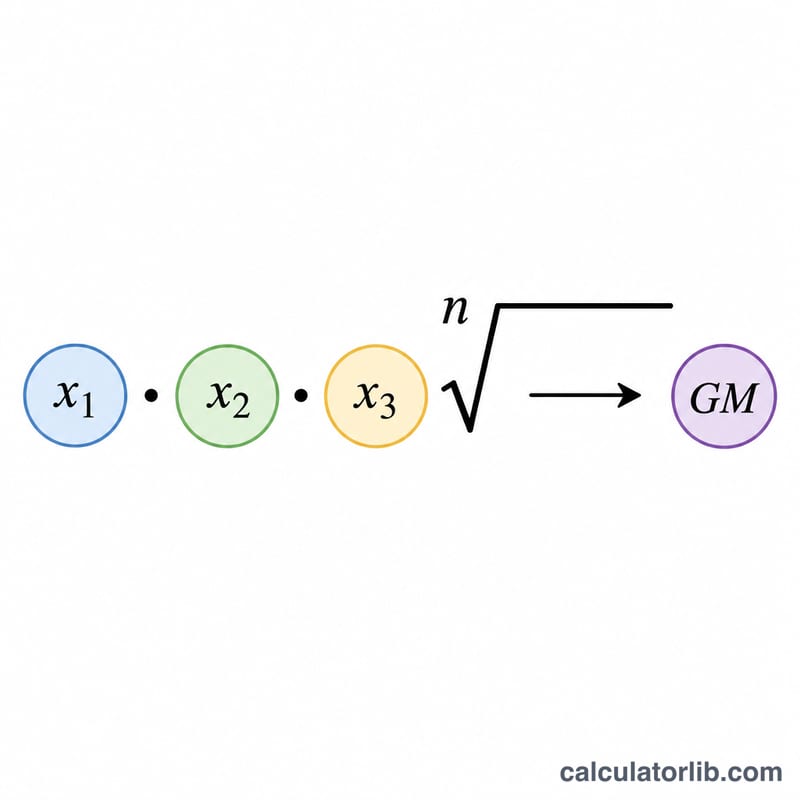
The geometric mean of \(n\) numbers is
$$\text{GM} = \left( \prod_{i=1}^{n} x_i \right)^{\frac{1}{n}} = \sqrt[n]{x_1 \cdot x_2 \cdots x_n}$$To avoid overflow with large products, this tool computes it in log space: it sums the natural logs of each value, divides by \(n\), then exponentiates — mathematically identical but numerically stable.
Worked Example
Take the values 4, 9 and 16. Their product is
$$4 \times 9 \times 16 = 576$$Since there are 3 values, take the cube root:
$$576^{\frac{1}{3}} \approx \mathbf{8.32034}$$So the geometric mean is about 8.32 — notably lower than the arithmetic mean of \((4+9+16)/3 \approx 9.67\).
FAQ
When should I use the geometric mean instead of the average? Use it for rates of return, growth percentages, or ratios where values compound over time.
Can I use negative numbers or zero? No. The geometric mean is only defined for positive numbers; any zero or negative value is ignored or invalidates the result.
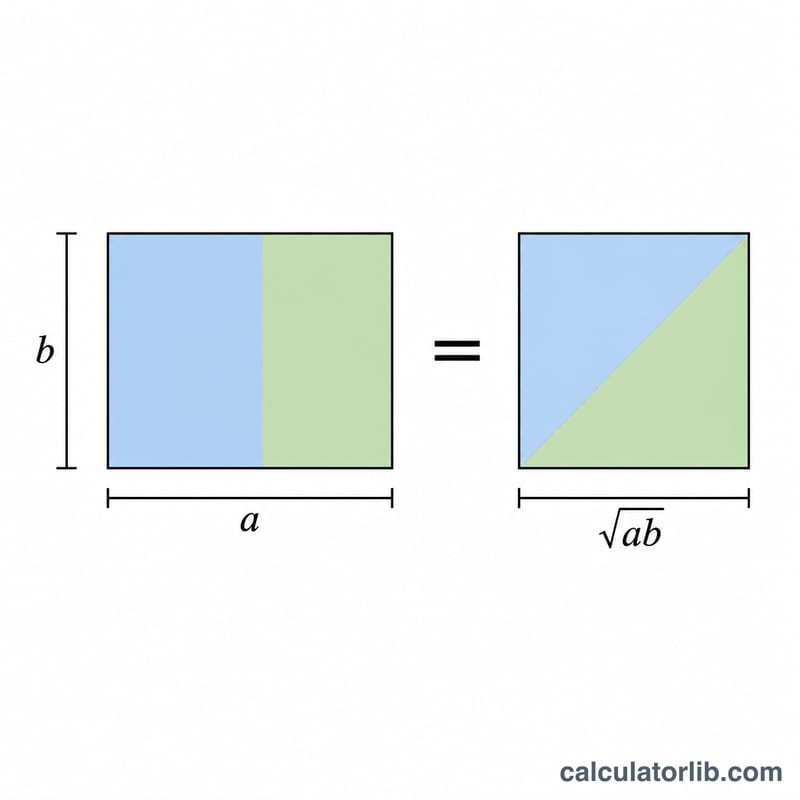
For two numbers, is it just the square root? Yes — the geometric mean of two numbers \(a\) and \(b\) is \(\sqrt{a \cdot b}\).