
What is the RMR to TDEE calculator?
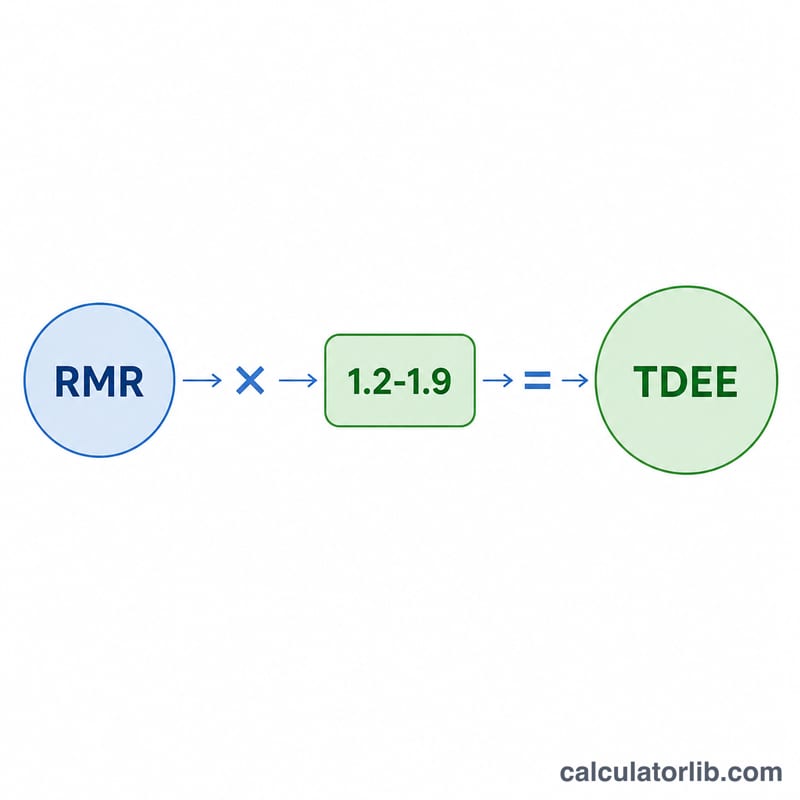
Your Resting Metabolic Rate (RMR), often used interchangeably with Basal Metabolic Rate (BMR), is the number of calories your body burns at complete rest to keep vital functions running. But you don't spend all day at rest — you walk, work, and exercise. This calculator scales your RMR up to your Total Daily Energy Expenditure (TDEE): the total calories you actually burn in a day.
How to use it
Enter your RMR (in calories per day) — you can get this from a metabolic test or a BMR calculator. Then pick the activity level that best matches your typical week. The calculator multiplies your RMR by the matching activity factor and shows your maintenance calories plus targets for weight loss and gain.
The formula explained
The equation is simply $$\text{TDEE} = \text{RMR} \times \text{Activity Factor}$$ The activity factor reflects how active you are:
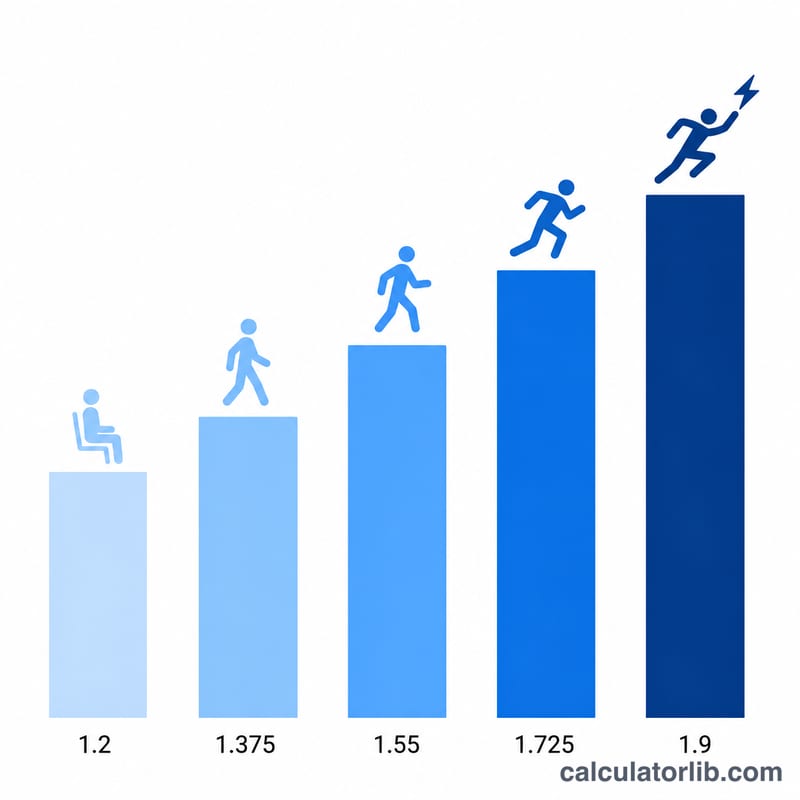
\(1.2\) = sedentary, \(1.375\) = lightly active, \(1.55\) = moderately active, \(1.725\) = very active, and \(1.9\) = extra active. Because a deficit of about 500 calories per day equals roughly 0.5 kg of fat per week, the tool subtracts 250 and 500 for loss targets and adds 500 for a gain target.
Worked example
Suppose your RMR is 1,600 calories/day and you are moderately active (factor 1.55). Your $$\text{TDEE} = 1{,}600 \times 1.55 = 2{,}480 \text{ calories/day}$$ to maintain weight. To lose about 0.5 kg per week you'd aim for \(2{,}480 - 500 = 1{,}980\) calories/day; to gain, \(2{,}480 + 500 = 2{,}980\) calories/day.
FAQ
Is RMR the same as BMR? They are very close. BMR is measured under stricter conditions, while RMR allows slightly more normal activity, so RMR is usually a touch higher. Either value works here.
Which activity level should I choose? Be honest and conservative. Most desk workers who exercise a few times a week fall under "lightly" or "moderately active."
Are these calorie targets exact? No — they are estimates. Track your weight over 2–3 weeks and adjust your intake up or down by 100–200 calories as needed.